
Bacteriostatic water for peptides
Bacteriostatic water for peptides has benzyl alcohol, so one mixed vial takes many draws. See how much to add, when sterile water fits and why vials gel.
Bacteriostatic (BAC) water is the default diluent for most research peptides. It is sterile water with 0.9% or 1.1% benzyl alcohol, a preservative that holds back bacterial growth. That is why you can draw from one mixed vial again and again. How long the vial lasts depends on the peptide. As for how much water to add, 1, 2 or 3 mL all work in a standard peptide vial. The water changes the concentration and the units per dose. The amount of peptide in the vial stays the same. The BAC Water page has the full profile and a calculator.
What the benzyl alcohol does
On the Hospira label, the 30 mL plastic vial carries 9 mg of benzyl alcohol per mL (0.9%). The 20 mL glass vial carries 11 mg/mL (1.1%). "Bacteriostatic" means the preservative stops bacteria from multiplying if some get in during use. It does not sterilize the vial. Keep the water itself at room temperature, 20 to 25 °C. Its label has no fridge instruction.
Benzyl alcohol also has some numbing effect. Five studies of facial botulinum toxin injections report less pain when the toxin is mixed in benzyl-alcohol saline instead of plain saline. In one split-face trial, all 15 patients felt less pain on the preserved side.
BAC water or sterile water
Sterile water for injection has no preservative. Its label marks the vial single-dose and says to discard the unused portion. BAC water is a multiple-dose product, made for repeated draws from one vial.
Tesamorelin shows the difference. It comes in a single-use form and a multi-day form. Egrifta SV is mixed with sterile water and used at once, and any leftover is thrown away. Egrifta WR is a reformulated powder mixed with BAC water, and one vial gives daily doses for 7 days. The active peptide is the same in both.
Sterile water still fits a few cases.
- A vial used in one sitting. Nothing is left over, so there is nothing to preserve.
- A known benzyl-alcohol allergy. Reactions are uncommon but reported, including one case confirmed by skin test.
- A product that ships with its own diluent. The Egrifta SV label, for one, says to use only the sterile water provided.
Never use tap, distilled or spring water. Injection waters are labeled sterile and nonpyrogenic, meaning free of the contaminants that cause fever.
Benzyl alcohol can harm some folded proteins. Studies found it partly unfolds a model protein and makes interferon alpha-2a clump, more so at higher strength. A study of a 31-amino-acid acylated peptide found no clumping and no detectable interaction. Increlex, the drug form of IGF-1, is itself preserved with 9 mg/mL benzyl alcohol and keeps for 30 days after first use. BAC water stays the default diluent for most research peptides.
How much bacteriostatic water to add
Any volume works as long as the powder fully dissolves. More water lowers the concentration, so each dose takes more units on a U-100 syringe. The total peptide and the number of doses stay the same. The Novarel hCG label shows it with one vial. Mixed with 1 mL it is 10,000 IU/mL. Mixed with 10 mL it is 1,000 IU/mL.
| Water added | Strength of a 10 mg vial | Units for a 250 mcg dose |
|---|---|---|
| 1 mL | 10 mg/mL | 2.5 units |
| 2 mL | 5 mg/mL | 5 units |
| 3 mL | 3.33 mg/mL | 7.5 units |
Every row holds 40 doses of 250 mcg. Pick the volume that turns your dose into an easy number of units to read. A standard peptide vial holds 3 mL at most. Glutathione and NAD+ vials hold up to 10 mL and take more water.
The calculator on the BAC Water page turns any vial size, water volume and dose into syringe units. The reconstitution and syringe-unit math guide covers the formula behind it.
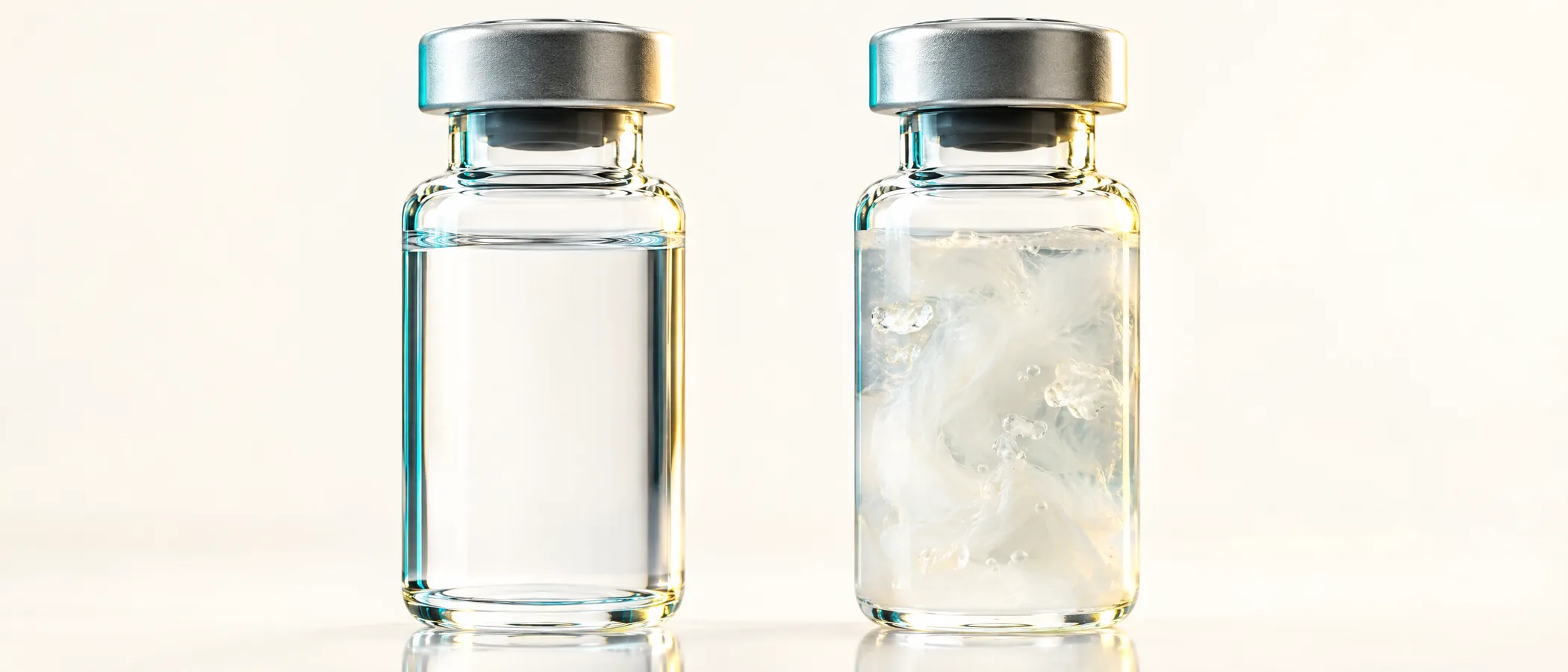
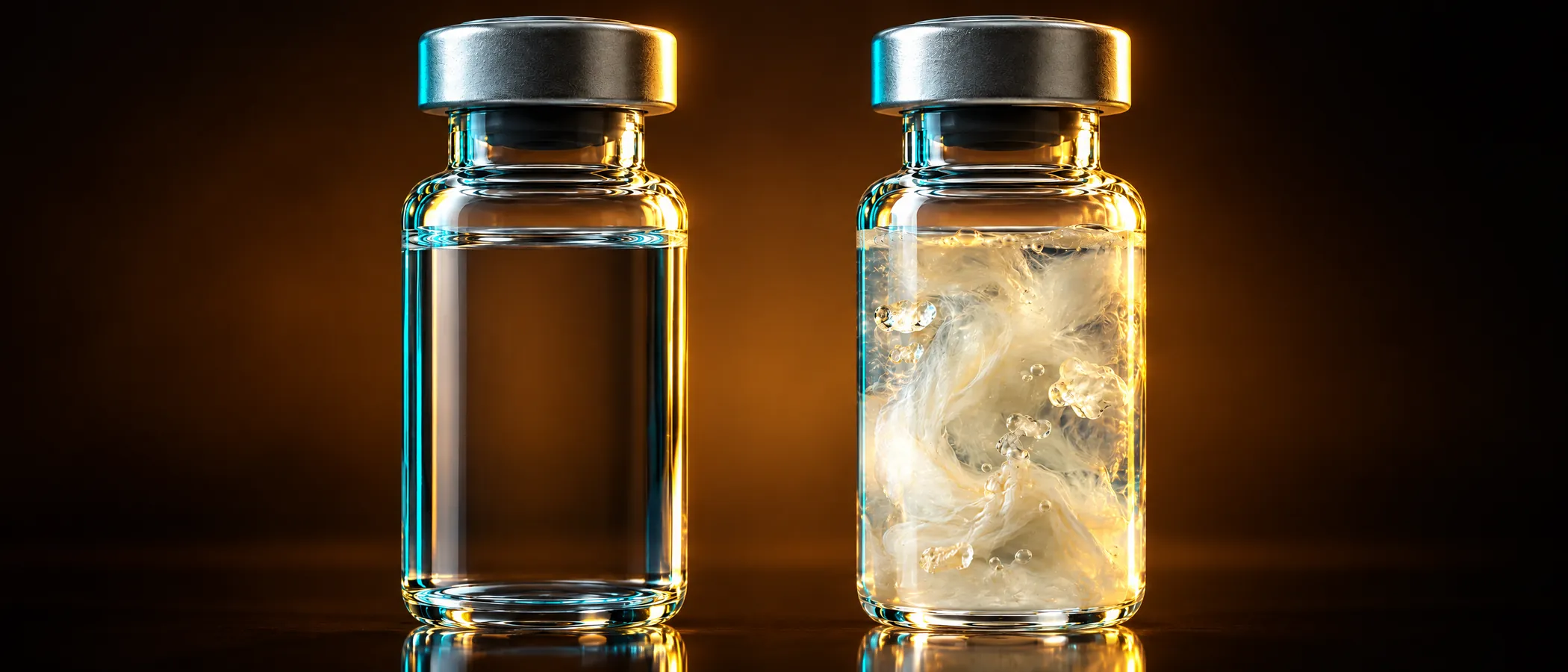
Why a vial foams, clouds, gels or won't dissolve
What you see in the vial usually points to the cause. The growth-hormone reconstitution guide covers each one in depth.
| What you see | Usual cause | Read more |
|---|---|---|
| Foam or froth after mixing | Shaking. Air-water surfaces make folded proteins unfold and clump. The Egrifta WR label expects some foam even after swirling, and the foam separates in a few seconds. | Growth-hormone reconstitution guide |
| Haze that clears in a minute or two | Powder dispersing before it dissolves. This is normal. | Reconstitution and syringe-unit math guide |
| A thick or gel-like vial | A long, water-repellent peptide such as tesamorelin, often in too little water | Growth-hormone reconstitution guide |
| Clumps that never dissolve | IGF-1 and analogs such as IGF-1 LR3, which need an acidic diluent | Growth-hormone reconstitution guide |
| Cloudy, gritty or colored after it was clear | Breakdown or contamination. Discard the vial. | Peptide storage and stability guide |
The Genotropin, Pregnyl and tesamorelin labels all say not to shake the vial. The tesamorelin labels say to swirl or roll it instead. The Genotropin label says why. Shaking "may cause denaturation of the active ingredient."
Why glutathione won't dissolve
Glutathione dissolves easily, and its listed solubility in water is 292.5 mg/mL. The problem is too much powder in too little water. A 600 mg vial in 6 mL is 100 mg/mL and clears with swirling and a little time. The same vial in 2 mL is 300 mg/mL, past that limit. More water fixes it, and a glutathione vial takes up to 10 mL. The syringe-unit math guide explains the milky "snow globe" look in the first minute.
How long a mixed vial lasts
Two separate limits apply. An opened BAC water vial gets 28 days after its first puncture, unless its maker says otherwise. That is the standard rule for any opened multiple-dose container. The peptide you mixed has its own limit. Drug labels show how far apart the two can be.
| Product | Diluent | Life once mixed or opened, per the label |
|---|---|---|
| Egrifta SV (tesamorelin) | Sterile water | Used at once, the rest discarded |
| Egrifta WR (tesamorelin) | BAC water | 7 days at room temperature |
| Genotropin 5 mg and 12 mg cartridges (growth hormone) | Preserved with metacresol | 28 days in the fridge |
| Novarel (hCG) | BAC water | 30 days in the fridge |
| Increlex (IGF-1) | Ready-made solution with benzyl alcohol | 30 days in the fridge after first use |
| Pregnyl (hCG) | Solvent with benzyl alcohol and salt | 60 days in the fridge |
People keep a mixed research peptide at 2 to 8 °C, away from light, and never freeze it. The Genotropin, Increlex and Pregnyl labels all say not to freeze. In a 2026 study, benzyl alcohol made freeze-thaw clumping of an antibody worse. For a mixed research peptide, the common window is up to 28 days in the fridge, the same as the opened-water limit. The peptide storage and stability guide has the details.
Questions people ask
How much bacteriostatic water should I add to a peptide? Any amount up to the 3 mL a standard vial holds, as long as the powder dissolves. Glutathione needs more, up to 10 mL. More water means more units per dose, with the same total peptide. The calculator on the BAC Water page turns your vial, water and dose into syringe units.
Can I use sterile water instead? Yes, for a vial you use in one sitting or if you react to benzyl alcohol. It has no preservative, so you throw away whatever is left.
Does bacteriostatic water need to be refrigerated? The water itself does not. Its label stores it at 20 to 25 °C and has no fridge instruction. A mixed research peptide vial is the one that goes in the fridge, at 2 to 8 °C.
How long is bacteriostatic water good after opening? It is good for 28 days after the first puncture, unless its label gives a different date.
How long does a mixed peptide vial last? Up to 28 days at 2 to 8 °C is the common window. The peptide can set a shorter one. Drug labels range from single use for Egrifta SV to 60 days for Pregnyl.
Does more water make the peptide weaker? No. The vial holds the same amount of peptide. Each dose is a larger volume, so it takes more units on the syringe.
Does benzyl alcohol damage peptides? It can make some folded proteins clump. A study of a short acylated peptide found no effect. Increlex, the drug form of IGF-1, contains it and keeps 30 days after opening.
Sources
- DailyMedBacteriostatic Water for Injection, USP. Hospira/Pfizer (FDA label). 30 mL plastic vial 0.9% (9 mg/mL) and 20 mL glass vial 1.1% (11 mg/mL) benzyl alcohol; multiple-dose vials; store at 20 to 25 °C
- DailyMedSterile Water for Injection, USP, Fresenius Kabi (FDA label). No bacteriostat; supplied only in single-dose containers; "Discard unused portion"
- FDA guidance (Oct 2018)FDA guidance on package type terms for multiple-dose, single-dose and single-patient-use containers, October 2018. An opened multiple-dose container has a 28-day beyond-use date unless the maker specifies otherwise; antimicrobial testing checks that a product prevents microbial growth after contamination
- DailyMedEgrifta WR (tesamorelin 11.6 mg vial; mannitol and hydroxypropyl betadex) label. Mixed with Bacteriostatic Water for Injection; one vial gives daily doses for 7 days at 20 to 25 °C; swirl, do not shake; let the foam layer separate for a few seconds
- DailyMedEgrifta SV (tesamorelin 2 mg vial; mannitol, sucrose, histidine and polysorbate 20) label. Use only the diluent provided, Sterile Water for Injection; used immediately and unused solution discarded; roll, do not shake
- DailyMedNovarel (chorionic gonadotropin) label. 10,000 IU vial is 10,000 IU/mL in 1 mL and 1,000 IU/mL in 10 mL of bacteriostatic water; refrigerate and use within 30 days
- DailyMedPregnyl (chorionic gonadotropin) label. Solvent with 0.56% sodium chloride and 0.9% benzyl alcohol; refrigerate at 2 to 8 °C and discard after 60 days; do not shake, do not freeze
- DailyMedIncrelex (mecasermin, recombinant IGF-1) label. 9 mg/mL benzyl alcohol; stable 30 days after first vial entry at 2 to 8 °C; do not freeze
- DailyMedGenotropin (somatropin) label. Metacresol-preserved 5 mg and 12 mg cartridges kept at 2 to 8 °C for up to 28 days; "Do not shake; shaking may cause denaturation of the active ingredient"
- PubChem CID 124886Glutathione water solubility 292.5 mg/mL
- PMID 30915582Li et al., AAPS J 2019. Air-water and other interfaces drive protein unfolding and aggregation
- PMID 23169345Hutchings et al., J Pharm Sci 2013. Antimicrobial preservatives, benzyl alcohol among them, enhance partial unfolding and aggregation of a model protein
- PMID 25100180Bis et al., J Pharm Sci 2015. Benzyl alcohol drives concentration-dependent unfolding and aggregation of interferon alpha-2a
- PMID 35917158Li et al., Mol Pharm 2022. Benzyl alcohol caused no aggregation and no detectable interaction with an acylated 31-residue peptide
- PMID 41325828Xu et al., Int J Pharm 2026. Benzyl alcohol worsens freeze-thaw aggregation of trastuzumab
- PMID 11939813Alam et al., Arch Dermatol 2002. Botulinum toxin in preserved saline hurt less on injection in all 15 patients of a split-face trial
- PMID 35017698Hunt and Malhotra, Eye (Lond) 2022. Five studies report less pain for facial and periocular botulinum toxin injections mixed in 0.9% benzyl-alcohol saline
- PMID 3757780Wilson et al., Drug Intell Clin Pharm 1986. Systemic hypersensitivity to parenteral benzyl alcohol, confirmed by skin test
Related peptides
- BAC WaterBacteriostatic Water for Injection, USP · benzyl-alcohol-preserved sterile water
- GlutathioneGSH · the cell's principal intracellular antioxidant (a tripeptide)
- TesamorelinStabilized GHRH analog · FDA-approved for HIV-associated visceral fat
- IGF-1 LR3Long-[Arg³] Insulin-like Growth Factor 1 · 83-AA IGF-1 analog
- HCGGlycoprotein LH-analog hormone · FDA-approved for fertility (Pregnyl, Novarel, Ovidrel)
- NAD+Nicotinamide adenine dinucleotide · redox coenzyme (not a peptide)
Research use only · Not medical advice · Updated 2026-10-04