
Ki Researcher
Peptide calculator
Enter the vial's mg, the water you added and your dose to get the units to draw. Pick a peptide and all three fill in with its usual values.
Calculated for a 1 mL U-100 insulin syringe (100 units/mL).
Step 1 of 4
Which peptide?
Research use only. Not for human consumption. Outputs are reference values based on research literature. Verify all measurements independently.
Nasal spray builder
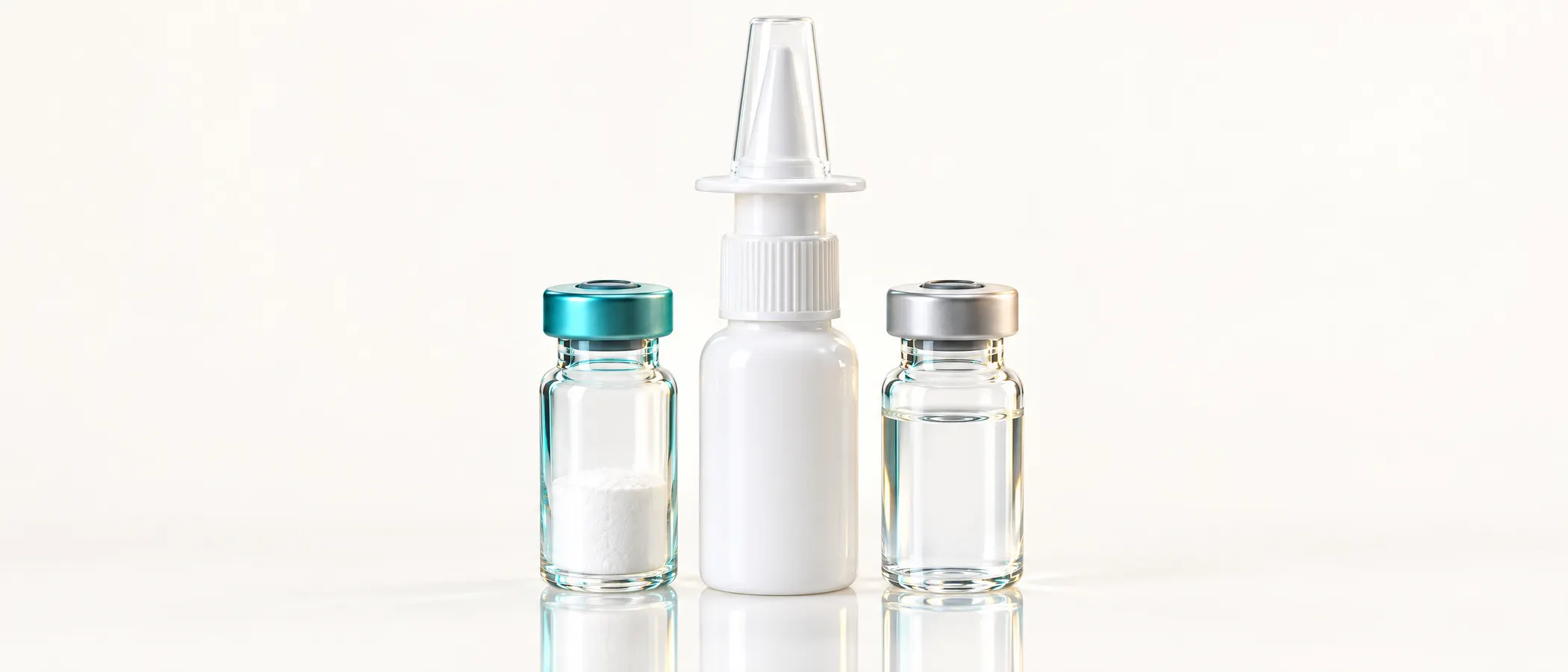
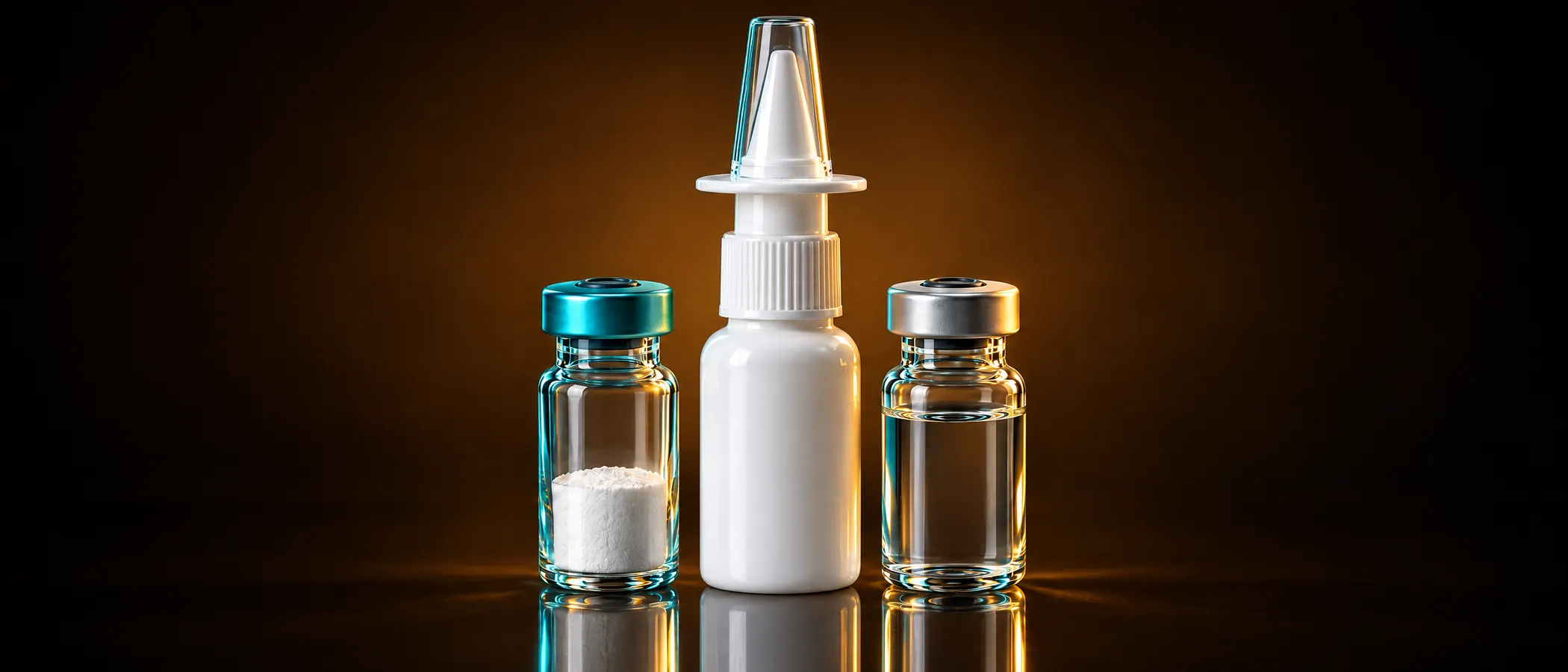
Tell it how much peptide you have and what one spray should deliver, and it gives you the bacteriostatic water to add. Or go the other way and check what a bottle you've already mixed puts in each spray.
Metered pump · 0.125 mL / spray
What you have
Add up every vial going in. Two 30 mg vials = 60 mg.
What one pump should deliver. If a dose is one spray in each nostril, enter half the dose here.
One pump of the bottle. Most meter 0.125 mL, some 0.1. Check the listing.
Its size. The answer doesn't have to fill it.
Only changes how long the bottle lasts.
The answer
Add this much bacteriostatic water
5 mL
Every 0.125 mL spray then carries 250 mcg, 40 sprays in the bottle.
Fits your 10 mL bottle with 5 mL to spare.
After 6 priming sprays you have 34 usable sprays, about 34 days at 1 a day.
Getting it into the bottle
- Dissolve the powder in its vial with about 1 mL of the water.
- Draw it into the spray bottle, then rinse the vial with a little more water and add that too.
- Add the rest of the water to reach 5 mL in total. Cap it and swirl gently, but don't shake.
Sterile saline can stand in for any part of the water, volume for volume. The math doesn't change, only the preservative does. Switch to "What's in each spray?" to see a split.
Show the math
Actuations sprayed to waste to purge air before the pump delivers a full volume.
What this mix does and doesn't establish
- Benzyl alcohol lands at 0.9%, over the 0.5% FDA maximum for a nasal metered spray. Neat bacteriostatic water sits here, at 1.8× the cap.
- This bottle holds about 34 days of doses, past the 14-day refrigerated beyond-use date USP <795> assigns an aqueous preparation whose preservation is not demonstrated. Build a smaller bottle, or discard the remainder.
No advisory here means none of these checks fired, not that the mix is qualified.
Research use only. Not for human consumption. Outputs are reference values. Verify every measurement independently.
How to read this builder
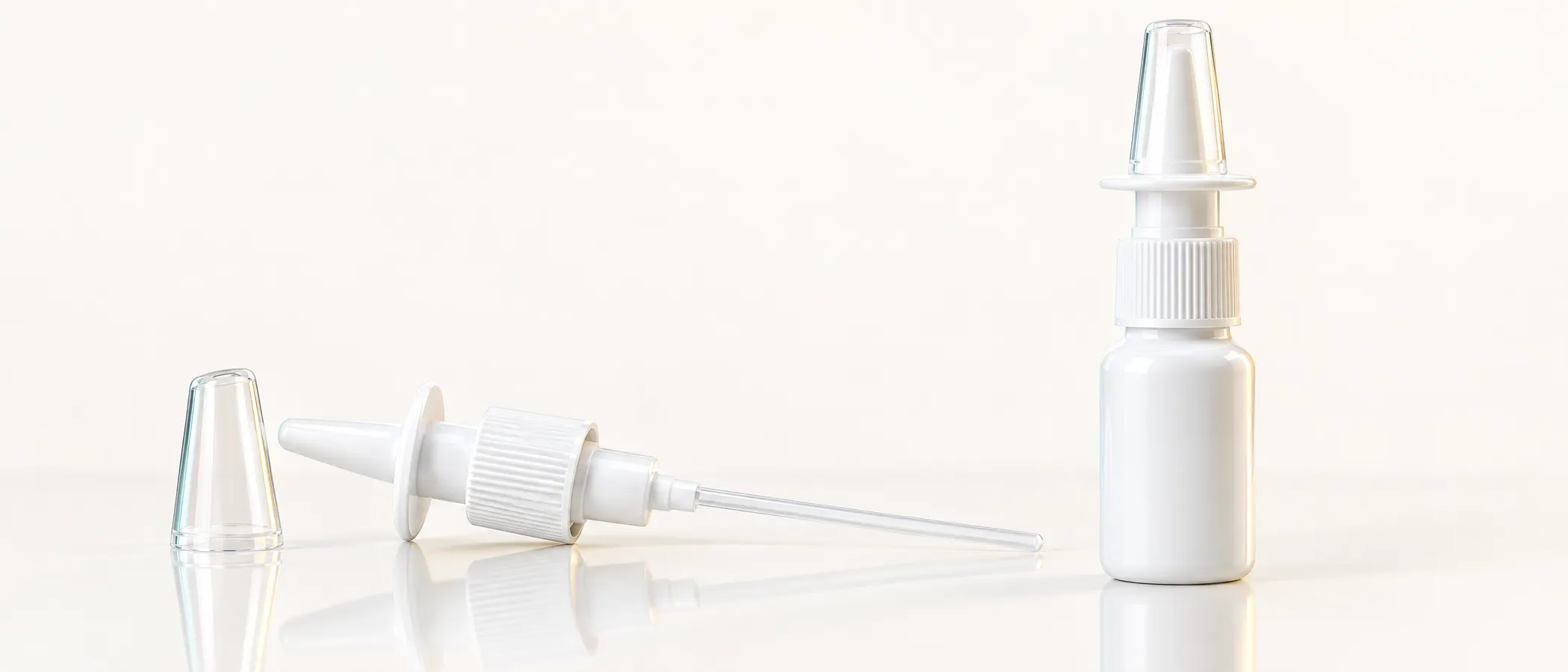
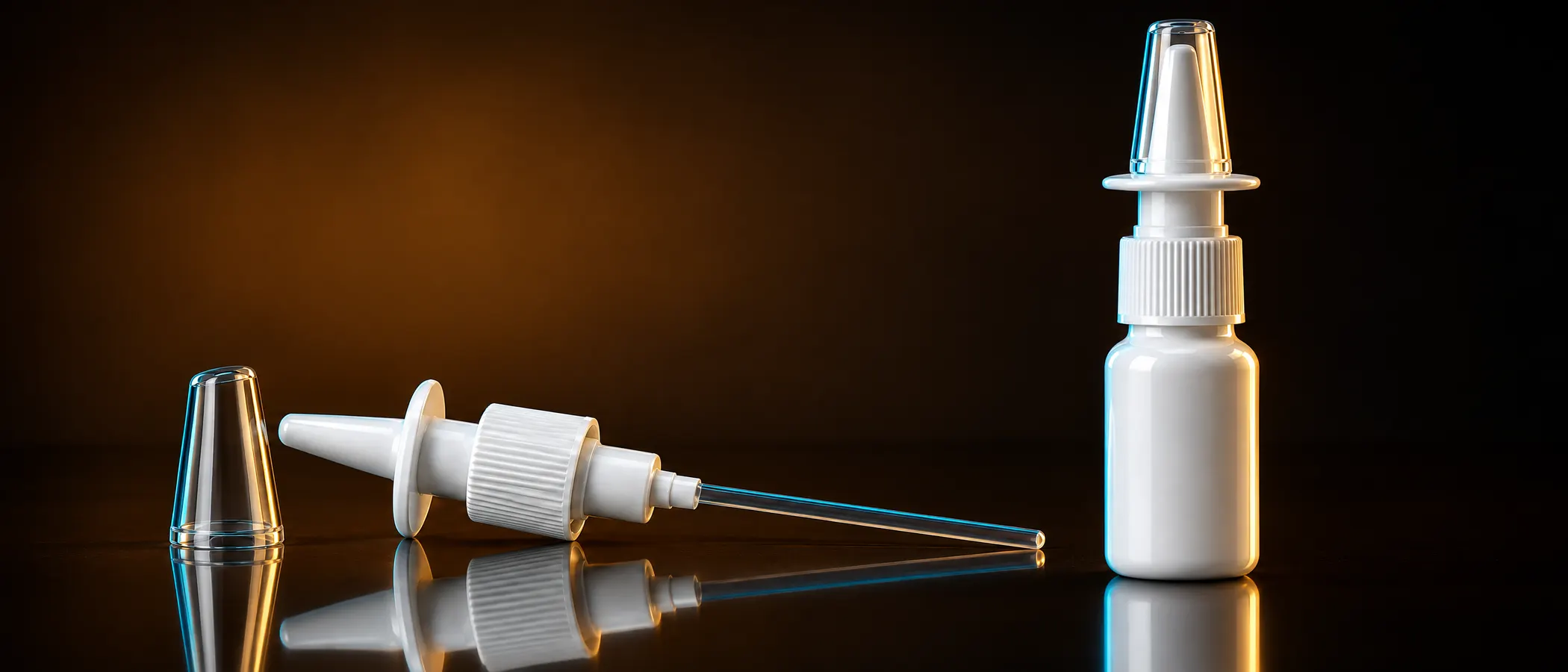
Six things decide whether a home-built nasal spray works, and four of them are not obvious. Every figure below traces to a primary source.
01It's the inverse of a syringe
With a syringe you pick a dose and read off a volume. With a metered pump the device fixes the volume, so the dose is decided before you ever spray, by how much peptide went into the bottle. Changing your dose means either changing the number of sprays or rebuilding the bottle at a different concentration.
02Priming costs you doses
A fresh pump sprays air until the dip tube and metering chamber fill. Commercial labels call for 4 to 6 actuations to waste (Astelin 4; Hikma fluticasone 6; Ryaltris 6), and instrumented testing shows the air-to-liquid transition finishing around the fifth stroke. This builder defaults to 6, and does not model re-priming after a few days' rest, which labels put at another 2 to 6. A commercial bottle carries overfill to absorb all this. A home-filled one does not, so real yield is at or below what you see here.
03The preservative problem has no comfortable answer
Bacteriostatic water is 0.9% benzyl alcohol, and that figure is qualified for a sealed septum vial, not an open pump bottle whose tip touches the nares and which draws room air into the headspace on every actuation. The lowest benzyl alcohol level in any FDA-approved nasal product is 0.5%, and that product is unit-dose, so it is not even a multi-dose precedent. The FDA's maximum for a nasal metered spray is the same 0.5%. Below that you are under every concentration in documented antimicrobial use; above it you are over the nasal maximum; neat BAC water is 1.8× over. There is no BAC-to-saline ratio that is both plausibly preserved and within approved nasal concentrations, except the single point near 55% BAC. That is the shape of the problem, and it is the argument for a purpose-made nasal preservative rather than for tuning a ratio.
04"Unqualified" is not "unsafe", and the endpoint has been measured
There is no pharmacopeial minimum concentration for a preservative. USP <51> specifies a performance test that a specific formulation in its specific container must pass; concentration is an output of formulation work, not a threshold handed down. So this builder says a mix is unqualified rather than unsafe. What has been measured is the outcome: 18 of 20 unpreserved saline spray containers grew bacteria, including S. aureus, P. aeruginosa, E. coli, and Proteus, after just three days of home use, while only 3 of 20 dropper bottles did, which points at the pump rather than the saline. Preserved spray with 0.01% benzalkonium chloride came in at 4 of 198.
05Fourteen days, refrigerated
A locally-acting nasal spray is a compounded non-sterile preparation. USP <797> says nasal forms for local application are not required to be sterile, and <795> claims them by name. <795> Table 3 gives an aqueous preparation 14 days refrigerated when preservation is not demonstrated, and 35 when it is. A home dilution cannot demonstrate it, so 14 days refrigerated is the default, and that row has no room-temperature option. Said plainly, <795> binds compounders and their facilities, not an individual preparing something for themselves. It is the best available yardstick for what good looks like, not a rule someone at home is breaking.
06The nose has a volume ceiling
Device engineers put the optimum at about 0.1 mL per nostril, noting that higher volumes are prone to drip straight back out, and put a both-nostrils dose in the 0.1 to 0.2 mL range. A 0.125 mL pump already exceeds the single-nostril optimum, which makes dose-splitting a design question rather than a rounding error. If a dose needs several sprays, alternate nostrils, or rebuild the bottle stronger so it needs fewer.
Sources
Brook I, Am J Infect Control 2002;30(4):246-7 (contamination of unpreserved spray containers; note the widely repeated "90.7%" is a typographic artifact. The data is 18/20) · Aydin E et al., BMC Ear Nose Throat Disord 2007;7:2 (preserved-spray contamination) · USP <51> Antimicrobial Effectiveness Testing · USP <795> Table 3 and <797> (beyond-use dating; non-sterile nasal forms) · FDA Inactive Ingredient Database, nasal metered spray · Enbumyst prescribing information · Astelin, Hikma fluticasone and Ryaltris labels (priming) · Aptar device literature (per-nostril volume).
How the math works
You need three numbers.
- Vial
- The mg of peptide printed on the vial label.
- Water
- The mL of bacteriostatic (BAC) water you added.
- Dose
- Your dose, in mcg or mg.
The vial's mg divided by the water's mL gives the concentration in mg per mL. Your dose in mg divided by the concentration gives the volume to draw in mL. Multiply that volume by 100 to get the units on a U-100 syringe.
Example: a 10 mg vial mixed with 2 mL of water holds 5 mg per mL. A 250 mcg dose then takes 0.05 mL, which is 5 units, and the vial gives 40 doses.
Read the syringe math guide for the full math and a reference table
Calculators by peptide
Each page opens the calculator with that peptide already picked.
Blends
Single compounds
- 5-Amino-1MQ
- ACE-031
- Adipotide
- AOD-9604
- ARA-290 (Cibinetide)
- BPC-157
- Cagrilintide
- Chonluten (EDG)
- CJC-1295
- Cortagen (AEDP)
- Crystagen
- DSIP
- Epitalon
- Follistatin-344
- FOXO4-DRI
- GHK (copper-free, Gly-His-Lys)
- GHK-Cu
- GHRP-2
- GHRP-6
- Glutathione
- Gonadorelin
- Hexarelin
- HGH Fragment 176-191
- Humanin
- IGF-1 DES
- IGF-1 LR3
- Ipamorelin
- Kisspeptin-10
- KPV
- Liraglutide
- Livagen (KEDA)
- LL-37 (Cathelicidin)
- Melanotan 1
- Melanotan 2
- MGF
- MOTS-c
- N-Acetyl Selank Amidate
- N-Acetyl Semax Amidate
- NAD+
- Oxytocin
- P21
- Pancragen (KEDW)
- PE-22-28
- PEG-MGF
- Pinealon (EDR)
- PT-141
- Retatrutide
- Selank
- Semaglutide
- Semax
- Sermorelin
- SS-31 (Elamipretide)
- Survodutide
- TB-500
- Tesamorelin
- Testagen (KEDG)
- Thymalin
- Thymogen (Oglufanide)
- Thymosin Alpha-1
- Thymulin (FTS)
- Tirzepatide
- Ventfort (A-3)
- Vesugen (KED)
- Vilon (Lys-Glu)
Calculator questions
- How many units does my dose take?
- Multiply your dose in mg by the water in mL, divide by the vial's mg, then multiply by 100. On a U-100 syringe, 250 mcg from a 10 mg vial with 2 mL of water takes 5 units. The calculator here does this for you.Syringe math guide
- How many units is 1 mL on an insulin syringe?
- On a U-100 insulin syringe, 1 mL is 100 units and 1 unit is 0.01 mL. Syringes labeled 30 or 50 units are 0.3 and 0.5 mL barrels on that same scale. A U-40 syringe puts 40 units in 1 mL. The calculator uses U-100.Syringe math guide
- Can the calculator work out the water for the units I want?
- Not directly. To find the water in mL, multiply the units you want by the vial's mg, then divide by your dose in mg and by 100. A 5 mg vial, a 250 mcg dose and a 10-unit draw need 2 mL. Keep it to 3 mL or less in a standard vial.Syringe math guide
- How do I split a blend vial like KLOW or Wolverine?
- Each draw keeps the vial's ratio. A standard KLOW vial holds 50 mg GHK-Cu plus 10 mg each of BPC-157, TB-500 and KPV. In 3 mL, 10 units carry about 1.67 mg GHK-Cu and 333 mcg of each other peptide. Wolverine, 20 mg in 2 mL, gives 250 mcg of each in 5 units.KLOW calculatorWolverine calculatorBlends guide
- How do I avoid mixing up mg and mcg?
- A milligram (mg) is 1,000 micrograms (mcg), so a mix-up is a 1,000-fold error. Type the dose in the unit your notes use. The calculator refuses a dose bigger than the vial. To check a draw, multiply the units by what each unit holds.Syringe math guide
- Why share a dose in mcg and not in units?
- A unit is a volume, so the dose it carries depends on the water. From a 10 mg vial, 250 mcg takes 2.5 units with 1 mL of water and 5 units with 2 mL. Share the mcg, the vial size and the water instead.
At the bench
Storage & handling
Sealed vial
Fridge (2–8 °C). Freezer is fine long-term. Keep it dark.
After mixing
Back in the fridge. Use within ~28 days. Never refreeze.
BAC water
The preservative that makes repeat draws possible. Plain sterile water has none.
Looks off?
Cloudy, or particles floating? Toss the vial.