
Gonadorelin
Native GnRH decapeptide · pulsatile-stimulates / continuous-suppresses
Gonadorelin is lab-made GnRH (gonadotropin-releasing hormone). The brain pulses it so the pituitary releases luteinizing hormone (LH) and follicle-stimulating hormone (FSH), which drive testosterone and sperm. People run twice-daily micro-doses to keep testes active on testosterone therapy. Pump-delivered pulses induce ovulation in hypothalamic amenorrhea.
At a glance
- Dose
- 100 mcg twice a day to start, 100–200 mcg standard
- How often
- Twice a day about 12 hours apart, never more often
- How
- A small injection under the skin
- When
- Morning for the first dose, the second about 12 hours later
- Cycle
- Continuous on testosterone therapy, or 4–6 weeks post-cycle with clomiphene or enclomiphene
The 30-second versionEverything on this page, fast
Native GnRH · TRT support · LH and FSH · Pulsed dosing
The go signal at the top of the reproductive chain. Gonadorelin is native GnRH, so it tells your pituitary to make its own LH and FSH, the hormones behind testosterone and sperm. That is why people micro-dose it on testosterone replacement therapy (TRT) to keep the testes running. Brief, spaced pulses are what make it work.
The basics
- A lab-made copy of native GnRH, the 10-amino-acid hormone the brain pulses to tell the pituitary to release LH and FSH (luteinizing and follicle-stimulating hormone).
- Cleared in minutes (half-life about 2–10 min), so it works as a brief pulse. Its biggest use is as a micro-dosed substitute for HCG (human chorionic gonadotropin) on testosterone therapy.
Why people use it
- Keeps the testes active on TRT. It signals the pituitary to release LH and FSH, so people micro-dose it alongside testosterone as the go-to HCG substitute.
- Stimulates your own LH and FSH. It works one rung up, on the pituitary, so your body makes its own gonadotropins instead of having them replaced.
- A proven fertility tool in pulses. Through a pulse pump it induces ovulation in hypothalamic amenorrhea, with high live-birth rates and mostly single-egg ovulation.
- The pituitary rung of a full-axis stack. It sits between Kisspeptin-10 above and hCG below, so the three cover the whole axis.
- Works in pulses. Spaced doses stimulate the pituitary and a constant level switches it off, so the interval is part of the protocol.
Stacks well with
- Kisspeptin-10, one rung up. Kisspeptin triggers the GnRH pulse; gonadorelin is that GnRH at the pituitary.
- hCG, one rung down. It mimics LH directly at the testis, so it is usually an alternative to gonadorelin, layered in only for fertility protocols.
- Clomiphene or enclomiphene, a SERM (selective estrogen receptor modulator), raises your own LH and FSH by a different route and runs alongside gonadorelin post-cycle.
Good to know
- Pulsed, not continuous. Dosing too often desensitizes the pituitary and flips it from stimulating to suppressing, so the 12-hour interval is the whole protocol.
- Side effects are usually mild and brief: flushing, headache and nausea that often pass within 30–60 minutes. Rotate injection sites to avoid lumps.
- On TRT, testosterone feedback can blunt its effect. It works only through a responsive pituitary, so people pair it with bloodwork (LH, FSH, testicular volume) and adjust if the response is weak.
- Banned in male athletes at all times (WADA S2.2); not prohibited in females.
What it does
People run gonadorelin to keep their own pituitary working, most often alongside testosterone replacement therapy (TRT).
- Keeps the testes active on TRTIn men lacking GnRH signaling, pump pulses under the skin every 90 minutes tripled average testis size by 2 years.
- Stimulates your own LH and FSHIn healthy men, one 100 mcg shot under the skin raised LH 437% on average, peaking about 34 minutes later.
- A proven fertility tool in pulsesIn women with hypothalamic amenorrhea, pump pulses under the skin gave 61 clinical pregnancies in 82 treatments, one with twins.
- Testosterone up nearly sevenfold on a pumpIn 6 men lacking GnRH, pump pulses under the skin lifted testosterone from 77 to 520 ng/dL in a month.
Sources:PMID 40800099RxList (Factrel label)PMID 36378460PMID 6813732
How it works
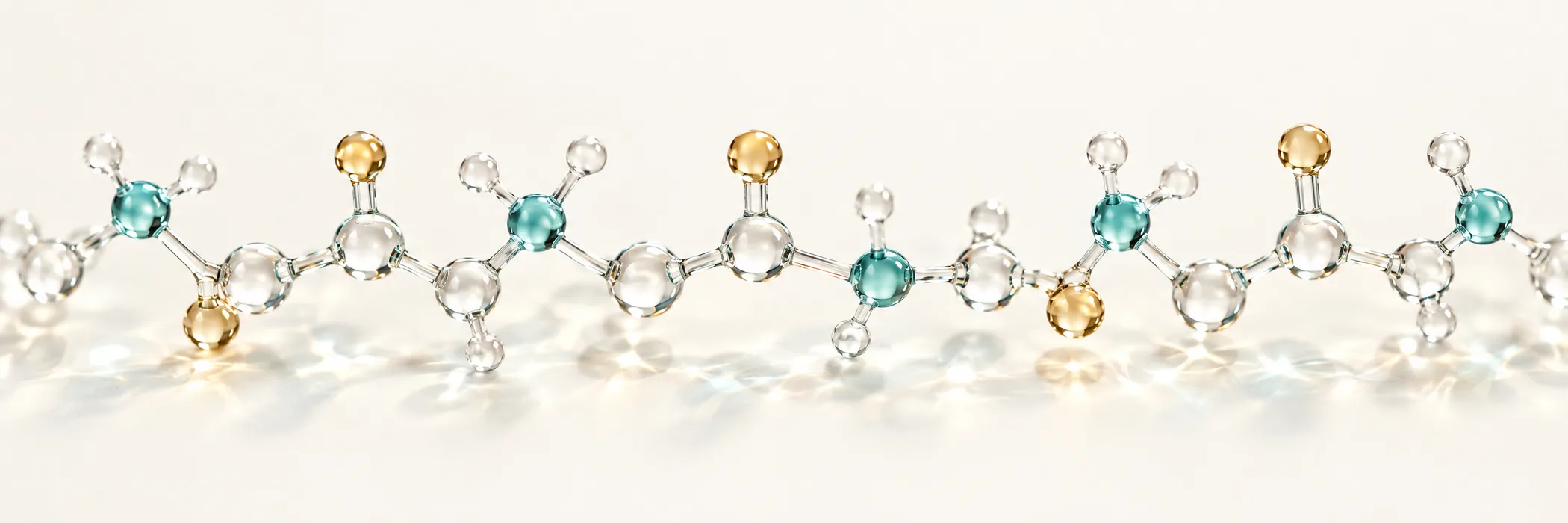
Signals the pituitary. Gonadorelin binds the GnRH receptor on the pituitary, which then releases luteinizing hormone (LH) and follicle-stimulating hormone (FSH). LH drives testosterone and the ovulation surge. FSH drives sperm production and follicle growth.
Pulses switch it on. A pulse every 60–120 minutes keeps the receptor responsive and LH and FSH flowing. A constant level makes the receptor pull inside, so after a brief flare LH and FSH fall. Long-acting GnRH drugs such as leuprolide suppress the gonads this way.
Built to pulse. It is the exact natural GnRH, so it clears in minutes. Knobil's lab showed the pulse rule in monkeys in 1978, and ovulation pumps run on it.
Sources:PMID 100883PMID 36378460
How to dose it
Most people run gonadorelin as a small injection under the skin, twice a day.
Dose tiersMen on testosterone therapy run 100–200 mcg twice daily to keep the testes active.
- Starting dose:
- 100 mcg twice daily, about 12 hours apart. The calculator's default.
- Standard range:
- 100–200 mcg twice daily, where most clinics sit. Some run three times per week instead.
- Diagnostic test dose:
- 100 µg IV (into a vein) once, the standard pituitary stimulation test. Not a testosterone-therapy dose.
How to injectInto the fat under the skin, with an insulin syringe marked in units.
- Injection site:
- Belly (a couple of inches from the navel), love handles or outer thigh. Rotate sites to avoid irritation and lumps.
- Measuring the dose:
- At 10 mg in 2 mL bacteriostatic water (5,000 mcg/mL), 100 mcg takes 2 units and 200 mcg takes 4 units on a U-100 syringe. The calculator does other vials.
- Timing and interval:
- Doses sit ~12 hours apart (8 AM, 8 PM) so the receptor resets. More than twice daily pushes toward suppression.
- Food window:
- Food makes no difference. Time it consistently with your testosterone dose.
Cycle and breaksOn testosterone therapy it runs for the whole course, no set break.
- On testosterone therapy:
- Starts with or soon after testosterone and runs while testicular function is the goal. People stop to switch to HCG, leave TRT or start a fertility protocol.
- Re-check:
- Check LH, FSH and testicular volume at 8–12 weeks. If the response is weak, some protocols add hCG or adjust the testosterone dose.
- Coming off TRT:
- In early post-cycle recovery it runs 4–6 weeks on the same schedule, often with clomiphene or enclomiphene.
Mixing the vialA 10 mg vial with 2 mL bacteriostatic water makes 5,000 mcg per mL.
- Mixing:
- At 10 mg in 2 mL, 100 mcg takes 2 units, 150 mcg takes 3 units, 200 mcg takes 4 units, 250 mcg takes 5 units on a U-100 syringe.
- Why 2 mL:
- Each unit holds 50 mcg, which keeps the math simple. At 3 mL, the vial's maximum, 100 mcg takes 3 units.
Best time to take it
Implied best time
Morning (or per protocol)
Most people inject in the morning and again about 12 hours later. The spacing matters more than the hour.
- Spacing doses ~12 hours apart, such as 8 AM and 8 PM, lets the pituitary receptor reset between pulses.
- Morning roughly lines up with the body's own higher morning LH pulses, which is why it anchors the first dose.
- It clears in ~2–10 min, so each dose is a brief pulse instead of a steady level that would dull the receptor.
Sources:PMID 100883
What to stack it with


Gonadorelin works at the pituitary. The best partners work one rung above or below. Two pituitary stimulators are redundant.
Gonadorelin + Kisspeptin-10Kisspeptin triggers your own GnRH, and gonadorelin adds GnRH directly at the pituitary.
- Why it works:
- Kisspeptin-10 drives GnRH release upstream. Gonadorelin hits the pituitary even if your own GnRH is suppressed.
- The protocol:
- Gonadorelin 100 mcg + kisspeptin-10 100–200 µg, both under the skin morning and evening.
- Outcome:
- People run it for axis restarts, fertility, and low LH and FSH with a working pituitary.
Gonadorelin + hCGUsually either-or. HCG acts on the testis, gonadorelin one level up.
- Why they differ:
- hCG mimics LH at the testes whatever the pituitary is doing. Gonadorelin needs a responsive pituitary, which testosterone dampens on TRT.
- When to combine:
- Some fertility protocols run gonadorelin 100 mcg morning and evening + HCG 500–1,000 IU 2× weekly to keep sperm production going. Loop in your prescriber.
- Outcome:
- For testicular size alone on TRT, most protocols pick one.
Gonadorelin + clomiphene or enclomipheneAfter a cycle, clomiphene or enclomiphene lifts the estrogen brake while gonadorelin pushes the pituitary.
- Why it works:
- Clomiphene and enclomiphene block estrogen feedback, so your own LH and FSH rise. Gonadorelin adds GnRH on top.
- The protocol:
- Gonadorelin 100 mcg morning and evening for 4–6 weeks, with enclomiphene 12.5–25 mg daily or clomiphene 25–50 mg daily, all starting once the testosterone ester clears.
- Outcome:
- People run it to restart the hormone axis after an anabolic steroid cycle.
Support nutrients
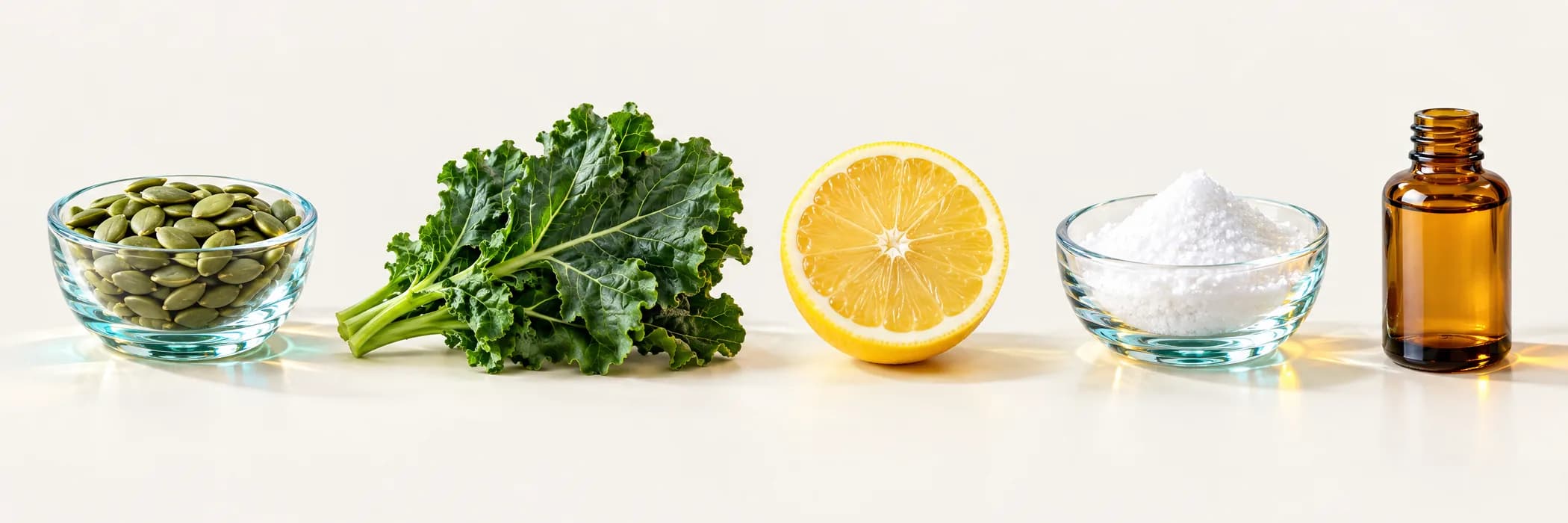
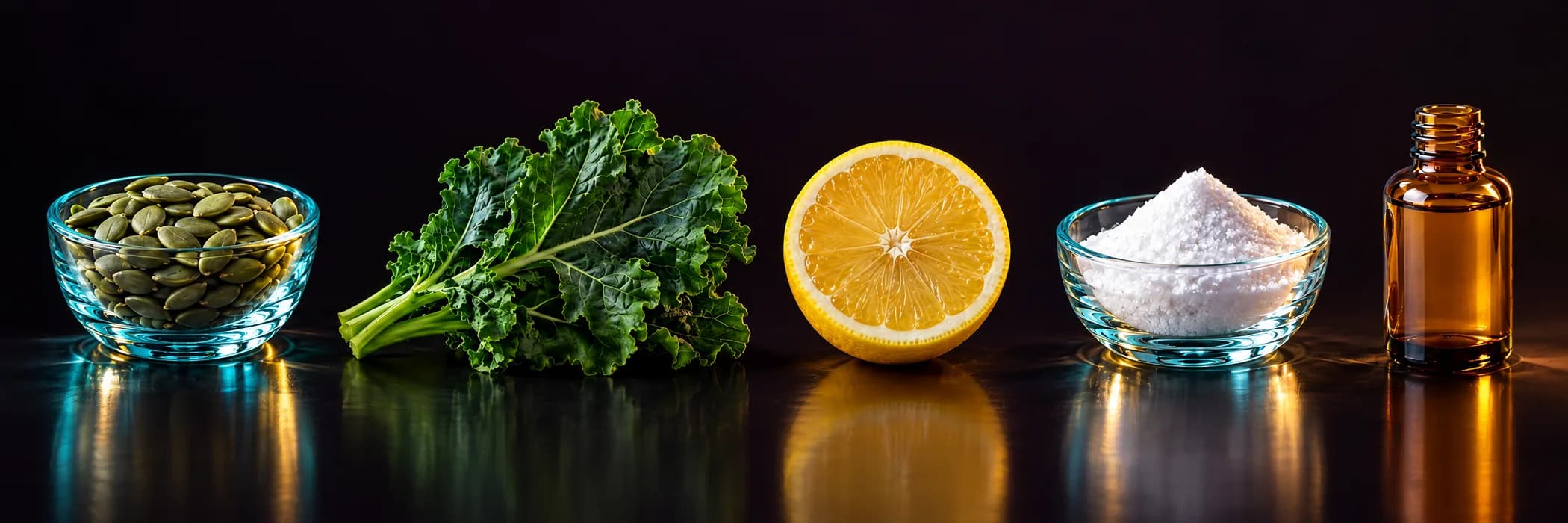
Gonadorelin sends the signal. These help it become testosterone.
Eat enough to keep the axis onThe hormone axis only runs when the body has enough fuel.
- Why:
- Very low body fat (men under ~8–10%), hard calorie cuts or heavy endurance training suppress GnRH pulses directly.
- In practice:
- Keep body fat above that, avoid sustained deficits (>500 kcal/day) and eat enough fat, including cholesterol, the raw material for sex hormones.
Take the stress brake offCortisol and prolactin both suppress GnRH and LH.
- Why:
- Stress raises cortisol. Stress, poor sleep and dopamine-blocking drugs raise prolactin.
- In practice:
- Sleep 7–9 hours, when LH pulses peak. Manage stress and avoid prolactin-raising drugs (antipsychotics, some antiemetics, high-dose SSRI antidepressants). Many add ashwagandha (KSM-66, 300–600 mg/day) to bring cortisol down.
Testosterone building blocksLow zinc, vitamin D or magnesium blunts testosterone output.
- Zinc:
- 15–30 mg/day zinc picolinate or bisglycinate, a testosterone-synthesis cofactor that brakes aromatase, the enzyme making estrogen. Above 15 mg daily, add 1–2 mg copper bisglycinate to prevent copper depletion.
- Vitamin D:
- Target 50–80 ng/mL 25-OH vitamin D, dosed to bloodwork, usually 2,000–5,000 IU/day D3 + K2 (100 mcg MK-7).
- Magnesium:
- 300–400 mg/day elemental magnesium glycinate or threonate before bed. Lowers SHBG (sex hormone-binding globulin) binding and improves sleep.
Free up more testosteroneBoron lowers SHBG, freeing more testosterone to act.
- Why:
- Clinical studies report 3–10 mg/day lowers SHBG, so more of the same total testosterone is free.
- In practice:
- 3–6 mg boron glycinate daily with food. A modest, additive effect.
Dose calculator
Reconstitution calculator
Calculated for a 1 mL U-100 insulin syringe (100 units/mL).
Units per dose
2 units
Draw this many units on a U-100 syringe
Each unit holds 50 mcg
- Volume per dose
- 0.02 mL
- Doses per vial
- 100
- Concentration
- 5 mg/mL
One vial lasts
- Daily
- 100 days
- Every other day
- 200 days
- 5×/week
- 140 days
Research use only. Not for human consumption. Outputs are reference values based on research literature. Verify all measurements independently.
Side effects and what to watch
What people notice. Brief flushing and headache, nausea that often passes within 30–60 minutes, sometimes stomach upset. Injection sites can get tender or bruised, more with a pump or long-term cannula.
Rarer. Allergic reactions, including anaphylactoid ones, are reported, more often with repeated doses. Long pump courses can trigger antibodies. An indwelling IV line rarely inflames the vein. Ovarian hyperstimulation is uncommon at pulse doses but possible, especially with other ovulation drugs.
Skip it or take care if. The label says to skip it with gonadorelin allergy, pregnancy, hormone-dependent tumors, or ovarian enlargement or cysts not from PCOS (polycystic ovary syndrome). Take care with pituitary tumors or high prolactin.
Competing? Banned for male athletes at all times, not for women.
Sources:PMID 2122733
Common questions
How is gonadorelin dosed?
Most men on testosterone therapy run 100–200 mcg twice daily as a small injection under the skin, starting at 100 mcg. Doses sit about 12 hours apart.
How is it different from HCG?
HCG mimics LH and acts on the testis directly, even with a suppressed pituitary. Gonadorelin works one level up, telling the pituitary to make its own LH and FSH, so it needs a responsive pituitary and pulsed doses.
Why do the doses need spacing?
A constant level makes the pituitary pull its GnRH receptors inside and stop responding. After a brief flare, LH and FSH fall. Spaced pulses let the receptors reset between hits, so only pulsed dosing stimulates.
Is it the same as leuprolide or triptorelin?
No. Gonadorelin is natural GnRH and clears in minutes. Leuprolide and triptorelin are modified to last, and that steady action makes them suppress instead.
What is its half-life?
2–10 minutes. In fertility treatment, a programmable pump re-doses it every ~90 minutes to copy the body's rhythm. That fast clearance keeps each dose a brief pulse.
Does gonadorelin help fertility?
When the pituitary works but the GnRH signal is missing, pulsed gonadorelin can induce ovulation with high live-birth rates and mostly single-egg ovulation. It does nothing for pituitary failure.
Deep dive
Doses used in studies · Molecular identity · References
10From the researchDoses used in studies
These are the doses used in the published studies, from pulse-pump fertility treatment, the pituitary stimulation test and the founding monkey study.
| Dose | Route | Model | Outcome | Sources: |
|---|---|---|---|---|
| 1 µg/min × 6 min hourly (pulsatile) vs same total continuous | IV | Animal, rhesus monkeys, hypothalamic-lesioned | Pulsatile restored and maintained LH/FSH; continuous → initial rise then progressive suppression; reversible on return to pulsatile (the founding demonstration) | PMID 100883 |
| Pulsatile, dose not stated in the abstract | IV | Human, 109 women, primary and secondary hypothalamic amenorrhea (multi-center) | Ovulation in 91% of primary and 96% of secondary hypothalamic amenorrhea. Those are the two DIAGNOSTIC subgroups, not two dosing regimens. IV-line complications 0–11% (mean 7%); 12% multiple pregnancy | PMID 2122733 |
| Pulsatile pump protocol | SC/IV pump | Human, n=66 FHA patients, 212 cycles (25-year cohort) | Ovulation ~96%/cycle; live-birth 65.9% per treatment; single-follicle 75%; low multiple-gestation | PMID 36378460 |
| 100 µg (60 µg/m² peds) bolus | IV | Human, delayed-puberty males & females (diagnostic) | A single gonadorelin stim test was largely sufficient to distinguish hypogonadotropic hypogonadism from constitutional delay in males | PMID 26365959 |
11ChemistryMolecular identity
- Molecular weight
- 1182.3 g/mol (free base)
- Molecular formula
- C55H75N17O13
- Monoisotopic mass
- 1181.5730 Da
- Water solubility
- 1 mg/mL
- Sequence
- pyroGlu-His-Trp-Ser-Tyr-Gly-Leu-Arg-Pro-Gly-NH2 (10 AA)PubChem CID 638793
- Structure / class
- Native GnRH / LHRH decapeptide (unmodified endogenous sequence)PubChem CID 638793
- CAS / UNII
- 33515-09-2 (free base) / 71447-49-9 (acetate) · 9O7312W37GPubChem CID 638793
- Molecular target
- GnRH receptor (pituitary gonadotrophs). Pulsatile stimulates, continuous suppressesPubChem CID 638793
- Brand / approval
- Historically FDA-approved as Factrel (diagnostic) & Lutrepulse (pulsatile fertility); both commercially discontinued in the US (manufacturer withdrawal, not safety)Widely cited (not registry-verified)
- Anti-doping status
- Prohibited in males at all times (WADA S2.2); not prohibited in femalesWADA 2026
12Primary sourcesReferences
- PubChem CID 638793PubChem CID 638793 (Gonadorelin)
- PMID 100883Belchetz et al., Science 1978 (pulsatile vs continuous GnRH, rhesus monkeys)
- PMID 2122733Santoro, Am J Obstet Gynecol 1990 (IV pulsatile GnRH / Lutrepulse efficacy & safety)
- PMID 36378460Quaas et al., J Assist Reprod Genet 2022 (pulsatile GnRH in FHA, 25-year cohort)
- PMID 26365959Sun et al., Chin Med J 2015 (GnRH stimulation test in delayed puberty)
- WADA 2026WADA 2026 Prohibited List, S2.2. GnRH/gonadorelin & agonists prohibited in males
- PMID 40800099Jiang et al., Transl Androl Urol 2025 (pulsatile GnRH pump in 54 men with congenital hypogonadotropic hypogonadism)
- RxList (Factrel label)Factrel (gonadorelin hydrochloride) prescribing information, Ayerst Laboratories (via RxList)
- PMID 6813732Hoffman & Crowley, N Engl J Med 1982 (pulsatile GnRH pump induces puberty in 6 men)
Reviewed by Ki Researcher Team · Research use only · Not medical advice · Updated 2026-10-19