
New to peptides
What are peptides?
Short chains of amino acids that your body already makes and uses to send signals. Here is how they work, how they differ from steroids and how people start.
A five-minute read
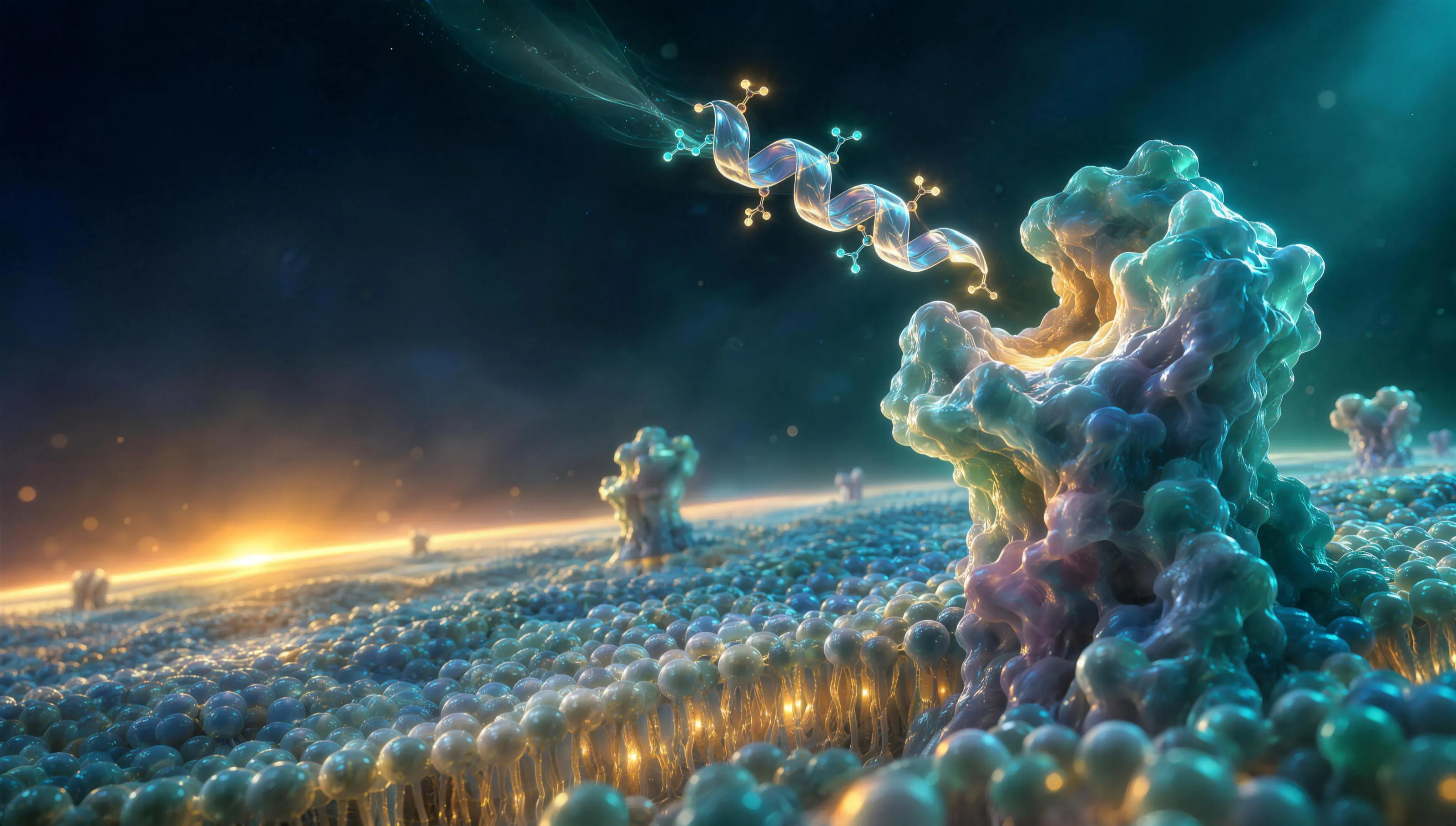
A short chain with one job.
Amino acids are the building blocks of protein, the same ones in the food you eat. Join a few of them in a chain and you have a peptide. Most peptides have 2 to 50 links. Longer chains are usually called proteins.
Most signaling peptides fold into a shape that fits a matching receptor, the way a key fits a lock. When it docks, the cell acts on the message, for example by releasing a hormone or starting a repair. Enzymes then cut the peptide back into amino acids.
- GlutathioneThe main antioxidant inside your cells3
- OxytocinLabor and bonding9
- BPC-157From a protein its discoverers found in stomach juice15
- GLP-1Fullness and insulin release30
- InsulinMoves sugar into your cells, in two chains of 21 and 3051
At about 50 links, a chain starts to be called a protein. Insulin, at 51, sits on the line.
Your body makes them all day.
Insulin tells your cells to take in sugar. Oxytocin drives labor and milk let-down and helps people bond. GLP-1 tells your brain you have eaten enough. Endorphins dull pain. All four are peptides your body makes on its own.
Peptides are not steroids.
Peptides get lumped in with steroids because both can come in a vial. Chemically, they have little in common.
| Peptides | Anabolic steroids | |
|---|---|---|
| Built from | A chain of amino acids, like a very small protein | Four rings of carbon, made from cholesterol |
| Dissolves in | Water, so the dry powder gets mixed with water before use | Fat, which is why injectable steroids come dissolved in oil |
| How it works | Most dock on a receptor on the outside of a cell and pass the signal inside | Passes into the cell and switches sets of genes on or off |
| Related to | Your own insulin, oxytocin and GLP-1 | Testosterone |
A few peptides do act on hormones. The growth hormone peptides, for example, signal your pituitary gland to release more of its own growth hormone instead of adding the hormone itself.
Medicine has used them for more than a century.
- 1922
Insulin, a peptide, is given to a patient for the first time, in Toronto.
- 1953
Oxytocin becomes the first peptide hormone made in a lab. The chemist behind it, Vincent du Vigneaud, won the 1955 Nobel Prize in Chemistry.
- 2005
Exenatide becomes the first GLP-1 medicine. Semaglutide followed in 2017 and tirzepatide in 2022.
- Today
About 100 peptide medicines are approved in major markets.
Why most are injected.
Swallowed, a peptide is digested like the protein in a meal, and very little reaches the blood intact. A small injection under the skin skips digestion. A few, such as Semax and Selank, also work as a nasal spray.
Doses are small, usually micrograms or a few milligrams, because a signal needs very little to work.
Natural peptides often last only minutes. Many research peptides are built to last longer. Half of your own GLP-1 is gone in about 2 minutes, while semaglutide, a modified GLP-1, takes about a week to drop by half.
What people use them for.
The library groups peptides by goal. Pick the one closest to yours.
- RecoveryRecovery from training and injuryBPC-157 · TB-500 · KPV
- MetabolicAppetite and weightSemaglutide · Tirzepatide · Retatrutide
- PerformanceGrowth hormone and lean muscleIpamorelin · CJC-1295 · Tesamorelin
- CognitiveFocus and calmSemax · Selank
- LongevityCell energy and healthy agingEpitalon · MOTS-c · NAD+
- SleepSleep qualityDSIP
- ImmuneImmune signals and defenseThymosin Alpha-1 · LL-37 (Cathelicidin)
- HormoneTestosterone and fertility signalsKisspeptin-10 · Gonadorelin
How people start.
One peptide, one goal.
Most people begin with a single peptide for one clear goal, so they can tell what it does.
A low dose first.
They start at the low end of the usual range and step up only if they need to. Every page lists the range people use, linked to the studies.
The math, done for you.
Peptides come as a dry powder that you mix with water. The calculator turns your vial and dose into the exact units to draw.
Questions people ask first.
Are peptides steroids?
Are peptides natural?
Why do they come as a powder?
Do I have to inject them?
Find your first one.
Search the library by name or goal, or open the calculator if you already have a vial.
Sources
- PMID 35076485Mahmood and Pettinato, Antibodies 2021: peptides are short chains of 2 to 50 amino acids
- PubChem CID 124886Glutathione, a tripeptide of glutamate, cysteine and glycine
- UniProt P01178Oxytocin, 9 amino acids (CYIQNCPLG)
- PMID 40573323Sikiric et al., Pharmaceuticals 2025: BPC-157, 15 amino acids, a partial sequence of a human gastric juice protein
- UniProt P01275GLP-1(7-36) amide, 30 amino acids
- UniProt P01308Human insulin, an A chain of 21 and a B chain of 30 amino acids
- UniProt P02768Human serum albumin, 585 amino acids in the mature protein
- StatPearls NBK541112Biochemistry, Hormones: steroid hormones come from cholesterol and act inside the cell; peptide hormones act on cell-surface receptors
- NIDAAnabolic steroids, synthetic substances similar to testosterone
- Nobel PrizeThe first insulin injection, Toronto, January 1922
- Nobel Prize 1955Vincent du Vigneaud, Chemistry 1955, the first synthesis of a polypeptide hormone
- Drugs@FDAExenatide (Byetta) approved April 2005; semaglutide (Ozempic injection) December 2017 and tirzepatide (Mounjaro) May 2022 under NDA 209637 and 215866
- PMID 40194730Rosson et al., Int J Pharm 2025: about 100 peptide drugs approved in major markets
- FDA labelOral semaglutide tablets: 0.4% to 2% of a dose reaches the blood, with an absorption enhancer
- PMID 14988249Meier et al., Diabetes 2004: intact GLP-1 half-life 2.3 minutes
- FDA labelSemaglutide injection: elimination half-life about 1 week