
BPC-157
Body Protection Compound · Pentadecapeptide BPC 157
BPC-157 is a 15-amino-acid peptide modeled on a protective compound in stomach juice. People run it to heal tendons, ligaments, muscle and gut faster. Three decades of research back it, and it survives stomach acid, which most peptides can't.
Buy BPC-15710 mg vial
Ki Researcher is affiliated with Ki Peptides.
Ships to the US only. Buyers must be 21 or older.
At a glance
- Dose
- 250–500 mcg a day (more for an active injury)
- How often
- Once daily, split morning and night for acute injuries
- How
- A small injection under the skin (belly fat), sometimes near the injury
- When
- Evening, to ride your overnight repair window
- Cycle
- 4–6 weeks on, then a 2–4 week break
The 30-second versionEverything on this page, fast
Tissue repair · Gut healing · Accelerated recovery · Anti-inflammatory
The cornerstone recovery peptide. Research shows BPC-157 promotes angiogenesis, the growth of new blood vessels that feed a healing site, and accelerates healing across tendons, ligaments, muscle, and bone, while supporting gut barrier integrity and systemic recovery.
The basics
- A lab-made copy of a protective compound found naturally in stomach juice.
- The peptide most people start with for injury recovery and gut health.
Why people use it
- Heals injuries faster in tendons, ligaments and muscle by growing fresh blood supply into the repair zone.
- The go-to for stubborn tendons and ligaments that just won't settle.
- Calms and protects a troubled gut, its most-studied use of all.
- Stacks with almost anything because it works through repair signaling.
Stacks well with
- TB-500 is the classic recovery partner. BPC builds the blood supply and TB-500 pulls repair cells in.
- GHK-Cu adds collagen quality and skin and connective-tissue remodeling.
Good to know
- Well tolerated in animal studies, though 28-day studies showed clotting and liver lab shifts worth tracking.
- Banned in tested sport (WADA), which matters if you compete.
- Clears the blood fast but leaves a lasting repair signal, so exact timing is flexible.
What it does
The recovery peptide most people start with, and the one they keep coming back to.
- Bounce back from injuries fasterAfter a crushed calf muscle, treated rats had less bruising and swelling and regained full use of the leg.
- The go-to for stubborn tendons and ligamentsRats with tendon cut from muscle, a gap that never heals alone, regained full function on BPC-157.
- A favorite for gut resilienceIn three rat ulcer tests, its top injected dose cut ulcer area 60–66%, beating the ulcer drug famotidine each time.
- Bone repair that matched a graftIn rabbits, two weeks of injections healed a bone gap about as well as a bone graft did.
Sources:PMID 18668315PMID 34829776PMID 15052688PMID 10071911
How it works
Builds blood supply. BPC-157 switches on angiogenesis, the growth of new blood vessels into a healing site. Studies show it works through the VEGFR2–Akt–eNOS pathway, raising VEGFR2 and vessel density and relaxing vessel walls so blood flows more easily.
Moves repair cells in. It speeds up fibroblasts, the cells that rebuild connective tissue, by activating FAK and paxillin, the cell's traction system.
Makes tendon respond. It raises the growth-hormone receptor on tendon cells and switches on EGR-1, a gene that drives new tissue and organized collagen.
Talks to the gut and brain. Research also reports effects on dopamine and serotonin signaling through the brain-gut connection.
Sources:PMID 27847966PMID 33051481PMID 21030672PMID 25415472PMID 17628536PMID 34829776PMID 27138887PMID 15840402PMID 40005999
How to dose it
Most people run BPC-157 as a small injection under the skin, once a day.
Dose tiersThe dose scales with the goal. An active injury calls for more than maintenance.
- Low / maintenance:
- 150–250 mcg once daily. Maintenance, mild gut support, or a first run to check response.
- Standard:
- 250–500 mcg once daily. The common range for tendon, ligament, muscle and gut goals.
- Acute split:
- 500 mcg split as 250 mcg × 2, morning and night, for an active injury or gut flare.
How to injectIt goes into the fat under the skin. Rotate sites and keep a steady time.
- Injection site:
- Belly, outer hip or outer thigh. Rotate to avoid irritation and lumps. For tendon or ligament work, many place one dose near the injured spot.
- Measuring the dose:
- On a U-100 insulin syringe. At the standard mix, 250 mcg takes 5 units and 500 mcg takes 10 units.
- Time of day:
- Evening for most. A steady daily time beats the exact hour. For a split, space doses ~10–12 hours apart (8 AM and 8 PM).
- Food window:
- Meals don't matter. Food doesn't affect absorption.
Cycle and breaksMost studies started dosing the day of the injury.
- Acute-injury cycle:
- 4–6 weeks of daily use, started as early as possible.
- Maintenance / chronic cycle:
- 6–8 weeks at a lower daily amount (150–250 mcg), then a 2–4 week break, then reassess. Gut goals often run longer blocks.
- Washout:
- 2–4 weeks off after each cycle. People check hs-CRP or tissue imaging in the break.
Mixing the vialThe default mix is a 10 mg vial with 2 mL of bacteriostatic water.
- Mixing:
- That makes 5,000 mcg per mL. On a U-100 syringe (100 units = 1 mL), 250 mcg takes 5 units, 375 mcg takes 7.5 units, 500 mcg takes 10 units.
- Why 2 mL:
- Less water means each unit holds more peptide, handy at 250–500 mcg. Under 100 mcg, people use 3 mL, the vial's maximum (100 mcg takes 3 units).
Sources:PMID 27847966PMID 36588717PMID 20225319PMID 34829776
Best time to take it
Implied best time
Evening
Most people take BPC-157 in the evening, so the repair signal lands in the body's overnight recovery window.
- Overnight is when the body repairs. Deep sleep brings the growth-hormone pulse, peak tissue regeneration and the least load on healing tissue.
- BPC-157 clears the blood in minutes (rat plasma half-life ~15 min). What counts is the repair signal it leaves behind.
- Splitting a higher dose? The evening half matters most. A morning dose is handy for injecting near an injury before activity.
What to stack it with


BPC-157 builds blood supply and structure. The best partners hit recovery from a different angle.
BPC-157 + TB-500The classic recovery pair. BPC-157 builds blood supply and TB-500 pulls repair cells in.
- Why it works:
- TB-500 moves repair cells to the injury while BPC-157 grows the vessels that feed them. Two different levers.
- The protocol:
- BPC-157 250–500 mcg SC daily + TB-500 2–5 mg SC weekly, both 4–6 weeks. Some load TB-500 (2 × 5 mg injections the first 2 weeks, then 5 mg/week).
- Outcome:
- The most common stack for tendon, ligament and muscle injuries. Pre-mixed, it's Wolverine.
BPC-157 + KPVAdds an inflammation brake when swelling or gut inflammation is slowing the repair.
- Why it works:
- KPV turns down NF-κB, the switch behind inflammatory cytokines. BPC-157 rebuilds while KPV calms the tissue around it.
- The protocol:
- BPC-157 250–500 mcg SC daily + KPV 300–500 mcg SC daily, at the same site or rotated.
- Outcome:
- People run it for gut inflammation and post-injury swelling.
BPC-157 + GHK-CuAdds copper-peptide collagen remodeling for skin and connective tissue. With TB-500 too, it's GLOW.
- Why it works:
- GHK-Cu raises collagen synthesis on its own and delivers copper to lysyl oxidase, the enzyme that cross-links collagen.
- The protocol:
- BPC-157 250–500 mcg SC daily + GHK-Cu 1–2 mg SC daily for whole-body connective tissue, or GHK-Cu topically on a skin wound. Rotate sites.
- Outcome:
- People run it when collagen quality matters as much as speed, such as after surgery or on a long-running tendon problem.
Sources:PMID 27847966PMID 21030672PMID 17628536PMID 34829776
Support nutrients
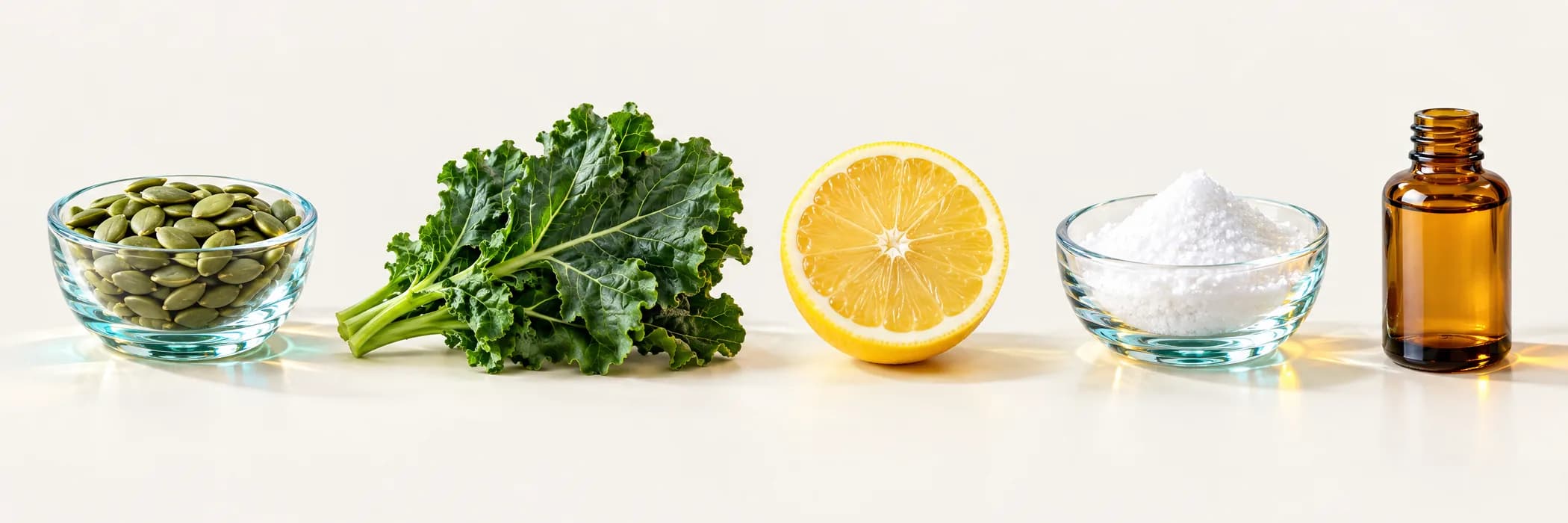
BPC-157 sends the repair signal. These give it the raw materials to build with.
Collagen building blocksBPC-157 signals new collagen. This group supplies the raw material.
- Hydrolyzed collagen + vitamin C:
- 10–15 g collagen peptides (Type I/III) with 500 mg vitamin C, ~30–60 min before activity. In a human study, vitamin-C gelatin before exercise doubled a collagen-synthesis marker.
- Glycine & proline:
- The two amino acids that make up most of collagen. Protein at 1.6–2 g/kg/day keeps the pool full. Some add 5–10 g/day glycine during an acute injury.
Feed the nitric-oxide pathwayArginine and citrulline feed the nitric oxide system BPC-157 works through.
- L-arginine or L-citrulline:
- L-arginine 3–6 g/day or L-citrulline 3 g/day, morning or pre-workout. Arginine is what eNOS turns into nitric oxide. Citrulline converts to arginine efficiently and skips gut breakdown.
Trace minerals for cross-linkingCopper cross-links new collagen into strong tissue. Zinc powers the enzymes that remodel the repair zone.
- Zinc:
- 15–30 mg zinc picolinate or bisglycinate daily. Zinc runs the MMP enzymes that clear damaged matrix and shape the remodel.
- Copper:
- 1–2 mg copper bisglycinate daily, alongside zinc. Lysyl oxidase needs copper to cross-link collagen and elastin. Long zinc courses without copper can deplete it.
Sources:PMC2589959PMID 27852613PMID 9587142PMC5793244PMID 27847966PMID 33051481
Dose calculator
Reconstitution calculator
Calculated for a 1 mL U-100 insulin syringe (100 units/mL).
Units per dose
5 units
Draw this many units on a U-100 syringe
Each unit holds 50 mcg
- Volume per dose
- 0.05 mL
- Doses per vial
- 40
- Concentration
- 5 mg/mL
One vial lasts
- Daily
- 40 days
- Every other day
- 80 days
- 5×/week
- 56 days
Research use only. Not for human consumption. Outputs are reference values based on research literature. Verify all measurements independently.
Side effects and what to watch
What people notice. Very little. Safety studies in mice, rats, rabbits and dogs found no serious toxicity, no DNA damage and no harm to fetal development.
Worth knowing. In 28-day studies, clotting time shifted in rats and dogs and triglycerides rose. Low-dose female rats had higher ALT (a liver enzyme) and glucose two weeks after stopping. Dogs' creatinine, a kidney marker, dipped at 2 mg/kg and recovered.
A human report. A woman using a BPC-157 and TB-500 product got skin and gum darkening. It came back when she restarted and did not return after she quit.
Skip it or take care if you have an active cancer, since it grows new blood vessels.
Competing? It is banned in tested sport.
Sources:PMID 32334036FDA briefing document (BPC-157), PCAC July 2026PMID 27847966
Common questions
What do people run BPC-157 for?
Injury recovery and gut health. Its most-studied area is gut protection and healing, alongside recovery of tendon, ligament, muscle and bone.
How is BPC-157 dosed?
The common range is 250–500 mcg a day as a small injection under the skin. For an active injury, people often split it into 250 mcg morning and evening.
Do I need to cycle BPC-157?
Most people do. A typical run is 4–6 weeks of daily use, then a 2–4 week break. Lower-dose maintenance blocks run 6–8 weeks.
Can I run it with TB-500?
Yes, it is the classic recovery pair. BPC-157 runs at 250–500 mcg daily with TB-500 at 2–5 mg weekly, both for 4–6 weeks. It also comes pre-mixed as Wolverine.
What is BPC-157's half-life?
Short. Plasma half-life is ~15 min in rats and ~5 min in dogs by IV. The repair signal it leaves lasts longer, so exact timing is flexible.
Deep dive
Doses used in studies · Blood markers to track · Molecular identity · References
10From the researchDoses used in studies
These are the doses used in the published studies, reported per kilogram of body weight. Gut studies often run lower than tendon and muscle studies.
| Dose | Route | Model | Outcome | Sources: |
|---|---|---|---|---|
| 400–800 ng/kg | IM / intragastric | Rat (gastric ulcer) | Ulcer-area reduction 46–66% | PMID 15052688 |
| 10 µg/kg | IP / oral | Rat (cysteamine colitis) | Colon healing + anastomosis | PMID 24304574 |
| 10 µg/kg | IP / oral | Rat (reflux esophagitis) | Lesion + sphincter recovery | PMID 17116974 |
| 10 µg/kg | Intraperitoneal | Rat (ligament) | Ligament healing + biomechanics | PMID 20225319 |
| 10 µg/kg | IP / oral (drinking water) | Rat (myotendinous) | Functional + microscopic recovery | PMID 34829776 |
| 20–500 µg/kg | IV & IM | Rat (PK) | Pharmacokinetics (n=6/group) | PMID 36588717 |
| 6–150 µg/kg | IV & IM | Beagle dog (PK) | Pharmacokinetics | PMID 36588717 |
11Labs before / during / afterBlood markers to track
What people track. A few blood tests give a read on recovery during a tissue-repair run.
hsCRP (high-sensitivity C-reactive protein) shows body-wide inflammation. A complete blood count plus ferritin, the stored-iron marker, covers iron status. Read ferritin next to CRP, since inflammation pushes it up. 25-hydroxy vitamin D matters for muscle, bone and connective tissue.
Sources:PMC12782873WHO 2020PMC4530385
12ChemistryMolecular identity
- Molecular weight
- 1,419.5 g/mol
- Molecular formula
- C62H98N16O22
- Monoisotopic mass
- 1,418.70 Da
- Sequence (15 AA)
- GEPPPGKPADDAGLV
- CAS / UNII
- 137525-51-0 · 8ED8NXK95P
- Molecular target
- No single receptor; acts via the nitric-oxide / VEGFR2–Akt–eNOS angiogenic pathwayPMID 27847966 · PMID 33051481
- Origin
- Synthetic stable fragment of gastric “Body Protection Compound”Research literature
- Regulatory status
- Unapproved drug (not FDA-approved); prohibited in sport (WADA S0)FDA / WADA Prohibited List
13Primary sourcesReferences
- PubChem CID 9941957PubChem CID 9941957
- PMID 40005999Pharmaceuticals 2025 (review)
- PMID 40759852Inflammopharmacology 2025
- PMID 27847966J. Mol. Med. 2017
- PMID 33051481Sci. Rep. 2020
- PMID 21030672J. Appl. Physiol. 2011
- PMID 25415472Molecules 2014
- PMID 17628536Eur. J. Pharmacol. 2007
- PMID 34829776Biomedicines 2021
- PMID 27138887Curr. Neuropharmacol. 2016
- PMID 15840402Eur. J. Pharmacol. 2005
- PMID 15052688World J. Gastroenterol. 2004
- PMID 17116974J. Pharmacol. Sci. 2006
- PMID 24304574J. Physiol. Pharmacol. 2013
- PMID 18818478J. Pharmacol. Sci. 2008
- PMID 18668315Surgery Today 2008
- PMID 10071911Bone 1999 (rabbit)
- PMID 20225319J. Orthop. Res. 2010
- PMID 36588717Front. Pharmacol. 2022
- PMID 32334036Regul. Toxicol. Pharmacol. 2020
- PMID 9403784Sikirić et al. 1997
- PMID 21295044Ilić et al. 2011
- PMID 35678659Curr. Issues Mol. Biol. 2022
- PMC2589959Ascorbate & collagen (review)
- PMID 27852613Shaw et al. 2017
- PMID 9587142Rucker et al. 1998
- PMC5793244Zinc in wound healing (review)
- PMC12782873hsCRP review
- WHO 2020WHO 2020 iron guideline
- PMC4530385Vitamin D & muscle (review)
- Regulatory statusOPSS (U.S. DoD)
- FDA briefing document (BPC-157), PCAC July 2026FDA briefing document on BPC-157, Pharmacy Compounding Advisory Committee, July 23-24, 2026
BPC-157
10 mg vial
Ki Researcher is affiliated with Ki Peptides.
Ships to the US only. Buyers must be 21 or older.
Reviewed by Ki Researcher Team · Research use only · Not medical advice · Updated 2026-10-19