
GHK (copper-free, Gly-His-Lys)
Copper-binding tripeptide (Gly-His-Lys) · the copper-free form of GHK-Cu
GHK is a three-amino-acid peptide (glycine-histidine-lysine) your body makes, and it grips copper tightly. People run it for skin remodeling, collagen and tissue repair. It is the copper-free form of GHK-Cu. In the body it binds copper and becomes GHK-Cu, the active form.
At a glance
- Dose
- 500 mcg–2 mg a day, 1 mg the standard
- How often
- Once a day, larger doses sometimes split about 12 hours apart
- How
- A small injection under the skin
- When
- Evening for the overnight repair window; morning works too
- Cycle
- 8–12 weeks on, then a 4-week break
The 30-second versionEverything on this page, fast
Skin Remodeling · Collagen Signaling · Copper Delivery · Tissue Repair
The copper-free tripeptide. Free GHK is a copper scavenger that binds copper in the body and becomes GHK-Cu, the form that signals collagen and skin remodeling. Keep your copper up and it has what it needs to work.
The basics
- A small natural peptide (glycine-histidine-lysine) found in human plasma. This is the copper-free version; the copper complex GHK-Cu has its own page.
- Sold as a cosmetic ingredient (INCI name, the International Nomenclature of Cosmetic Ingredients: Tripeptide-1) and as an injectable research peptide.
Why people use it
- Skin remodeling and collagen signaling. Once it binds copper and becomes GHK-Cu, it signals fibroblasts to build collagen and the skin's matrix.
- Delivers copper to tissue. It grips copper exceptionally tightly and converts to GHK-Cu in the body, feeding collagen cross-linking.
- Tissue repair and wounds. In wound models the GHK-Cu it forms drives skin regrowth and new blood vessel growth.
- Stacks cleanly. It pairs with its own copper complex GHK-Cu and with repair peptides like BPC-157 and TB-500.
Stacks well with
- GHK-Cu is the same peptide with copper already attached, one molecule in two copper states rather than two pathways.
- BPC-157 + TB-500 is the systemic repair pair. It adds blood-vessel repair and cell migration to GHK's matrix-remodeling lever.
Good to know
- Copper is the activating cofactor. Without enough copper, free GHK has nothing to bind and the active complex doesn't form, so keep dietary copper at 1–2 mg a day.
- If you'd rather skip the conversion step, GHK-Cu is the pre-formed complex and gives you the active form immediately. Some people run or alternate both.
- Check the label when you source it. GHK and GHK-Cu are separate products with separate chemical records.
What it does
People run GHK for the same skin and tissue goals as GHK-Cu, the form it becomes in the body.
- Skin remodeling and collagen signalingOnce it binds copper and becomes GHK-Cu, it signals fibroblasts to build collagen and the skin's matrix.
- Copper delivered to tissueIt grips copper exceptionally tightly and converts to GHK-Cu, carrying copper where it feeds collagen cross-linking.
- Tissue repair and wound healingIn wound models, the GHK-Cu it forms promotes skin regrowth and new blood vessels.
- A remodeling base that stacks wellIt pairs with GHK-Cu and with repair peptides BPC-157 and TB-500 for fuller tissue repair.
How it works
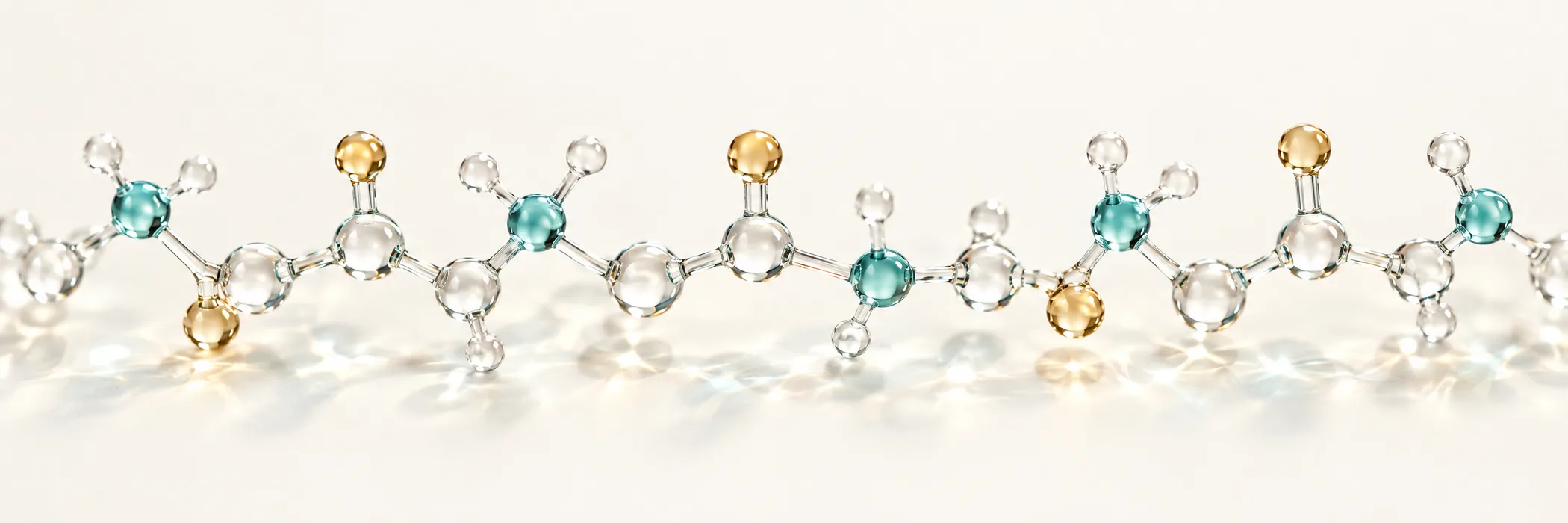
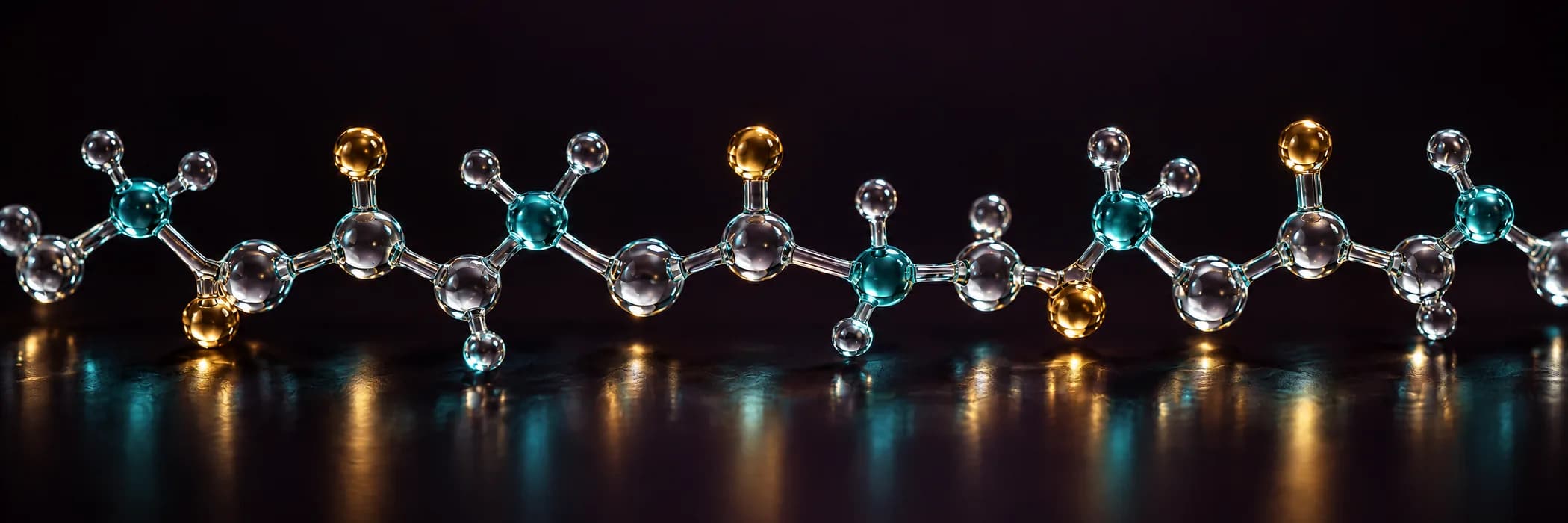
A copper carrier. GHK is a matrikine, a small signal peptide from the tissue matrix. Its defining trait is a very tight grip on copper. Its discoverers write that virtually all of its biological effects need that copper bound.
Becomes GHK-Cu in the body. Injected free GHK pulls copper from plasma and tissue and converts to GHK-Cu, the active form. That is why copper is its headline cofactor.
What GHK-Cu does. In fibroblasts, the cells that build skin's scaffold, it stimulates collagen, elastin and glycosaminoglycan synthesis. Studies also report it shifts matrix-remodeling enzymes and supports new blood vessels and nerve outgrowth, with antioxidant and anti-inflammatory activity in cell studies.
How to dose it
Most people run GHK as a small injection under the skin, 500 mcg to 2 mg a day. The on-page calculator is built for it.
Dose tiersMost people run 1 mg once a day, starting at 500 mcg to test tolerance.
- Low / introductory:
- 500 mcg once daily, to test tolerance or as a conservative skin-support dose.
- Standard:
- 1 mg (1,000 mcg) once daily. The most common maintenance dose for skin remodeling and collagen signaling.
- Higher end:
- 1.5 to 2 mg a day, the top of the range, sometimes split into two 750–1,000 mcg injections. No data shows added benefit over 1 mg.
How to injectGHK goes into the fat under the skin. Site rotation and timing are what you control.
- Injection site:
- Abdomen (a few centimeters from the navel), outer thigh or love handle. Rotate sites to avoid irritation and lipohypertrophy, fatty lumps from reusing one spot.
- Measuring the dose:
- 10 mg in 2 mL (5,000 mcg/mL), U-100 syringe: 500 mcg takes 10 units, 1,000 mcg takes 20 units, 1,500 mcg takes 30 units. The calculator covers any vial.
- Time of day:
- Most lean evening for overnight repair; morning works too. A consistent daily time matters more than the hour. Split doses go about 12 hours apart.
- Food window:
- No food interaction. Inject independent of meals.
Cycle and breaksMost people run GHK in defined cycles rather than year-round.
- Standard cycle:
- 8–12 weeks of daily dosing, then reassess. Some run shorter 4–6 week blocks.
- Washout:
- A 4-week break between cycles, by convention.
- On-demand use:
- Some run shorter 2–4 week skin-focused pulses around a procedure, season change or healing period instead.
Mixing the vialThe calculator does this live. Quick reference for a standard 10 mg vial.
- Mixing:
- 10 mg + 2 mL bacteriostatic water = 5,000 mcg/mL. On a 100-unit (1 mL) syringe: 500, 1,000, 1,500 and 2,000 mcg take 10, 20, 30 and 40 units.
- Why 2 mL:
- It keeps low-milligram doses landing neatly on syringe markings.
Best time to take it
Implied best time
Evening
Most people take GHK in the evening, lined up with the body's overnight repair window. Morning works too.
- Through the GHK-Cu it forms, GHK signals fibroblasts to lay down collagen and elastin. Skin and connective tissue do most of that rebuilding overnight.
- It is a remodeling signal, not a stimulant, so there is no wakefulness reason to favor the morning.
- No half-life is published for free GHK, so timing follows the mechanism. A consistent daily time matters more than the exact hour.
What to stack it with


GHK's closest partner is its own copper complex. Its other pairings hit tissue repair from a different angle.
GHK + GHK-CuThe same tripeptide, copper-free and copper-loaded.
- Why it works:
- GHK-Cu delivers the active form right away. Free GHK scavenges extra copper from tissue and converts on-site.
- The protocol:
- GHK-Cu 1 mg plus free GHK 500 mcg–1 mg under the skin daily, or alternate them on different days.
- Outcome:
- Extended copper delivery and collagen-signaling coverage from one molecule in two states, not a multi-pathway stack.
GHK + BPC-157GHK signals the collagen matrix; BPC-157 heals the tissue and builds blood supply.
- Why it works:
- BPC-157 drives angiogenesis (new blood vessel growth) and growth-factor signaling at injury sites. GHK-Cu has fibroblasts fill the space with collagen and elastin.
- The protocol:
- Free GHK 1 mg plus BPC-157 250–500 mcg, each under the skin once daily at rotated sites. Draw separately or co-inject. Keep copper up so GHK converts.
- Outcome:
- Reached for on skin aging, wound healing and soft-tissue recovery.
GHK + BPC-157 + TB-500The systemic repair trio. TB-500 adds cell migration.
- Why it works:
- TB-500 (Thymosin β4) promotes migration of repair cells into damaged tissue. BPC-157 brings blood supply; GHK drives collagen and matrix synthesis.
- The protocol:
- Free GHK 1 mg plus BPC-157 250–500 mcg daily. TB-500 runs its own schedule, commonly 5–10 mg/week for 4 weeks to load, then 2.5–5 mg/week maintenance, weekly or twice-weekly.
- Outcome:
- Reached for on post-procedure recovery, chronic tendon or fascial injury and systemic skin remodeling.
Support nutrients
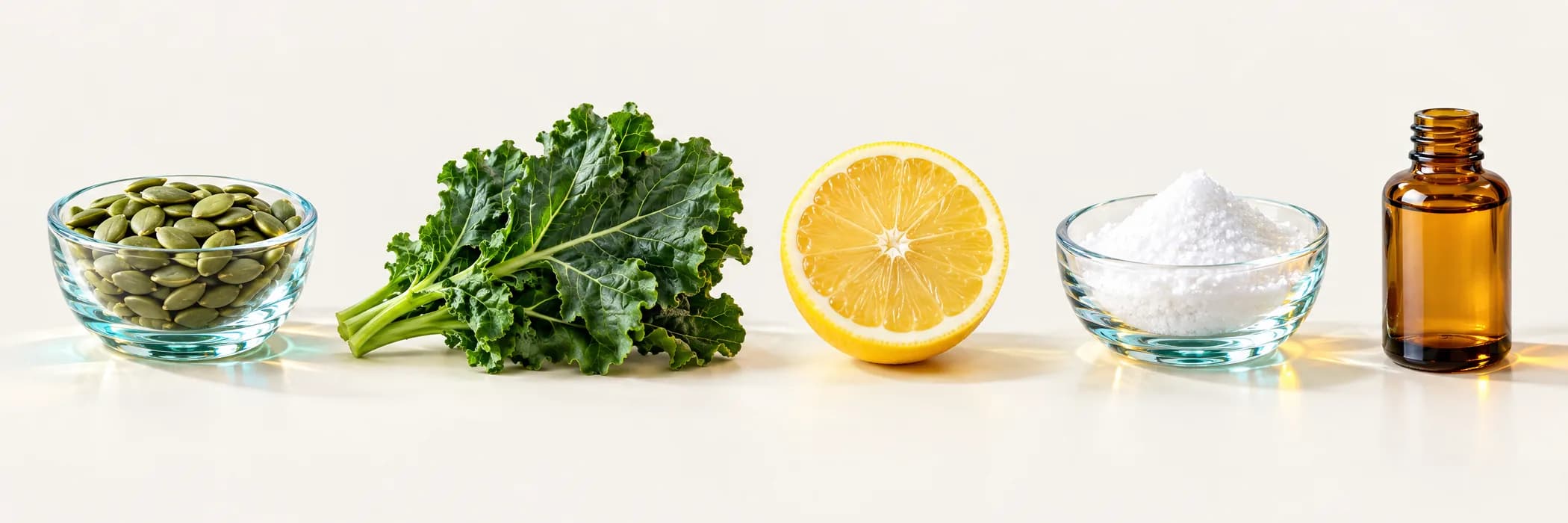
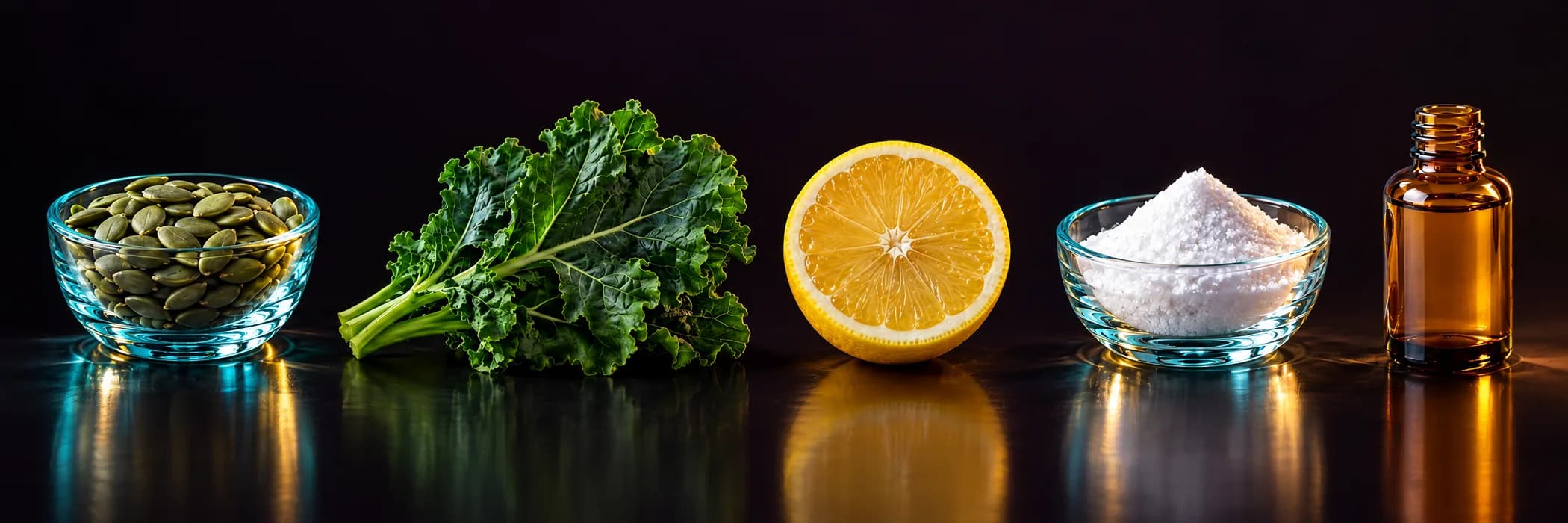
Copper comes first, since it turns free GHK into GHK-Cu. The rest feeds the collagen it signals for.
Copper that activates GHKCopper turns free GHK into GHK-Cu. Without enough copper, the active complex does not form.
- Mechanism:
- GHK grips one copper ion and becomes GHK-Cu, the form behind virtually all its regenerative work. Injected free GHK pulls that copper from plasma and tissue.
- Dose & timing:
- 1–2 mg elemental copper daily, food first (liver, shellfish, legumes, nuts, dark chocolate). Copper bisglycinate 1–2 mg with a meal covers a copper-sparse diet.
Collagen building blocksGHK-Cu signals fibroblasts to build collagen. These supply the raw materials.
- Vitamin C, 500 mg daily:
- Needed by prolyl and lysyl hydroxylase, the enzymes that stabilize collagen's triple helix. Take with a meal, any time of day.
- Hydrolyzed collagen, 10–15 g daily:
- Supplies the glycine-proline-hydroxyproline tripeptides fibroblasts reassemble into collagen. Take with vitamin C for potential synergy.
- Glycine / proline via diet:
- Glycine is a third of collagen, its most abundant amino acid. Broth, gelatin or a glycine supplement (~3–5 g/day) tops up the supply.
Zinc, paired with copperZinc powers collagen-clearing enzymes, but high doses drain copper.
- Mechanism:
- Zinc powers MMPs (matrix metalloproteinases), the enzymes that clear old cross-linked collagen for new matrix. Zinc and copper compete for absorption, so high-dose zinc depletes copper.
- Dose & timing:
- 15 mg zinc picolinate or bisglycinate daily, with 1–2 mg copper bisglycinate at the same time to prevent depletion. Take with a meal, away from iron if possible.
Dose calculator
Reconstitution calculator
Calculated for a 1 mL U-100 insulin syringe (100 units/mL).
Units per dose
20 units
Draw this many units on a U-100 syringe
Each unit holds 50 mcg
- Volume per dose
- 0.2 mL
- Doses per vial
- 10
- Concentration
- 5 mg/mL
One vial lasts
- Daily
- 10 days
- Every other day
- 20 days
- 5×/week
- 14 days
Research use only. Not for human consumption. Outputs are reference values based on research literature. Verify all measurements independently.
Side effects and what to watch
What people notice. As a natural peptide used on the skin, GHK is generally well tolerated. Local irritation or sensitivity is the usual possibility with topical use.
Worth knowing. No large long-term safety dataset exists for free GHK. GHK and GHK-Cu are separate products with separate chemical records, so check the label when you source it.
Common questions
How is GHK different from GHK-Cu?
GHK-Cu is the same tripeptide with copper already attached, and it has its own page. Free GHK picks up copper in the body and becomes GHK-Cu. Its discoverers say copper is needed for virtually all of GHK's effects.
How is GHK dosed?
Most people run 1 mg (1,000 mcg) once a day as an injection under the skin, starting at 500 mcg and topping out at 1.5 to 2 mg a day.
Do I need to cycle it?
Most run 8–12 weeks of daily dosing, then take a 4-week break. Some prefer shorter 2–4 week skin-focused pulses.
If free GHK becomes GHK-Cu, why not just use GHK-Cu?
GHK-Cu gives you the active form immediately. Free GHK converts to GHK-Cu depending on the copper you have available. Some people run both or alternate them, and the GHK-Cu page covers that route in depth.
Why does copper matter so much?
Free GHK works by delivering copper. It grips a copper ion to form GHK-Cu, the active form. If your copper is low, less GHK-Cu forms. The usual baseline is 1–2 mg of dietary copper a day.
Where does the 4,000-gene figure come from?
That figure comes from the discoverers' gene-database analysis in cell lines, which reported GHK shifting roughly a third of the genes tested.
Deep dive
Doses used in studies · Molecular identity · References
10From the researchDoses used in studies
These are the conditions used in the published studies, lab and database work done almost always with the copper complex GHK-Cu.
| Dose | Route | Model | Outcome | Sources: |
|---|---|---|---|---|
| 10⁻¹²–10⁻⁹ M | In vitro (fibroblast culture) | Original collagen study, explicitly the copper complex GHK-Cu (Maquart 1988) | Stimulated collagen synthesis at very low concentrations; genuine primary research, but a GHK-Cu finding, not evidence for copper-free GHK | PMID 3169264 |
| Database analysis | In silico / microarray (CMAP) | Connectivity-Map gene-expression analysis by the originators (Pickart 2014) | Reported GHK changed expression of ~31% of assayed genes, source of the '~4,000 genes' claim; database/in-vitro, labelled 'GHK', not a clinical property of copper-free GHK | PMID 25302294 |
| 1 µM | In vitro (PC3/MCF7 cell lines) | Gene-expression profiling; copper emphasized as required (Pickart 2017) | Cell-culture concentration for gene profiling; same paper states copper is required for 'virtually all' GHK effects. Not a human injectable dose | PMID 28212278 |
| Not established | Subcutaneous | Independent controlled human trial of copper-free GHK (literature search) | No confirmed independent RCT of copper-free GHK located; the often-cited 2002 cream trial is an unindexed conference abstract that used GHK-Cu. Recorded absence, not a positive result | PMID 29986520 |
11ChemistryMolecular identity
- Molecular weight
- 340.38 g/mol (free peptide)
- Molecular formula
- C₁₄H₂₄N₆O₄ (free peptide)
- Monoisotopic mass
- 340.18590 Da
- Sequence
- Gly-His-Lys (glycyl-L-histidyl-L-lysine), 3 AA, N-to-C tripeptidePubChem CID 73587
- Structure / class
- Endogenous copper-binding tripeptide (matrikine); the apo/metal-free ligand of GHK-CuPubChem; copper-peptide literature
- CAS / UNII
- 49557-75-7 · 39TG2H631E (free peptide; distinct from the GHK-Cu complex CAS 89030-95-5)PubChem CID 73587
- PubChem CID
- 73587PubChem (free peptide; NOT the copper-complex CIDs)
- Water solubility
- Freely water-soluble; highly hydrophilic (computed XLogP −4.4, TPSA 176 Ų)PubChem CID 73587 (computed properties)
- Copper coordination
- Apo ligand. Carries no copper itself; binds one Cu²⁺ via the imidazole N + N-terminal amine to form GHK-Cu in vivoCopper-peptide coordination chemistry; PubChem (separate complex record)
- Molecular target
- No classic receptor. Acts as a copper(II)-binding/transport ligand (matrikine); the studied biology belongs to the GHK-Cu complexCopper-peptide literature; PMID 28212278
- Relationship to GHK-Cu
- Copper-free ligand; binds Cu²⁺ in vivo and converts to GHK-Cu; most studied GHK biology used the copper complexCopper-peptide literature; PubChem (separate records)
- Half-life
- Not established for free GHK (no published human pharmacokinetics)Not established
- Regulatory status
- Cosmetic ingredient (INCI Tripeptide-1), not a drug; not FDA-approved for any therapeutic claimINCI; no NDA/BLA record located
12Primary sourcesReferences
- PMID 3169264Maquart FX et al., FEBS Lett 1988. Original in-vitro study: the tripeptide-copper complex GHK-Cu stimulated collagen synthesis in fibroblast cultures at very low concentrations (primary research; COPPER COMPLEX, not free GHK)
- PMID 25302294Pickart L, Vasquez-Soltero JM, Margolina A, Biomed Res Int 2014. 'GHK and DNA: Resetting the Human Genome to Health'; Connectivity-Map microarray analysis reporting GHK altered ~31% of assayed genes (source of the '~4,000 genes' figure); originator-authored, in-vitro/database
- PMID 26236730Pickart L, Vasquez-Soltero JM, Margolina A, Biomed Res Int 2015. Review, 'GHK Peptide as a Natural Modulator of Multiple Cellular Pathways in Skin Regeneration'; states GHK functions as a complex with copper(II) (GHK-Cu)
- PMID 28212278Pickart L, Vasquez-Soltero JM, Margolina A, Brain Sci 2017. Gene-expression analysis + review; the honesty anchor: authors state 'virtually all biological GHK effects require copper 2+ chelated to the tripeptide'; CMAP profiles at 1 µM in cell lines
- PMID 29986520Pickart L, Margolina A, Int J Mol Sci 2018. Review, 'Regenerative and Protective Actions of the GHK-Cu Peptide…'; synthesizes regeneration claims for the COPPER COMPLEX across skin/lung/bone/liver
- PubChem CID 73587PubChem record, identity for the FREE peptide: CID 73587, C₁₄H₂₄N₆O₄, MW 340.38, CAS 49557-75-7, UNII 39TG2H631E. Note: PubChem's synonym list for CID 73587 is contaminated with copper-complex names (GHK-Cu, Prezatide); the complex is a distinct molecule (CAS 89030-95-5, separate CIDs)
Reviewed by Ki Researcher Team · Research use only · Not medical advice · Updated 2026-10-05