
Ventfort (A-3)
Khavinson 'Cytomax' peptide extract from calf vascular tissue · the vascular bioregulator of the family
Ventfort is the vascular bioregulator of the Cytomax line from Vladimir Khavinson's St. Petersburg institute, a complex of small peptides extracted from calf blood-vessel tissue. People run it as the blood-vessel piece of a longevity routine, a capsule course with months off in between.
At a glance
- Dose
- About 20 mg a day (2 capsules of 10 mg)
- How often
- Once a day, within a course
- How
- A capsule by mouth, no injection
- When
- Before meals, at the same time each day
- Cycle
- About 30 days on, then 2–6 months off
The 30-second versionEverything on this page, fast
Vascular bioregulator · Khavinson system · Longevity course · Aging blood vessels
The vascular piece of the Khavinson bioregulator system. Ventfort is the blood-vessel slot in a tissue-by-tissue longevity routine, a peptide extract from calf vascular tissue run as a short capsule course.
The basics
- A peptide complex from calf blood-vessel tissue, the vascular member of the Khavinson Cytomax line.
- Run as a short course, not continuously, the way the whole bioregulator family is used.
Why people use it
- Fills the vascular slot in a Khavinson stack. The piece people add when they want blood vessels covered in a tissue-by-tissue routine.
- Aimed at aging blood vessels. The bioregulator framework assigns it to the vascular system as its target tissue.
- Low effort. A capsule course that asks little of the user, with months off between courses.
Stacks well with
- Vesugen is the other Khavinson vascular peptide, a defined tripeptide (KED) that covers the vascular system from a second angle.
Good to know
- Run it as a course, not continuously. Short blocks with months off between, the bioregulator pattern.
- It is not Vesugen. Ventfort is a tissue extract; Vesugen is a defined tripeptide with its own chemistry.
- Exercise and blood-pressure control are the proven vascular basics. Ventfort goes with them, not in place of them.
What it does
People run Ventfort for one thing, vascular support as they age.
- Covers blood vessels in a bioregulator routineIn the Khavinson one-bioregulator-per-tissue model, Ventfort is the piece assigned to the blood vessels.
- Aimed at age-related declineRun like the rest of the Cytomax line, in short periodic courses aimed at general age-related decline.
- Easy to runA simple capsule course that asks little of the user, with months off between courses.
- Builds on the proven vascular basicsPeople run it on top of exercise, blood-pressure control, not smoking and nitric-oxide precursor nutrition.
Sources:PubMed (verified count = 0 for 'Ventfort')PubChem (no compound for 'Ventfort')
How it works
One peptide set per tissue. In the Khavinson bioregulator model, short peptides from a tissue reach its cells, influence gene activity and help restore that organ's function. Ventfort is the set drawn from blood vessels.
A mix, not one molecule. Ventfort is a complex of small peptides from calf vascular tissue, with no single sequence. The model applies to the extract as a whole, with no single peptide-to-DNA step mapped for it.
Where it fits. It is the blood-vessel member of the Cytomax line, the tissue extracts the Khavinson school assigns one to each organ.
How to dose it
Most people take Ventfort by mouth, about 20 mg/day, in 30-day courses repeated every 2–6 months.
Dose tiersMost people take about 20 mg a day, two 10 mg capsules, for 30 days.
- Oral course:
- A 10 mg oral capsule, roughly 20 mg per day (2 × 10 mg), for a 30-day course repeated every 2–6 months.
- Route:
- Oral capsule, and historically a sublingual tablet (dissolved under the tongue). There is no injectable Ventfort product, and no injection practice was found.
- The injected figure:
- The often-cited 1,000–2,000 mcg (1–2 mg) injected figure is a conversion from the oral course, not a practice people report.
How to take itCapsules by mouth once a day, before meals, at a consistent time.
- Oral capsule:
- Take the capsule(s) once daily at a consistent time, before meals per the product instructions.
- Time of day:
- No set hour. Pick one daily time you can keep. See Best time to take it below.
- If you mix a powder:
- Mixed powder would go under the skin of the belly (a couple of inches clear of the navel), the love handles or outer thigh. Rotate sites. Meals do not matter.
Cycle and breaksAbout 30 days on, then 2–6 months off, run in courses the Khavinson way.
- Course length:
- Approximately 30 days on (a 4–6 week run).
- Break:
- 2–6 months between courses, and at minimum a 4–8 week break.
- Why courses:
- The Khavinson school runs bioregulators in periodic courses, not continuously.
Mixing the vialCapsules need no mixing. If you have a 10 mg powder vial, the math is below.
- Capsule or tablet:
- The product is an oral capsule (historically a sublingual tablet), so nothing is mixed. Product instructions say 1–2 capsules once or twice daily before meals (≈20 mg/day).
- Mixing:
- 10 mg vial + 2 mL bacteriostatic water = 5,000 mcg/mL. On a 100-unit (1 mL) insulin syringe, 1,000 mcg takes 20 units · 2,000 mcg takes 40 units.
- Storage and technique:
- The calculator on this page handles any vial size. Storage is on the calculator page. Sterile technique is not covered here.
Sources:PubMed (verified count = 0 for 'Ventfort')PubChem (no compound for 'Ventfort')
Best time to take it


Implied best time
Anytime (consistent)
No best hour. Take it at one fixed time each day that you can keep for the whole course.
- No half-life or absorption curve has been set for Ventfort, so there is no peak to time a dose against. Habit is what counts.
- It is a once-daily capsule within a short course, so locking it to a fixed daily slot keeps you on track.
- Running other bioregulators too? Spread the doses through the day to suit your routine.
Sources:PubMed (verified count = 0 for 'Ventfort')PubChem (no compound for 'Ventfort')
What to stack it with


Ventfort's natural partner is Vesugen (KED), the other vascular bioregulator. People also run it with the wider Khavinson set.
Ventfort + Vesugen (KED)Two vascular bioregulators run as separate oral courses to cover blood vessels from two angles.
- Two different products:
- Vesugen is a defined synthetic tripeptide (Lys-Glu-Asp, KED, PubChem CID (compound ID) 87571363). Ventfort is a calf tissue extract. Vesugen's sequence and CID do not belong to Ventfort.
- Why it works:
- The Khavinson framework assigns both to the vascular system, so people combine them to cover it from two angles. Vesugen, a defined tripeptide, has its own Russian-language research.
- The protocol:
- Separate oral courses run at the same time. Ventfort at ~20 mg/day, Vesugen at its own dose (~10–20 mg oral equivalent).
- Outcome:
- Reached for as general vascular support within the Khavinson framework.
Ventfort + other Khavinson bioregulatorsPeople add pineal, thymic or immune peptides to cover several systems at once.
- Why it works:
- The Khavinson school frames aging as each tissue losing its regulation, answered with that tissue's peptide. Running several, such as Epitalon for the pineal, follows that logic.
- The protocol:
- Each product at its own dose, run at the same time, usually as a 30-day course.
- Outcome:
- Reached for as a broad, multi-system longevity approach. The vascular habits in the cofactor cards stay the foundation.
Support nutrients
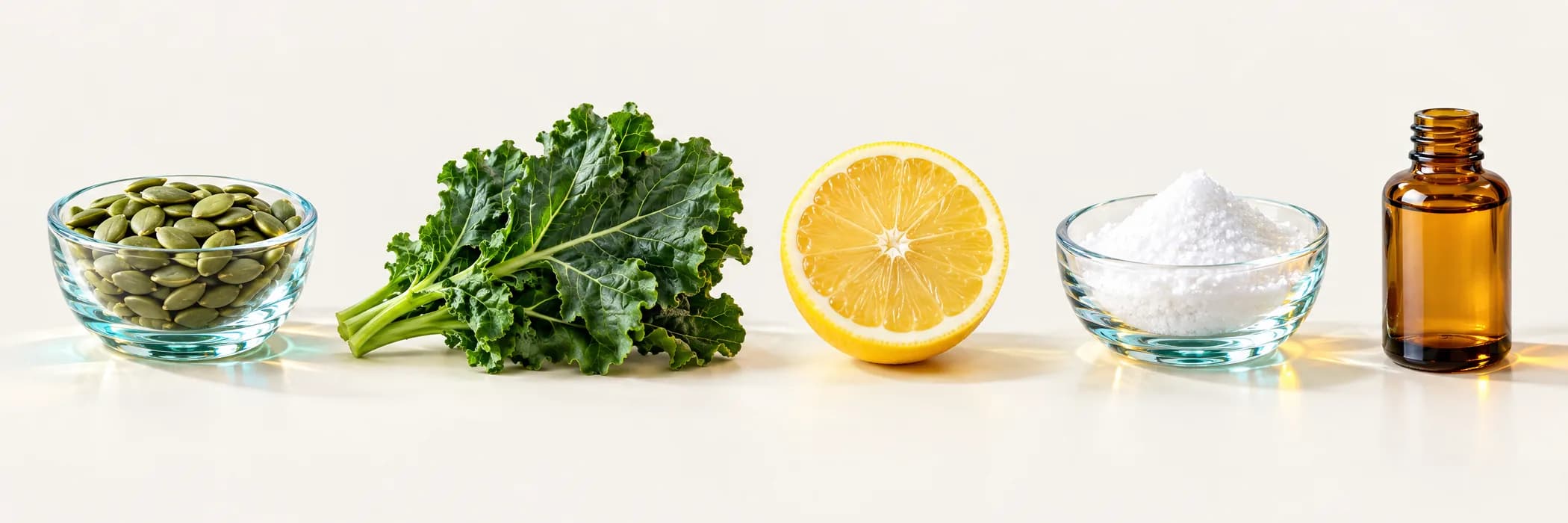
People pair Ventfort with the habits and nutrients blood vessels run on.
Habits that protect blood vesselsThe habits with the strongest vascular evidence.
- Exercise:
- Aerobic exercise improves the vessel lining and cuts arterial stiffness and resting blood pressure. 150 minutes per week of moderate-intensity cardio is the minimum.
- Blood pressure control:
- High blood pressure is the main driver of vessel-wall damage. Keep it healthy through diet, exercise, weight, or medication if needed.
- Not smoking:
- Smoking damages the vessel lining and speeds arterial stiffening. Quitting is the biggest single step.
Feed the nitric-oxide pathwayNitric oxide (NO) relaxes vessel walls. These supply its raw material.
- L-citrulline:
- 3–6 g daily, in the morning, independent of meals. It survives the gut better than L-arginine, and the kidneys turn it into arginine.
- Dietary nitrate:
- High-nitrate vegetables (beetroot, arugula, spinach, celery) daily, or a glass of beetroot juice. Gut bacteria turn nitrate into NO.
- Why these:
- NO sets vascular tone, the same biology Ventfort is aimed at.
Build and protect the vessel wallNutrients for vessel-wall collagen and healthy homocysteine.
- Vitamin C:
- 500–1,000 mg daily with meals, easier on the stomach at higher doses. Needed for stable vessel-wall collagen.
- Omega-3 (EPA and DHA, the two fish-oil fats):
- 2–3 g combined EPA/DHA daily from fish or algae oil, with a fatty meal. Lowers triglycerides and inflammatory tone, improves vessel-lining function.
- Folate + B6 + B12:
- A multivitamin or B-complex at RDA–2× RDA (recommended daily allowance). They recycle homocysteine, a marker of vascular risk.
Dose calculator
Reconstitution calculator
Calculated for a 1 mL U-100 insulin syringe (100 units/mL).
Units per dose
20 units
Draw this many units on a U-100 syringe
Each unit holds 50 mcg
- Volume per dose
- 0.2 mL
- Doses per vial
- 10
- Concentration
- 5 mg/mL
One vial lasts
- Daily
- 10 days
- Every other day
- 20 days
- 5×/week
- 14 days
Research use only. Not for human consumption. Outputs are reference values based on research literature. Verify all measurements independently.
Side effects and what to watch
What people notice. No side effects have been reported for Ventfort. No study has tracked its side effects, common or long-term.
Worth knowing. It is an extract from calf tissue, so batches can vary.
Skip it or take care if. You are under care for a heart or blood-vessel condition. Never use Ventfort in place of that care.
Common questions
What is Ventfort?
A Russian Cytomax supplement from the Khavinson bioregulator family, used for blood-vessel health. It is a peptide complex extracted from calf vascular tissue, designated A-3, rather than one defined molecule.
Is Ventfort the same as Vesugen?
No. Vesugen is a defined synthetic tripeptide (KED, Lys-Glu-Asp, PubChem CID (compound ID) 87571363). Ventfort is a tissue extract. A source that gives Ventfort a precise formula, sequence or CID is borrowing Vesugen's chemistry by mistake.
How is Ventfort dosed?
By mouth, about 20 mg/day (2 × 10 mg capsules), for a 30-day course repeated every 2–6 months. There is no injectable Ventfort product.
Do I need to cycle Ventfort?
Yes. The usual course is about 30 days on, then 2–6 months off, with at least a 4–8 week break. Khavinson bioregulators run in courses.
What does Ventfort stack with?
Vesugen, the other Khavinson vascular peptide, as a separate oral course. People also add other Khavinson bioregulators such as Epitalon, each at its own dose.
What is its chemical structure?
It is a mix of peptides from animal tissue, so it has no single sequence, formula, molecular weight or database ID.
Deep dive
Doses used in studies · Molecular identity · References
10From the researchDoses used in studies
No study has set a Ventfort dose, so people follow the capsule course in the cards above.
| Dose | Route | Model | Outcome | Sources: |
|---|---|---|---|---|
| None | No trial | No study exists under the name 'Ventfort' (verified PubMed count = 0) | There is no experimental or human dosing evidence for Ventfort. Vendor 'course' schedules (e.g. capsules daily for ~1 month, repeated periodically) are unverified marketing, not trial-derived doses | PubMed (verified count = 0 for 'Ventfort') |
11ChemistryMolecular identity
- Structure / class
- Natural peptide extract ('Cytomax A-3') from bovine vascular/aortic tissue; Khavinson-school bioregulatorVendor product literature (marketing)
- Sequence
- Not applicable (multi-peptide tissue extract, no ordered sequence)Vendor describes a peptide complex; no sequence asserted
- Molecular formula
- Not applicable (undefined extract)No single molecule (cannot be assigned a formula)
- Molecular weight
- Not a single species; vendor cites a mixture 'up to ~10,000 Da'Vendor claim about the peptide mixture (not a defined MW)
- CAS / UNII
- Unverified, not asserted (undefined extract)No CAS or UNII for an undefined tissue-extract mixture
- PubChem CID
- Unverified, not assertedPubChem search for 'Ventfort' returns no matching compound (count = 0). Do NOT borrow Vesugen's CID 87571363
- Molecular target
- No defined molecule and no classic receptor; vendor claims a vascular 'bioregulator' effect (no Ventfort-specific evidence)Vendor marketing (not independently established)
- Half-life
- Not established (undefined mixture; no pharmacokinetics)Not established
- Not to be confused with
- Vesugen (synthetic tripeptide KED / Lys-Glu-Asp, CID 87571363), a DIFFERENT, defined productIdentity disambiguation
- Regulatory status
- Sold as a dietary supplement; not approved as a medicine by any major regulator; no controlled human trials locatedNo NDA/BLA/EMA record located
12Primary sourcesReferences
- PubMed (verified count = 0 for 'Ventfort')PubMed. A search for the exact name 'Ventfort' returns zero records (E-utilities esearch, empty result). There is no PMID-backed study of Ventfort; this entry documents that verified absence of evidence
- PubChem (no compound for 'Ventfort')PubChem. A search for 'Ventfort' returns no matching compound (count = 0); Ventfort is an undefined tissue extract with no single-molecule record. Do NOT confuse with Vesugen (CID 87571363)
Reviewed by Ki Researcher Team · Research use only · Not medical advice · Updated 2026-09-24