
N-Acetyl Selank Amidate
Longer-acting Selank analog · acetyl and amide caps · intranasal
N-Acetyl Selank Amidate is the Russian anti-anxiety peptide Selank with two caps, an acetyl and an amide, that slow the enzymes which break Selank down. It is built to last longer and be dosed less often. People run it for calm focus without drowsiness.
Buy NA-Selank Amidate10 mg or 30 mg vial
Ki Researcher is affiliated with Ki Peptides.
Ships to the US only. Buyers must be 21 or older.
At a glance
- Dose
- 300–500 mcg/day by nose (250 mcg first run), or 250–500 mcg injected
- How often
- Once a day, or split morning and early afternoon 4–6 hours apart
- How
- Nasal drops or spray, or a small injection under the skin
- When
- Daytime, or a single dose before a demanding moment
- Cycle
- 2–4 weeks on, then 1–2 weeks off
The 30-second versionEverything on this page, fast
Calm focus · Anti-anxiety · Longer-acting Selank · Non-sedating
Selank, built to last longer. Two caps slow its breakdown, so its calm focus without drowsiness, which matched a benzodiazepine's anxiety relief in Selank's human trial, comes from fewer doses.
The basics
- Selank with an acetyl cap and an amide cap, built to last longer in the body.
- The same calm, non-drowsy, anti-anxiety profile as Selank, in a longer-acting form.
Why people use it
- Calm without the dull. In Selank's human trial it matched a benzodiazepine's relief while staying non-sedating.
- Longer calm, fewer doses. The caps slow the enzymes that break Selank down, so fewer daily doses cover the window.
- A quieter, less racing mind. Selank slows the breakdown of the body's own calming peptides, the enkephalins.
- The calm half of a stack. The base under a focus peptide like NA-Semax-Amidate, steadying the drive without dulling it.
Stacks well with
- NA-Semax-Amidate is the pair. This supplies the calm, NA-Semax the focus and drive.
- Semax gives the same calm-plus-drive logic with the more studied partner on the focus side.
Good to know
- Also run situationally, as a single daytime dose before a presentation or exam.
- Well tolerated, like Selank. Nasal use can irritate briefly, and a mild headache or dizziness is the usual extent of it.
What it does
The longer-acting take on Selank, the calm end of the Russian nootropic tradition.
- Calm focus without drowsinessIn Selank's human trial it matched a benzodiazepine's anxiety relief while staying non-sedating.
- Longer-lasting calm, fewer dosesTwo caps slow the enzymes that break Selank down, so fewer daily doses cover the window.
- Takes the edge off a demanding momentPeople run a single daytime dose before a presentation or exam, because the calm comes without sedation.
- Eases an anxious, racing mindSelank slows enkephalin breakdown and shifts GABA (gamma-aminobutyric acid) system genes without directly binding the GABA-A receptor.
- The calm partner to a focus peptidePairs with NA-Semax-Amidate or Semax. This supplies the calm, Semax the drive.
Sources:PMID 18454096PMID 26356395PMID 31625062PMID 26924987
How it works
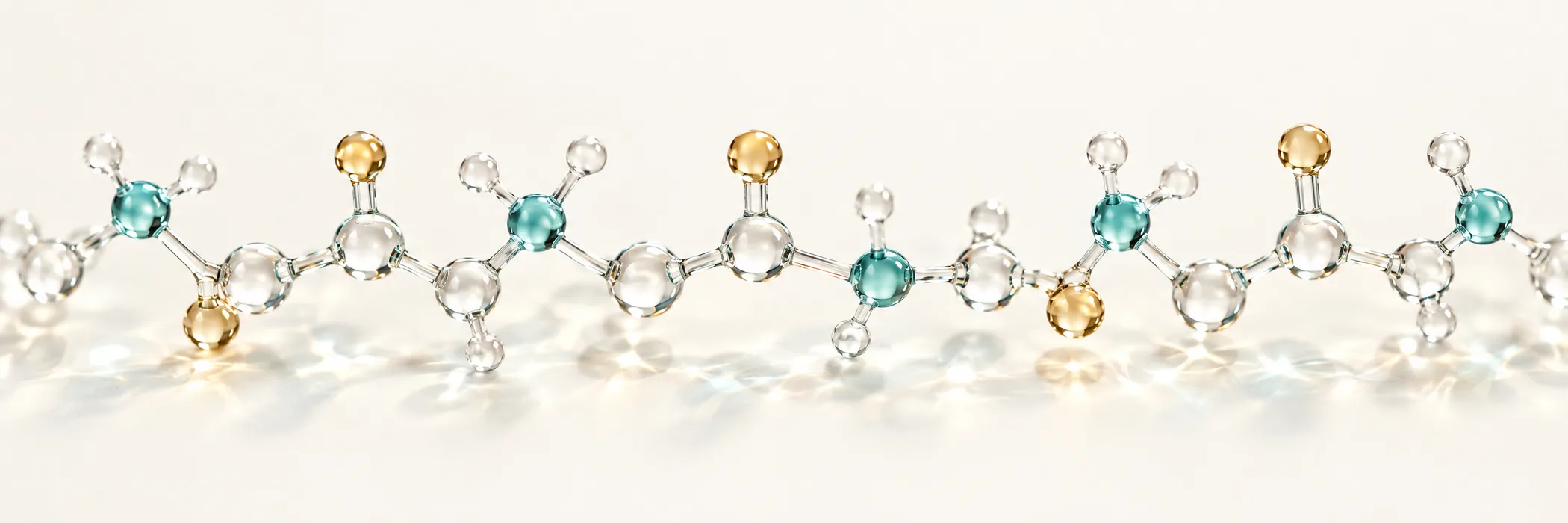

Protects the body's own calming peptides. Selank slows the enzymes that break down enkephalins, the body's opioid-like calming peptides. The human anxiety trial tracked a leu-enkephalin marker's half-life in serum as a readout.
Calms the GABA system without sedating. Dosing changed roughly 22 GABA signaling genes within hours, a benzodiazepine-like profile without direct GABA-A receptor binding. That is partly why Selank is described as non-sedating and non-dependence-forming.
Feeds a brain growth factor. Selank raises BDNF (brain-derived neurotrophic factor) in animal brain tissue and shifts serotonin, dopamine and norepinephrine metabolism by region.
What the caps change. The amidate keeps Selank's tuftsin backbone, so it works the same way; the acetyl and amide caps slow its breakdown.
How to dose it
Most people run it as nasal drops or a spray, Selank's Russian clinical route. Injection under the skin is the second option.
Dose tiersMost people run 300–500 mcg a day by nose, or 250–500 mcg injected.
- Nasal, first use:
- 250 mcg/day (1–2 drops or sprays per nostril, once daily) to read your sensitivity.
- Nasal, standard:
- 300–500 mcg/day, often split morning and early afternoon across both nostrils.
- Injected:
- 250–500 mcg once daily, measured in units on a U-100 insulin syringe. Steadier than drops, no nose-to-brain route.
How to spray or inject itNasal is the main route. Injection is the alternative.
- Nasal:
- Tilt the head back slightly, drops or one spray per nostril, hold 20–30 seconds so it reaches high in the nose. Split between nostrils, 250 mcg/nostril for 500 mcg.
- Injection site:
- Belly a few centimetres from the navel, outer thigh or love handle. Rotate sites to avoid irritation and lumps.
- Measuring:
- From a 10 mg vial in 2 mL bacteriostatic water, 250 mcg takes 5 units and 500 mcg takes 10 units on a U-100 syringe. The calculator handles any vial.
- Time of day:
- Daytime for either route, keeping the calm in waking hours, not sleep. Split nasal doses go 4–6 hours apart.
- Food:
- Meals don't matter for either route.
Cycle and breaksMost people run 2–4 weeks on, then 1–2 weeks off.
- Cycle:
- 2–4 weeks of daily use, then a break. The trials ran about 2–3 weeks; most extend to 4 weeks.
- Washout:
- 1–2 weeks off between cycles, the same break as plain Selank.
- On demand:
- A single morning dose before a presentation, exam or social event, instead of a fixed course.
Mixing the vialThe default mix and its syringe units.
- Mixing:
- 10 mg vial + 2 mL bacteriostatic water = 5,000 mcg/mL. U-100 syringe: 250 mcg takes 5 units, 300 mcg 6 units, 400 mcg 8 units, 500 mcg 10 units.
- Nasal solution:
- For drops, the mixed vial goes into a sterile nasal dropper bottle; for a spray, a nasal atomiser. 0.05–0.1 mL per nostril per administration is typical.
Sources:PMID 18454096PMID 26356395
Best time to take it

Implied best time
Daytime
Most people take N-Acetyl Selank Amidate during the day, for calm focus through the waking hours.
- It is non-sedating, so it suits daytime composure rather than sleep. Anyone sensitive to its mild activation keeps it clear of late evening.
- Reported to act fast and not sedate, so a single dose before a stressful moment is common, alongside or instead of a daily schedule.
- The longer-acting chemistry means one morning dose is expected to cover much of the day; a split goes morning and early afternoon.
Sources:PMID 18454096PMID 26356395
What to stack it with


The calm half. Partners add focus and drive. Plain Selank is the parent, not a partner; two Selank forms are redundant.
NA-Selank-Amidate + NA-Semax-AmidateThe amidate pair. Calm from this, drive from NA-Semax, both longer-acting.
- Why it works:
- NA-Semax-Amidate brings focus and drive. NA-Selank-Amidate keeps that drive from tipping into stress or jitters. Two different levers.
- By nose:
- NA-Selank-Amidate 300–500 mcg by nose in the morning, NA-Semax-Amidate 100–300 mcg by nose alongside or 30–60 minutes later, split across nostrils or in sequence. The most reported pairing.
- Injected:
- NA-Selank-Amidate 300–500 mcg + NA-Semax-Amidate 100–300 mcg under the skin, together or at separate sites, once in the morning. Rotate sites across the week.
- Outcome:
- The pair people run for calm focus and low-anxiety productivity. Semax's edge softened by Selank's calm, any drowsiness offset by Semax's wakefulness.
NA-Selank-Amidate + SemaxThe same calm plus drive with plain Semax, the more studied partner.
- Why it works:
- Plain Semax is the most studied version of the focus signal, with research in cognition and neuroprotection. A different lever in every respect.
- By nose:
- NA-Selank-Amidate 300–500 mcg + Semax 200–600 mcg, both by nose in the morning. Semax nasal doses run 200–600 mcg/day; people start at the low end when combining.
- Injected:
- NA-Selank-Amidate 300–500 mcg + Semax 200–400 mcg under the skin, once daily in the morning, sites rotated across the week.
- Outcome:
- The same calm-focus goal with more research depth on the Semax side. Semax or NA-Semax-Amidate is mostly a stability and half-life preference.
Support nutrients
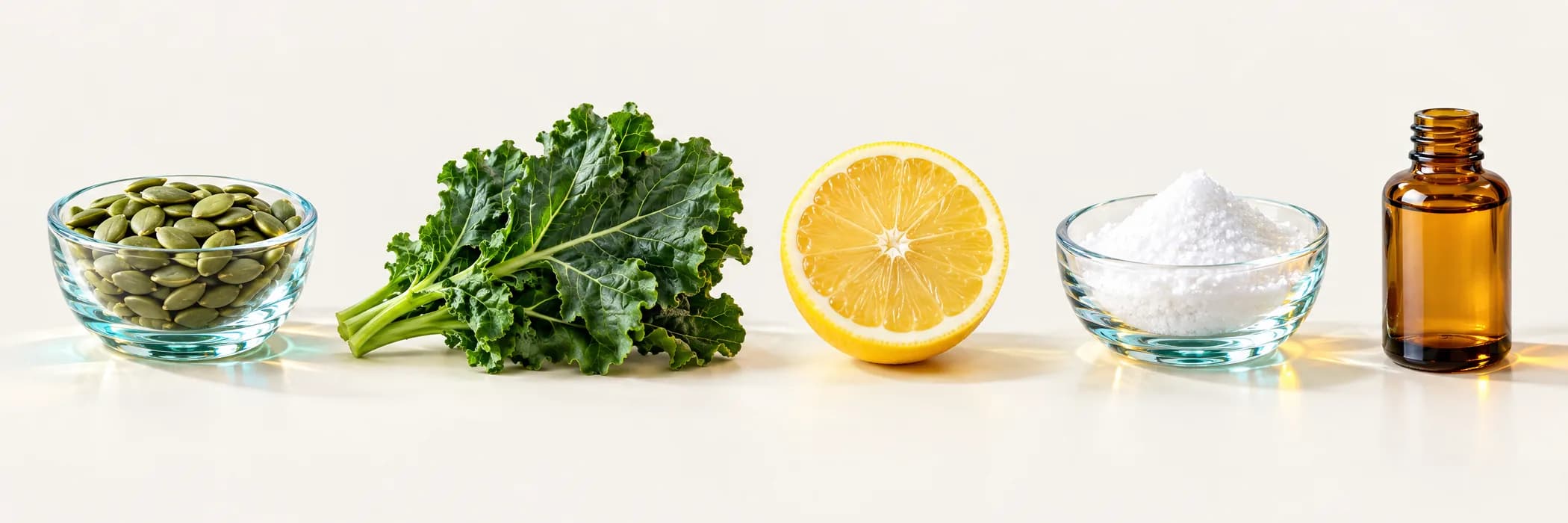

Selank works through serotonin, GABA and BDNF. These feed the same pathways.
Serotonin building blocksSelank's calm runs partly through serotonin. These supply the raw material.
- L-tryptophan:
- 500–1,000 mg in the evening, the amino acid serotonin is made from, timed to the natural serotonin-to-melatonin window.
- 5-HTP (alternative):
- 100–200 mg in the evening, one step closer to serotonin. One or the other, not both.
- Vitamin B6 (P5P form):
- 25–50 mg with meals, the cofactor for making serotonin from tryptophan and for making GABA. P5P (pyridoxal-5-phosphate) is the active form.
- Why:
- Selank shifts serotonin and enkephalin metabolism; feeding the pathway keeps that signal supplied.
Boost the calming signalSelank shifts ~22 GABA-system genes. These push the same calm from the nutrition side.
- Magnesium glycinate:
- 300–400 mg in the evening. Magnesium damps excitatory glutamate signaling and is a common shortfall; glycinate is well tolerated.
- L-theanine:
- 100–200 mg with the morning dose, nasal or injected. The green-tea amino acid for alpha-wave calm without sedation or dulling.
- Why:
- Magnesium and theanine push the same calm-versus-excitation balance Selank shifts, three levers in one direction.
Exercise and sleep for BDNFSelank raises BDNF in rodent brain. The most reliable human BDNF inputs are lifestyle.
- Aerobic exercise:
- 30+ minutes of moderate cardio most days, the best-documented everyday BDNF stimulus in humans. Timing around dosing is flexible.
- Sleep quality:
- 7–9 hours. BDNF consolidation happens in slow-wave sleep, which fits the better-sleep reports from Selank users.
- Why:
- No supplement replaces exercise or sleep for BDNF.
Dose calculator
Reconstitution calculator
Calculated for a 1 mL U-100 insulin syringe (100 units/mL).
Units per dose
6 units
Draw this many units on a U-100 syringe
Each unit holds 50 mcg
- Volume per dose
- 0.06 mL
- Doses per vial
- 33
- Concentration
- 5 mg/mL
One vial lasts
- Daily
- 33 days
- Every other day
- 66 days
- 5×/week
- 46 days
Research use only. Not for human consumption. Outputs are reference values based on research literature. Verify all measurements independently.
Side effects and what to watch
What people notice. Very little. Selank is well tolerated in Russian clinical use. The usual effects are brief nasal irritation and the occasional headache or dizziness. No dependence or withdrawal has been reported, its key advantage over benzodiazepines.
Worth knowing. In one trial, adding Selank to a benzodiazepine reduced the benzodiazepine's side effects. The safety picture comes from short Russian studies of about a month or less; long-term and high-dose data on the amidate do not exist.
Sources:PMID 26356395PMID 18454096
Common questions
How is it different from regular Selank?
It is Selank with an acetyl cap at one end and an amide at the other, added to slow the enzymes that break it down, so it lasts longer. The backbone and the calming profile are the same as Selank's.
How is it dosed?
Most people run 300–500 mcg a day by nose, starting at 250 mcg, once a day or split morning and early afternoon. Injected, the range is 250–500 mcg once daily.
Do I need to cycle it?
Most people do. A typical run is 2–4 weeks of daily use, then 1–2 weeks off. Some skip the course and take a single morning dose before a big moment.
Is it addictive or sedating?
Selank is reported to be non-sedating and not to cause dependence or withdrawal, its main advantage over benzodiazepines. It shifts GABA-system genes without directly binding the GABA-A receptor.
What does it stack with?
NA-Semax-Amidate, for the classic calm-plus-drive pair, 300–500 mcg of this with 100–300 mcg of NA-Semax by nose in the morning. Plain Semax works the same way at 200–600 mcg.
Deep dive
Doses used in studies · Molecular identity · References
10From the researchDoses used in studies
These are the doses used in the Selank studies. The human trials were nasal; the animal studies injected at the doses noted.
| Dose | Route | Model | Outcome | Sources: |
|---|---|---|---|---|
| Course over ~2–3 weeks | Intranasal | Human RCT, generalized anxiety / neurasthenia, plain Selank (n=62 vs medazepam) | Anxiolysis similar to the benzodiazepine medazepam, plus an additional anti-asthenic / mild stimulant effect; small Russian-language trial | PMID 18454096 |
| Add-on course | Intranasal | Human RCT, anxiety disorders, Selank added to phenazepam (n=70) | Faster onset and fewer benzodiazepine side-effects (less sedation/memory impairment) when Selank was added; small Russian trial | PMID 26356395 |
| 0.3 mg/kg ×7d | IP (rat) | Rats, ethanol-induced memory impairment, plain Selank | Prevented the memory deficit and normalized hippocampal/cortical BDNF (ANIMAL data) | PMID 31625062 |
| 0.3 mg/kg | IP (rat) | Rats, naloxone-precipitated morphine withdrawal, plain Selank | Withdrawal index reduced ~39.6% (vs ~49.3% for diazepam); attenuated convulsions and ptosis (ANIMAL data) | PMID 36322304 |
| Selank-style regimen (vendor) | Intranasal | N-Acetyl Selank Amidate, research-chemical practice | Vendor protocols reuse Selank dosing; NO amidate-specific study exists, and the 'longer-acting' rationale is unverified by data | PMID 18661785 |
11ChemistryMolecular identity
- Molecular weight
- ≈792.9 g/mol (calculated for Ac-TKPRPGP-NH₂; plain Selank's 751.9 g/mol does NOT apply)Calculated from acetyl-only CID 133082488 + C-amidation (not registry-verified)
- Molecular formula
- C₃₅H₆₀N₁₂O₉ (calculated; acetyl + C-amide on Selank C₃₃H₅₇N₁₁O₉; do NOT use plain Selank's formula)Calculated from acetyl-only CID 133082488 (C₃₅H₅₉N₁₁O₁₀) + amidation; no name-matched PubChem CID
- Monoisotopic mass
- ≈792.46 Da (calculated, not registry-verified)Calculated from acetyl-only CID 133082488 + C-amidation
- Sequence (backbone)
- Ac-Thr-Lys-Pro-Arg-Pro-Gly-Pro-NH₂ (acetyl + amide caps on Selank TKPRPGP), 7 AASelank backbone verified (PMID 18661785); caps are the variant claim
- Structure / class
- N-acetylated, C-amidated analog of Selank (tuftsin-derived heptapeptide); end-capped for enzymatic stabilityPlain Selank literature (modification is the vendor rationale)
- Base peptide
- Selank (Thr-Lys-Pro-Arg-Pro-Gly-Pro), tuftsin (TKPR) + Pro-Gly-ProPMID 18661785 (sequence inline); PubChem CID 11765600 (plain Selank)
- PubChem CID
- None verified for the full amidate; CID 133082488 is the acetyl-ONLY form (C₃₅H₅₉N₁₁O₁₀, MW 793.9), not C-amidatedPubChem (acetyl-only + salt entries exist; amidate not name-matched)
- CAS / UNII
- Unverified. No confirmed CAS or UNII for the amidate (vendor-listed CAS numbers are plain Selank's)No cross-confirmed registry entry for the amidate
- Water solubility
- Water-soluble; highly hydrophilic (parent Selank computed XLogP −6.1)PubChem CID 11765600 (parent, computed)
- Molecular target
- Assumed identical to Selank. Enkephalinase inhibition (human serum) + rodent BDNF/GABAergic-gene effects; no amidate-specific target study existsPMID 11443939 (plain Selank, human serum); borrowed, not amidate-verified
- Half-life
- Not established. No published pharmacokinetics for the amidate; the 'longer-acting' claim is a chemistry rationale (end-capping), not a measured valueNot established
- Regulatory status
- Research chemical, approved nowhere (plain Selank: Russia-only)Regulatory absence (no FDA/EMA approval)
12Primary sourcesReferences
- PMID 18454096Zozulia et al., Zh Nevrol Psikhiatr 2008. Peptide anxiolytic Selank in generalized anxiety / neurasthenia (human, n=62 vs medazepam). PLAIN SELANK
- PMID 26356395Medvedev et al., Zh Nevrol Psikhiatr 2015. Selank add-on to phenazepam for anxiety disorders (human, n=70). PLAIN SELANK
- PMID 31625062Kolik et al., Bull Exp Biol Med 2019. Selank protects against ethanol-induced memory impairment via BDNF (rats). PLAIN SELANK
- PMID 36322304Konstantinopolsky et al., Bull Exp Biol Med 2022. Selank attenuates morphine-withdrawal signs (rats). PLAIN SELANK
- PMID 18661785Sarkisova et al., Zh Vyssh Nerv Deiat 2008. Selank effects on depression-like behavior (rats/mice); confirms sequence Thr-Lys-Pro-Arg-Pro-Gly-Pro. PLAIN SELANK
- PMID 26924987Volkova et al., 2016 (PMC4757669). Selank alters expression of GABAergic-neurotransmission genes (benzo-like profile, no direct GABA-A binding). PLAIN SELANK
- PubChem CID 11765600PubChem Compound. Selank, CID 11765600 (C33H57N11O9, MW 751.9; PLAIN SELANK only; these numbers do NOT apply to the amidate)
- WADA 2026WADA 2026 Prohibited List, S0 (non-approved substances); Selank/amidate not named (status by inference)
NA-Selank Amidate
10 mg or 30 mg vial
Ki Researcher is affiliated with Ki Peptides.
Ships to the US only. Buyers must be 21 or older.
Reviewed by Ki Researcher Team · Research use only · Not medical advice · Updated 2026-09-24