
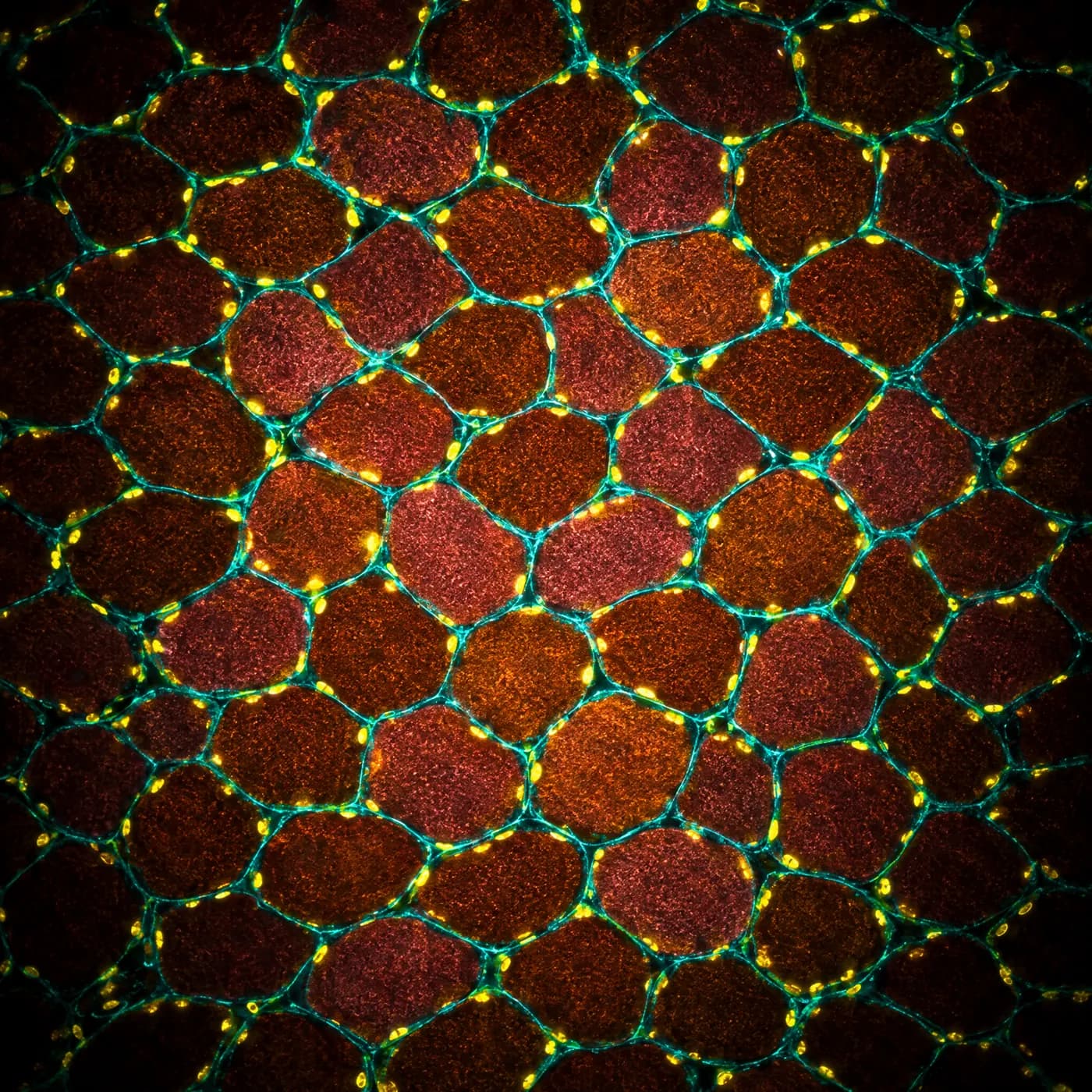
MGF
Mechano-Growth Factor · 24-AA IGF-1 Ec splice-variant E-domain peptide
MGF (Mechano-Growth Factor) is a 24-amino-acid peptide, the tail of an IGF-1 (insulin-like growth factor 1) variant muscle makes after hard loading. People run it for local muscle repair, injected into the muscle they just trained, as the stem-cell wake-up signal Goldspink's group proposed.
At a glance
- Dose
- 100–400 mcg per session (200–300 mcg is the common range)
- How often
- 2–4 times a week, training days only
- How
- An injection into the muscle you just trained
- When
- Within 30–60 minutes after training
- Cycle
- 4–6 weeks per block, then 2–4 weeks off
The 30-second versionEverything on this page, fast
Local muscle repair · Post-workout · IGF-1 variant · Satellite-cell signal
The local, post-workout repair signal. MGF is the short tail of an IGF-1 variant your body makes after hard loading. People inject it straight into the muscle they just trained as the satellite-cell wake-up signal Goldspink's group proposed, to start repair right there.
The basics
- Mechano-Growth Factor, a 24-amino-acid piece of an IGF-1 splice variant the body makes after muscle damage.
- A site-targeted repair pulse, run on training days into the muscle just worked.
Why people use it
- Wakes the muscle's stem cells. Goldspink's group proposed MGF activates satellite cells in the damaged spot, starting repair before mainstream IGF-1 takes over.
- Timed to the damage window. The natural variant shows up right after hard training, so people inject it post-workout to mimic that pulse.
- Site-targeted, not systemic. It is reported to be very short-lived, so it goes into or near the worked muscle for a brief local effect.
- Primes an IGF stack. Run ahead of IGF-1 DES or IGF-1 LR3. In Goldspink's model, MGF drives the proliferation step and the IGF variant finishes the repair in the same window.
Stacks well with
- IGF-1 DES follows MGF. In Goldspink's model, MGF drives the proliferation step and IGF-1 DES finishes the repair at the same site.
- PEG-MGF is the longer-acting sibling, not a stack partner. Both hit the same signal, so pick one.
Good to know
- Short window. It is reported to degrade fast, so keep the post-workout timing tight.
- Stacked with an IGF variant (DES or LR3), watch for blood-sugar dips. Keep simple carbs on hand and don't inject fasted.
- Banned in tested sport (WADA), which matters if you compete.
What it does

The local repair peptide, run into the muscle you just trained.
- A jump-start signal for muscle repairIn rats the natural variant's mRNA peaked 1 day after injury, then fell as mainstream IGF-1 climbed to day 7.
- Timed to the post-workout damage window2.5 h after 10 hard single-leg sets, the variant's mRNA was up in young men, flat in men over 70.
- Closed a bone gap in rabbitsAt its top dose the E-peptide bridged 4 of 9 gaps cut in the rabbit radius by week 8.
- Primes an IGF stackIn mouse myoblasts the E domain raised proliferation and held off differentiation, while mature IGF-1 drove that step instead.
Sources:PMID 12692175PMID 12562960PMID 21057789PMID 12095637PMID 20130113
How it works
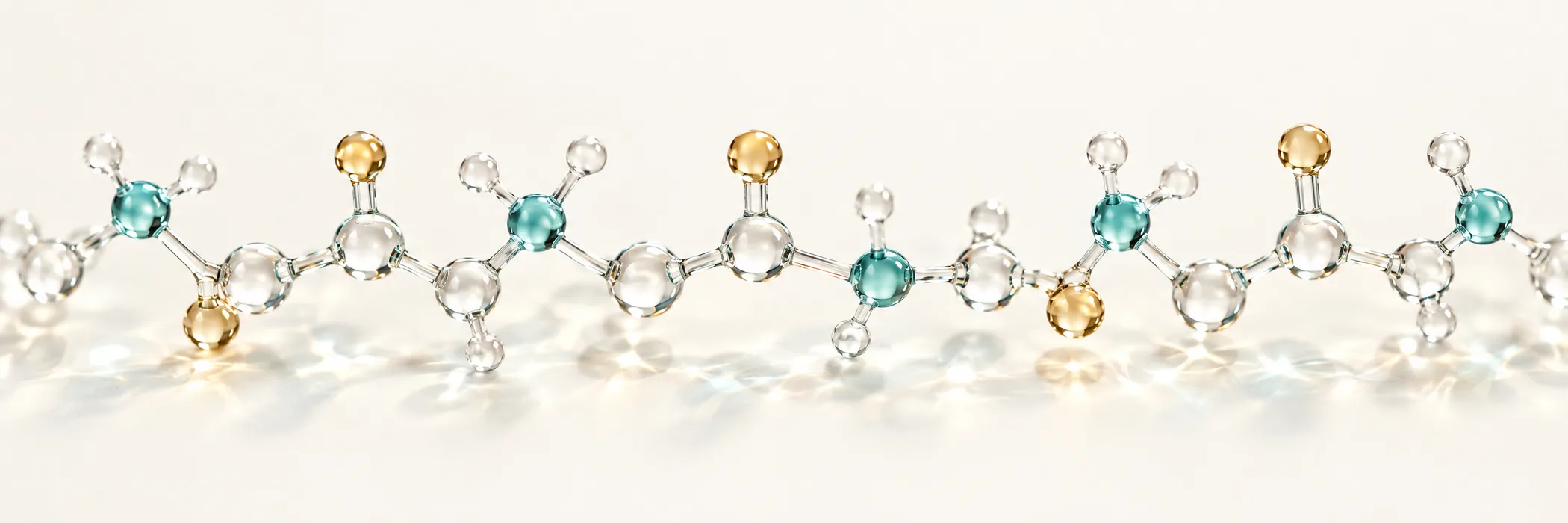

A variant made after hard training. The IGF-1 gene can be read ("spliced") in more than one way. After mechanical overload, meaning hard or damaging exercise, muscle briefly favors a variant called IGF-1Ec in humans. Its extra tail is the "E-domain", and MGF is that tail.
An early repair signal. Geoffrey Goldspink's group proposed the E-domain works on its own as an early signal. In their model it activates satellite cells (muscle stem cells) and protects muscle fibers, starting repair before the slower, mainstream IGF-1 takes over.
Its own lane. MGF was proposed to act through a separate, still-unidentified receptor, not the normal IGF-1 receptor. That is why people treat it as its own tool rather than more IGF-1.
Sources:PMID 16244184PMID 20130113
How to dose it
Most people inject MGF into the muscle they just trained, right after the workout.
Dose tiersMost people run 200 to 300 mcg per session, scaled to training intensity.
- Low / introductory:
- 100–200 mcg per session. A first run or lighter training days, with minimal whole-body load.
- Standard:
- 200–300 mcg per session. The most common range, after moderate-to-hard resistance training.
- High / heavy training:
- 300–400 mcg per session. The heaviest blocks of high-volume eccentric or damaging work. Not used daily.
How to injectStraight into the muscle you just trained, right after the workout.
- Injection site:
- The worked muscle, within 30–60 minutes post-workout. Outer quad after legs, side delt after shoulders. Rotate nearby sites. It takes a longer needle than an insulin pin.
- Measuring the dose:
- Measured in units on a 100-unit (1 mL) syringe. Marks are under Mixing the vial; the on-page calculator covers any vial.
- Timing:
- After the workout, once the damage is done. Before training there is nothing to amplify. It is reported to break down very fast, so the window stays tight.
- Food window:
- Food timing doesn't matter. Stacking an IGF variant that day? Plan the post-workout meal around blood sugar.
Cycle and breaksShort training-tied blocks, 4–6 weeks on and 2–4 weeks off.
- Frequency per week:
- 2–4 times per week, on training days that work the target muscle. Not on rest days.
- Cycle duration:
- 4–6 weeks per block, usually through the peak of a strength or hypertrophy cycle.
- Washout:
- 2–4 weeks off between blocks, a conservative break so the IGF-1 system can reset.
- Stack caution:
- With IGF-1 LR3 or IGF-1 DES on the same days, watch for hypoglycemia (low blood sugar), especially fasted.
Mixing the vialA 2 mg vial with 2 mL of bacteriostatic water makes 1,000 mcg per mL.
- Mixing:
- At 2 mg + 2 mL, 100 mcg takes 10 units, 200 mcg takes 20 units, 300 mcg takes 30 units, 400 mcg takes 40 units on a 100-unit syringe.
- Why 2 mL:
- Each unit holds 10 mcg, so a 100–400 mcg dose takes a 10–40 unit draw.
Best time to take it


Implied best time
Immediately post-workout (local)
Most people inject MGF into the worked muscle right after training, inside the damage window it is meant to amplify.
- The body makes the natural variant after mechanical damage. Dosing right after training mimics that pulse, so the workout sets the timing, not the clock.
- It is reported to break down very fast, so people inject within roughly 30–60 minutes post-workout, into or near the muscle just trained.
- Before training there is no damage signal yet, and rest days have none, so people dose only after the session on training days.
Sources:PMID 16244184PMID 20130113
What to stack it with


Pair MGF with a growth signal. A second mechano-growth peptide is redundant.
MGF + IGF-1 DESIn Goldspink's model, MGF drives proliferation, then IGF-1 DES finishes repair.
- Why it works:
- IGF-1 DES (des-1-3) binds the blood's IGF binding proteins poorly, so more reaches the receptor. Also very short-lived and site-injected.
- The protocol:
- MGF 200–300 mcg into the trained muscle post-workout, then IGF-1 DES 50–100 mcg 15–30 minutes later at the same or nearby site. Training days only.
- Outcome:
- People run it for hypertrophy (muscle growth) or recomposition in the trained muscle. Two IGF compounds a day raise hypoglycemia risk.
MGF + IGF-1 LR3A local repair pulse on a long-acting, whole-body growth signal.
- Why it works:
- IGF-1 LR3 is a long-acting IGF-1 analogue driving growth across muscle for hours. The idea: LR3 sets the growth signal, MGF aims it at the just-trained muscle.
- The protocol:
- MGF 200–400 mcg in the trained muscle post-workout, training days only. IGF-1 LR3 40–80 mcg under the skin (belly or quad) within 1–2 hours post-workout. LR3 runs daily or 5-on-2-off.
- Outcome:
- People run it in peak hypertrophy or strength cycles. LR3's long window stretches hypoglycemia risk; monitor glucose.
MGF or PEG-MGFPEG-MGF, the longer-acting sibling, carries the same signal. Pick one.
- The difference:
- PEG-MGF adds a polyethylene glycol (PEG) chain, so it lasts longer and acts more body-wide.
- Why not both:
- One already covers the signal. See the PEG-MGF page for its dosing.
- When MGF wins:
- Timed, site-specific, training-day protocols, where a short half-life helps.
Sources:PMID 7679979
Support nutrients

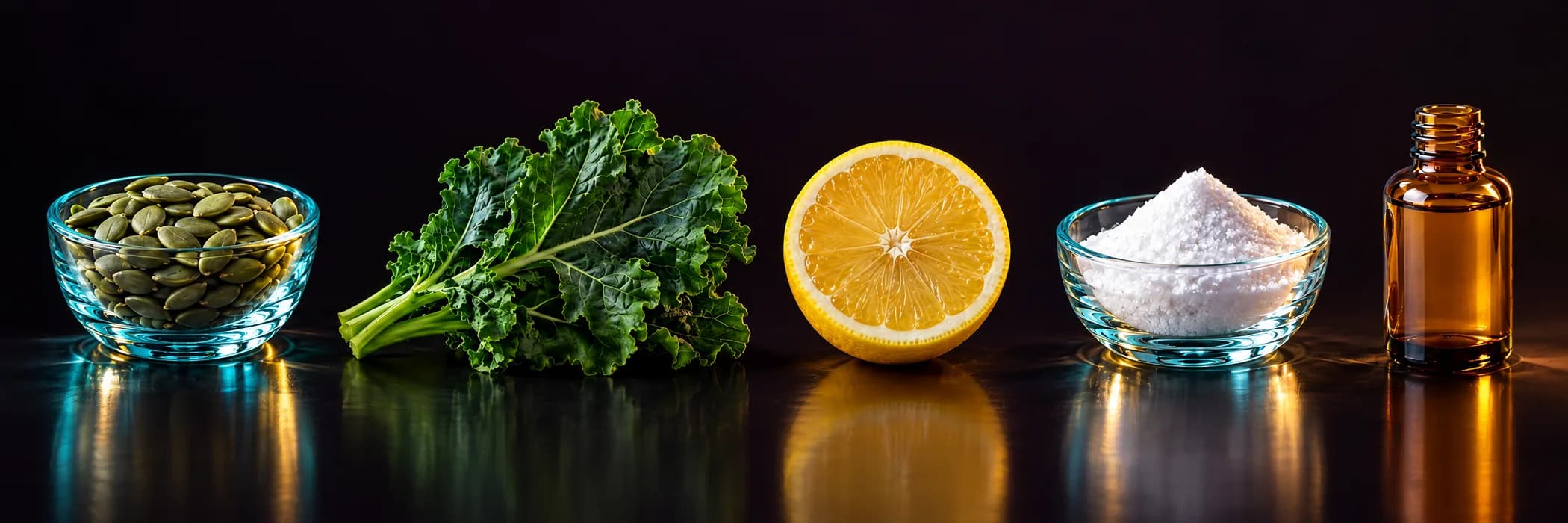
MGF needs hard training and protein to work with.
Hard training sets the signalHeavy resistance work, especially eccentric sets, creates the signal MGF amplifies.
- Why it matters:
- Natural MGF follows muscle damage. Heavy compound lifts, eccentric-focused sets or volume blocks supply that stimulus. Light cardio does little.
- When to inject:
- Into the worked muscle on hard days for that group, such as quads after heavy squats and Romanian deadlifts. Favor eccentric-heavy sessions.
Protein and leucine to build withThe repair signal needs amino acids. Protein and leucine supply them.
- Protein target:
- 1.8–2.2 g per kg of body weight per day (≈ 0.8–1.0 g per pound), toward the top end during MGF blocks, across 3–5 meals.
- Leucine timing:
- 2.5–3 g leucine after training, or a leucine-rich meal of roughly 40–50 g whey or animal protein, within 30–60 minutes. Leucine trips the mTOR switch for protein synthesis.
- Same window:
- The post-workout meal lands with the injection, so amino acids are ready when the signal fires.
Blood sugar in a stackIGF-1 DES and LR3 lower blood sugar. Manage it on stack days.
- The risk:
- Both can cause hypoglycemia, mostly when injected fasted or in a large calorie deficit. Two IGF compounds in one day raise the risk.
- How to handle it:
- Don't inject on an empty stomach. A post-workout meal with 40–60 g fast carbs (rice, fruit, sports drink) dampens the dip. Keep simple sugars on hand.
- MGF alone:
- A minor concern, since MGF's own effect is local and brief.
Dose calculator
Reconstitution calculator
Calculated for a 1 mL U-100 insulin syringe (100 units/mL).
Units per dose
25 units
Draw this many units on a U-100 syringe
Each unit holds 10 mcg
- Volume per dose
- 0.25 mL
- Doses per vial
- 8
- Concentration
- 1 mg/mL
One vial lasts
- Daily
- 8 days
- Every other day
- 16 days
- 5×/week
- 11 days
Research use only. Not for human consumption. Outputs are reference values based on research literature. Verify all measurements independently.
Side effects and what to watch
What people notice. Users mainly report injection-site reactions.
How people handle it. Rotating between nearby sites helps prevent local irritation. In an IGF stack, people don't inject on an empty stomach and keep simple sugars on hand.
Worth knowing. Like anything that promotes cell growth through the IGF-1 system, it carries a theoretical cancer-promotion concern. Long-term effects in people have not been studied.
Competing? It is banned in tested sport.
Sources:PMID 20130113
Common questions
What is MGF?
MGF (Mechano-Growth Factor) is the 24-amino-acid "E-domain" tail of IGF-1Ec, an IGF-1 gene variant muscle makes after mechanical overload. People inject it into the trained muscle as a local repair signal.
How does MGF work?
Goldspink's group proposed MGF is an early, local repair signal. In that model it wakes muscle stem cells (satellite cells) through its own receptor, starting repair before mainstream IGF-1 takes over.
How is MGF dosed?
The common range is 200–300 mcg per session, from 100 mcg on light days up to 400 mcg in heavy blocks. It goes into the worked muscle within 30–60 minutes of training, 2–4 times a week.
Do I need to cycle MGF?
Most people do. A block runs 4–6 weeks, then 2–4 weeks off.
What does MGF stack with?
IGF-1 DES is the usual partner. MGF 200–300 mcg goes in post-workout, then IGF-1 DES 50–100 mcg 15–30 minutes later at the same or a nearby site. IGF-1 LR3 is the whole-body option. Watch blood sugar with either.
What is the difference between MGF and PEG-MGF?
Same core peptide, different lifespan. Plain MGF is reported to break down fast, so it is a brief local pulse after training. PEG-MGF adds a polyethylene glycol (PEG) chain for a longer, more body-wide effect. Nearly all the studies used plain MGF.
Deep dive
Doses used in studies · Molecular identity · References
10From the researchDoses used in studies
These are the key papers on MGF: Goldspink's commentary that set out the repair model, a review, and an independent cell-culture study.
| Dose | Route | Model | Outcome | Sources: |
|---|---|---|---|---|
| n/a | n/a | Commentary / hypothesis piece, 2 pages (Goldspink group) | Sets out the satellite-cell activation theory, that MGF increases myoblast proliferation and blocks differentiation. This source is a commentary, not the myoblast experiment; cite the primary cell paper for the result itself | PMID 16244184 |
| In vitro | Cell-culture media | Myoblasts (independent replication) | Synthetic E-domain peptide showed NO unique biological activity | PMID 24253050 |
| n/a | n/a | Minireview (no primary animal data) | Reviews the claim of faster early repair vs IGF-1 from the originating group. A review, not the rat injection study the dose/route fields previously implied | PMID 20130113 |
11ChemistryMolecular identity
- Molecular weight
- 2,868.1 g/mol
- Molecular formula
- C121H199N41O40
- Monoisotopic mass
- 2,866.48 Da
- Sequence (24 AA)
- YQPPSTNKNTKSQRRKGSTFEERKPubChem CID 175675731
- Structure / class
- Synthetic C-terminal E-domain peptide of the IGF-1Ec splice variant (human mechano-growth factor)PMID 20130113
- CAS number
- No single reliable CAS registry numberNot established
- Physical form
- Lyophilized powder; a Cys-tagged 25-mer variant is sold separately for conjugationResearch literature
- Molecular target
- Proposed distinct (still-unidentified) receptor, NOT confirmed; unique activity not replicated independentlyPMID 24253050
- Half-life
- Not established (reported very short; no primary source)Not established
- Regulatory status
- Research reagent; not FDA-approved; prohibited in sport (WADA S2, growth factors; mechano growth factors named)WADA Prohibited List
12Primary sourcesReferences
- PMID 16244184Goldspink 2005 (MGF / mechano-growth-factor hypothesis)
- PMID 24253050Fornaro et al. 2014 (no unique activity for synthetic E-peptide)
- PMID 20130113Matheny et al. 2010 (MGF / IGF-1 E-domain review)
- PubChem CID 175675731PubChem CID 175675731 (MGF 24-AA peptide)
- WADA S2WADA Prohibited List S2
- PMID 12692175Hill & Goldspink 2003 (IGF-1 splice variants and satellite-cell activation after rat muscle damage)
- PMID 12562960Hameed et al. 2003 (IGF-1 splice variants after resistance exercise in young and old men)
- PMID 21057789Deng et al. 2011 (MGF E peptide and rabbit bone-defect healing)
- PMID 12095637Yang & Goldspink 2002 (E domain vs mature IGF-1 in myoblasts)
- PMID 7679979Oh et al. 1993 (IGF binding protein affinities for IGF-1 analogs, including des-1-3)
Reviewed by Ki Researcher Team · Research use only · Not medical advice · Updated 2026-10-19