
PEG-MGF
PEGylated Mechano-Growth Factor · long-acting conjugate of the MGF E-domain peptide
PEG-MGF is MGF (Mechano-Growth Factor) with a polyethylene-glycol (PEG) chain so it lasts longer in the body. The PEG shield slows the enzymes and kidneys that clear plain MGF within minutes. People run it as a whole-body muscle-repair signal, injected 2–3 times a week.
At a glance
- Dose
- 200–400 mcg per dose (200 mcg to start)
- How often
- 2–3 times a week
- How
- A small injection under the skin, rotating sites
- When
- After training on training days; the long action makes the hour flexible
- Cycle
- 4–6 weeks on, then at least 4 weeks off
The 30-second versionEverything on this page, fast
Long-acting MGF · Muscle repair · Systemic coverage · Fewer injections
MGF with a PEG shield bolted on so it lasts far longer in the body. Plain MGF fires and fades in minutes. PEG-MGF turns that brief local pulse into a longer-acting, whole-body muscle-repair signal you inject a couple of times a week.
The basics
- A PEG-shielded version of MGF, an IGF-1 (insulin-like growth factor 1) splice-variant peptide, built to survive much longer than plain MGF.
- The set-and-forget, systemic take on MGF, with fewer shots and body-wide reach instead of one injection site.
Why people use it
- Lasts far longer than plain MGF. The PEG chain shields it from the enzymes and kidneys that clear MGF within minutes.
- Works body-wide. Sustained systemic coverage instead of a single pulse at the injection spot.
- Fewer injections. About 2–3 a week instead of one around every workout.
- Forgiving on timing. With the long action, a dose a few hours off doesn't blow the window the way short-acting MGF would.
Stacks well with
- Plain MGF is the short-acting sibling, not a stack partner. Both carry the same signal, so pick one. MGF gives a short local pulse after training, PEG-MGF a steady whole-body signal.
- IGF-1 LR3 supplies the downstream IGF proliferation signal that satellite-cell activation hands off to.
Good to know
- Repeated PEG dosing can build anti-PEG antibodies over time, so keep cycles bounded and breaks real.
- It works body-wide rather than targeting one muscle, the trade-off against plain MGF's local pulse.
- Banned in tested sport (WADA) as a growth factor, which matters if you compete.
What it does

People run PEG-MGF as the longer-acting, whole-body version of MGF, with fewer injections.
- Keeps MGF's repair signal going longerThe PEG chain shields it from the enzymes and kidneys that clear plain MGF within minutes.
- Fewer injections, whole-body coverageDosed about twice a week and meant to act throughout the body, not at one injection site.
- Less tied to training timeSustained exposure relaxes plain MGF's inject-right-after-training demand. Weekly training volume does the work, not one session's clock.
- A whole-body base for an IGF stackThe all-week background for IGF-1 LR3 or a local IGF-1 DES pulse, the proposed next step after satellite-cell activation.
- Built on well-established drug chemistryPEGylation, the same polymer shield used in many approved drugs, reliably makes a peptide last longer than its parent.
How it works
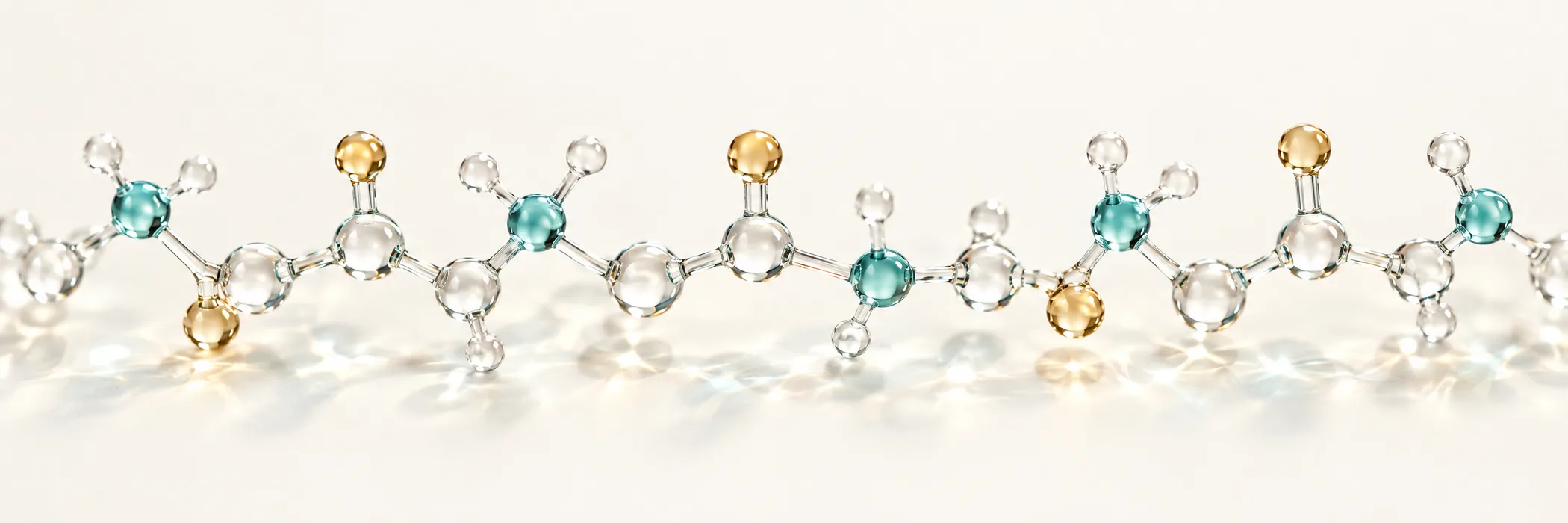

Same signal as MGF. PEG-MGF is meant to do what MGF does, longer and body-wide. MGF is the "E-domain" tail of a mechanically triggered version of IGF-1 (insulin-like growth factor 1). It is proposed to activate satellite cells (muscle stem cells) and kick-start repair through a receptor not yet identified.
A longer life. PEGylation changes the lifespan, not the biology. The chain makes the molecule bigger and wraps it in a watery shell. That slows the two things that clear plain MGF fast, enzyme breakdown in the blood and kidney filtration.
Whole-body reach. The aim is a peptide that lasts long enough to reach tissues body-wide and needs fewer doses. MGF's brief local pulse becomes steady, body-wide exposure.
How to dose it
Most people run PEG-MGF as a small injection under the skin, less often than plain MGF.
Dose tiersMost people run 200 to 400 mcg per dose, 2–3×/week.
- Low / introductory:
- 200 mcg per dose, 2×/week. A first run, or stacked with other IGF-axis peptides.
- Standard:
- 200–400 mcg per dose, 2–3×/week. The most common range for muscle repair and recovery.
- Upper end:
- 400 mcg per dose, 3×/week, for heavier cycles. The common ceiling before IGF cautions (low blood sugar, cell proliferation) apply.
How to injectInto fat under the skin. The goal is whole-body coverage, not targeting one muscle.
- Injection site:
- Belly (a couple of inches from the navel), outer thigh or love handles. Rotate sites to avoid irritation and fatty lumps.
- Measuring the dose:
- At 2 mg in 2 mL bacteriostatic water, 200 mcg takes 20 units on a U-100 insulin syringe. The calculator handles any vial.
- Timing:
- Post-workout on training days, but the hour matters far less than with plain MGF. Many pick a steady time, training or off days.
- Food window:
- Meals don't matter, as it skips the gut. With IGF partners, follow each one's food rule (IGF-1 LR3 is often taken fasted).
Cycle and breaksPeople cycle it, 4–6 weeks on and at least 4 weeks off.
- Standard cycle:
- 4–6 weeks at 2–3×/week. Some run 2–4 weeks when pairing with IGF-1 LR3.
- Washout:
- A 4-week minimum break. Repeat PEG exposure without breaks may build stronger antibodies against the PEG chain, so longer gaps matter more than for most peptides.
Mixing the vialThe default 2 mg vial puts every common dose on a clean mark.
- Mixing:
- 2 mg in 2 mL bacteriostatic water makes 1,000 mcg/mL. On a 100-unit (1 mL) syringe, 200 mcg takes 20 units, 300 mcg 30 units, 400 mcg 40 units.
- Why this dilution:
- The 1:1 mg-to-mL ratio keeps 200–400 mcg out of single-digit draws, where errors compound.
Best time to take it


Implied best time
Post-workout
Most people dose it post-workout on training days, but the exact hour matters far less than with plain MGF.
- It carries the same proposed repair signal as MGF, so a post-workout dose lines it up with the training it's meant to amplify.
- The PEG chain stretches its action across days, so a dose a few hours off still counts. It runs about 2–3×/week.
- Many users pick one steady time on training or off days. Injected under the skin, it has no food or body-clock constraint.
Sources:PMID 20130113PMID 27775236
What to stack it with


Partners add the next IGF growth step. Plain MGF duplicates the signal, and another PEGylated peptide adds antibody exposure.
PEG-MGF + IGF-1 LR3Activation from PEG-MGF, then the IGF growth step from IGF-1 LR3.
- Why it works:
- PEG-MGF is proposed to wake resting satellite cells, then IGF-1 LR3 drives them to multiply into new muscle fibers. Sequential steps, not doubling up.
- Protocol:
- PEG-MGF 200–400 mcg 2–3×/week. IGF-1 LR3 20–60 mcg daily or training days, fasted or mornings before eating, in 4-week cycles. PEG-MGF runs alongside or staggered.
- Outcome:
- Aggressive hypertrophy blocks. IGF cautions apply in full, so carry fast carbs for low blood sugar.
PEG-MGF + IGF-1 DESA local IGF-1 DES hit over the whole-body base.
- Why it works:
- IGF-1 DES, IGF-1 minus its first three amino acids, dodges binding proteins. It acts locally, binding tighter and lasting shorter than IGF-1 LR3.
- Protocol:
- PEG-MGF 200–400 mcg 2–3×/week. IGF-1 DES 50–150 mcg post-training near the target muscle, on training days, not daily.
- Outcome:
- Bringing up a lagging muscle group while keeping whole-body coverage. Same low-blood-sugar caution.
PEG-MGF or MGFPlain MGF, the short-acting sibling, carries the same signal. Pick one.
- The difference:
- MGF has no polyethylene glycol (PEG) chain, so it breaks down fast and acts as a short local pulse near the trained muscle.
- Why not both:
- One already covers the signal. See the MGF page for its dosing.
- When PEG-MGF wins:
- A steady whole-body signal with fewer injections, where the hour of the dose matters less.
Support nutrients

Steady daily protein and leucineA signal that runs all week needs amino acids all week.
- Why every day:
- Unlike plain MGF's post-workout pulse, PEG-MGF's signal runs around the clock, so fasted stretches and low-protein days matter more.
- Protocol:
- 1.8–2.2 g protein per kg bodyweight per day (≈ 0.8–1.0 g/lb), spread over 3–5 meals or shakes, each with at least 3 g leucine.
- Leucine specifically:
- Leucine flips mTOR (mechanistic target of rapamycin), the muscle protein synthesis switch, at ≥ 3 g per sitting. With PEG-MGF every meal counts.
Train across the whole weekWeekly volume is what the long signal works on.
- Why the week:
- Satellite cells respond to mechanical strain. PEG-MGF is meant to span several sessions, so weekly volume counts more than any one workout.
- Protocol:
- Progressive resistance training 3–5×/week on the target muscles, no need to time shots to sessions. Sleep 7–9 hours and eat in a calorie surplus on training days.
Limit PEG exposure, cover micronutrientsNo supplement reliably blocks anti-PEG antibodies. Bounded cycles limit them.
- The concern:
- Repeat exposure to PEGylated compounds can raise them, speeding clearance, blunting the effect over cycles and rarely causing hypersensitivity. Low levels are common from food and cosmetics.
- Limiting them:
- Cycles of 4–6 weeks, gaps of 4+ weeks. Space out other PEGylated products (some PEG growth hormone forms, PEGylated interferons) rather than run them at once.
- Micronutrient support:
- Zinc 25–50 mg/day, magnesium 300–400 mg/day, vitamin D to sufficient blood levels, vitamin C 500–1,000 mg/day. For IGF biology, not antibodies.
Dose calculator
Reconstitution calculator
Calculated for a 1 mL U-100 insulin syringe (100 units/mL).
Units per dose
20 units
Draw this many units on a U-100 syringe
Each unit holds 10 mcg
- Volume per dose
- 0.2 mL
- Doses per vial
- 10
- Concentration
- 1 mg/mL
One vial lasts
- Daily
- 10 days
- Every other day
- 20 days
- 5×/week
- 14 days
Research use only. Not for human consumption. Outputs are reference values based on research literature. Verify all measurements independently.
Side effects and what to watch
What to watch. Repeated PEG exposure can raise anti-PEG antibodies in some people, which may blunt the effect or cause reactions.
Worth knowing. The general IGF-axis concern applies. Sustained pro-growth signaling could in theory promote tumor growth, and the long-acting, whole-body design amplifies it.
How people handle it. Bounded cycles with real breaks between them, and fast carbs on hand when stacking IGF peptides.
Sources:PMID 27775236PMID 20130113
Common questions
How is PEG-MGF different from plain MGF?
Same peptide core, opposite lifespans. Plain MGF breaks down in minutes, so it's dosed often, post-workout, often near the worked muscle. The PEG chain makes PEG-MGF last much longer, so it's dosed about twice a week and acts throughout the body.
How is PEG-MGF dosed?
Most people run 200–400 mcg per dose, 2–3×/week, as a small injection under the skin. A first run is 200 mcg 2×/week. 400 mcg 3×/week is the upper end.
How long does PEG-MGF last?
Much longer than plain MGF, which clears within minutes. No exact human half-life has been published. The long action is why the dose time matters so little.
Do I need to cycle PEG-MGF?
Yes. People run 4–6 weeks on, then at least 4 weeks off. Repeat PEG exposure can build anti-PEG antibodies that may blunt the effect, so the breaks matter.
What are anti-PEG antibodies?
Immune proteins the body can make against polyethylene glycol, the chain that makes PEG-MGF last. Low levels are common from foods and cosmetics. Repeat injections can raise them.
Deep dive
Doses used in studies · Molecular identity · References
10From the researchDoses used in studies
The studies behind PEG-MGF, done on the parent MGF peptide in cell culture, plus the chemistry that makes a PEGylated peptide last longer.
| Dose | Route | Model | Outcome | Sources: |
|---|---|---|---|---|
| In vitro | Cell-culture media | Myoblasts (parent MGF, Goldspink group) | Parent MGF reported to increase proliferation / activate satellite cells | PMID 20130113 |
| In vitro | Cell-culture media | Myoblasts (independent replication) | Synthetic MGF E-domain peptide showed NO unique biological activity | PMID 24253050 |
| N/A (chemistry) | Conjugate property | PEGylation principle | PEG chain slows enzymatic/renal clearance → longer circulating half-life than parent | PMID 27775236 |
11ChemistryMolecular identity
- Peptide core
- MGF E-domain, 24 AA (IGF-1Ec splice-variant C-terminal peptide)PubChem CID 175675731
- Core sequence (24 AA)
- YQPPSTNKNTKSQRRKGSTFEERKPubChem CID 175675731
- Core molecular formula
- C121H199N41O40 (unmodified peptide core, before PEG)PubChem CID 175675731
- Core molecular weight
- 2,868.1 g/mol (unmodified core; conjugate is heavier)PubChem CID 175675731
- PEG attachment
- Variable; chain size/branching not standardized; no fixed conjugate formula, MW, CAS, or PubChem CIDManufacturer-dependent
- Structure / class
- PEGylated conjugate of the MGF E-domain peptide; PEG slows enzymatic/renal clearancePMID 27775236
- Molecular target
- Proposed (still-unidentified) MGF receptor, same contested mechanism as unmodified MGFPMID 24253050
- Half-life
- Longer than unmodified MGF (PEGylation rationale); no sourced human PK figurePMID 27775236
- Regulatory status
- Research reagent; not FDA-approved; prohibited in sport (WADA S2, growth factors; mechano growth factors named)WADA Prohibited List
12Primary sourcesReferences
- PMID 20130113Matheny et al. 2010 (MGF / IGF-1 E-domain review)
- PMID 24253050Fornaro et al. 2014 (no unique activity for synthetic E-peptide)
- PMID 27775236PEGylation pharmacology review (extended half-life rationale)
- PubChem CID 175675731PubChem CID 175675731 (MGF 24-AA core peptide)
- WADA S2WADA Prohibited List S2
Reviewed by Ki Researcher Team · Research use only · Not medical advice · Updated 2026-09-24