

Semax / Selank Blend
Fixed-ratio nootropic blend · Semax 10 mg + Selank 10 mg · intranasal
One vial holds the Russian nootropics Semax and Selank, 10 mg each, a fixed 1:1, run as a nasal spray. Semax brings drive and focus, Selank takes the edge off without sedating. People run the pair for activation without the jitters, on one 14-day course.
Buy Semax + Selank20 mg nasal spray
Ki Researcher is affiliated with Ki Peptides.
Ships to the US only. Buyers must be 21 or older.
At a glance
- Dose
- 1,500 mcg of blend a day, 1,000 to start
- How often
- Three times a day, one spray per nostril each time
- How
- A nasal spray, the route every human study used
- When
- First half of the day, since Semax can disturb sleep
- Cycle
- 14 days on, then a break
The 30-second versionEverything on this page, fast
Drive plus calm · Nasal spray · 14-day course · The Russian pair
The two Russian nootropics almost nobody runs separately. Semax brings the drive and focus, Selank takes the edge off without sedating. Designed by the same institute on the same template, they share the same nasal route, the same schedule and the same 14-day course. One bottle covers both.
The basics
- A pre-mixed powder, almost always 10 mg Semax + 10 mg Selank, mixed into a nasal spray bottle.
- Both are short peptides built the same way, an active natural fragment with a Pro-Gly-Pro tail added so it survives long enough to reach the brain.
Why people use it
- Drive and calm from one bottle. Activation without the edge, which is what running these two together is meant to produce.
- Nothing to reconcile. Same route, same schedule, same course length, same manufacturer. No cadence or dose clash to work around.
- The ratio fits. At 1:1 every sensible daily dose lands both halves inside their own page's bands, which no other blend here manages.
- Nose-to-brain is the point. About nine times more Semax reaches the brain intranasally than intravenously, which is why the registered products are nasal drops.
Stacks well with
- A choline source. Alpha-GPC or CDP-choline feeds the acetylcholine the focus effect runs on.
- Separate bottles, if you want to move one half without the other. A fixed 1:1 only moves as a pair.
Good to know
- Check what you bought. The plain peptides and the N-acetyl amidate versions sell under nearly identical names, and several vendors print the plain peptides' chemistry while advertising the modified ones.
- A home-mixed nasal bottle is not preserved the way the registered product is. Build small and use it inside two weeks.
- Research vials ship as acetate salts, so a "10 mg" vial is about 9.3 mg of actual peptide. The 1:1 ratio survives that; the absolute numbers run about 7% optimistic.
- Neither Semax nor Selank is named on the WADA prohibited list.
What it does
Semax's drive without the edge, on a schedule that takes no effort.
- Drive and calm from one bottleSemax brings focus and drive, Selank takes the edge off without sedating. Together, activation without jitters.
- Sharper attention in a human studyIn 16 power-plant operators, intranasal Semax raised attention and short-term memory at both ends of the working day.
- Calm without sedationIn a 70-patient study, Selank added to a benzodiazepine cut that drug's sedation and memory side effects, through withdrawal.
- Nothing to reconcileSame nasal route, same schedule, same 14-day course, same manufacturer. Only Semax has a timing rule.
- A ratio that fitsAt 1:1 every daily dose from 900 to 2,400 mcg lands both halves inside their own page's bands.
- Nose-to-brain deliveryAbout 0.093% of intranasal Semax reaches brain within two minutes, versus roughly 0.01% intravenously. Selank's label claims 92.8% nasal bioavailability.
Sources:DOI 10.4236/nm.2013.44035PMID 1652713PMID 26356395DOI 10.1002/(SICI)1520-6769(199609)19:2<115::AID-NRC171>3.0.CO;2-B
How it works
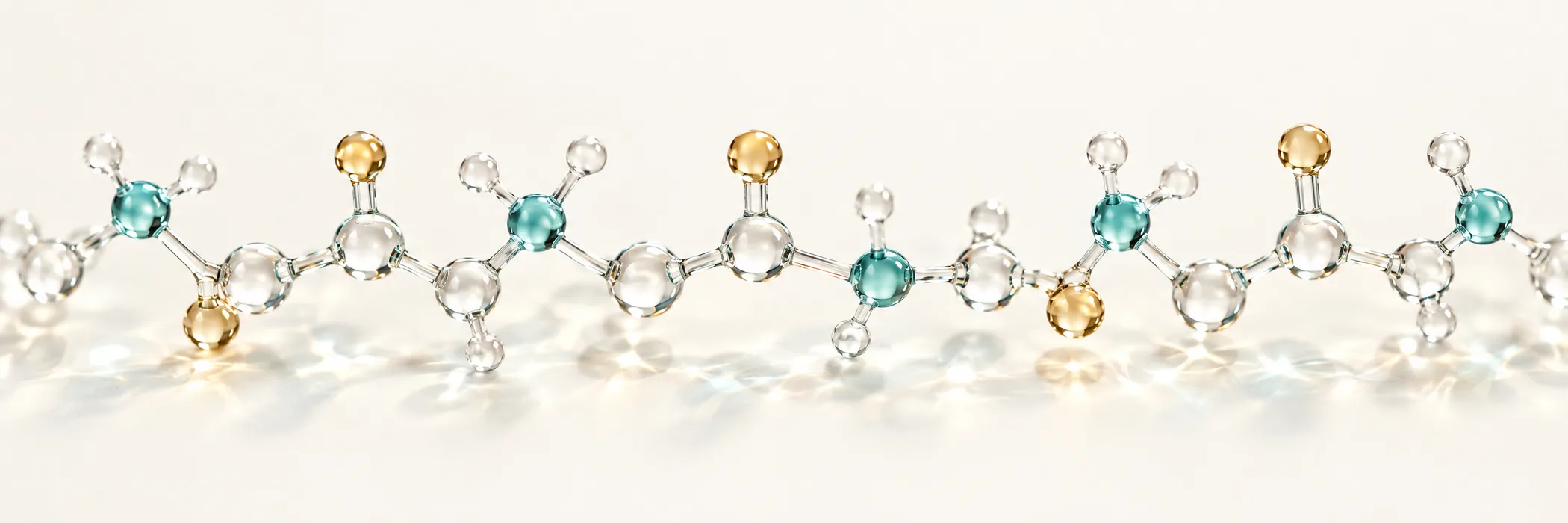

Same design, two jobs. Each is a fragment of a natural regulator, capped with Pro-Gly-Pro so enzymes cannot destroy it first. Semax carries ACTH(4-7), the Met-Glu-His-Phe run from adrenocorticotropic hormone. Selank carries tuftsin, the Thr-Lys-Pro-Arg fragment of the antibody molecule. Same cap, same nasal route.
Semax feeds nerve growth. In rats one dose raises a key BDNF (brain-derived neurotrophic factor) transcript 3-fold in the hippocampus, lifts the protein and activates TrkB (tropomyosin receptor kinase B) signaling. It binds brain tissue at a dissociation constant near 2.4 nM.
Selank keeps enkephalins up. In human serum it slows enkephalin-degrading enzymes. In rodents it also shifts hippocampal BDNF, genes for GABA (gamma-aminobutyric acid) in the frontal cortex and brainstem serotonin.
Sources:DOI 10.4236/nm.2013.44035PMID 16996037PMID 16635254PMID 11443939PMID 26924987PMID 18841804
How to dose it
Doses are per day. The nose takes about 0.1 mL per nostril, so raise the dose with more administrations, not bigger sprays.
Dose tiersOne administration, one spray per nostril, is 500 mcg of blend, 250 mcg of each.
- Low, 900–1,200 mcg/day:
- Two administrations (four sprays) gives 1,000 mcg of blend, 500 mcg of each. Semax in its 400–600 low band, Selank in its 450–900 low band. A good first week.
- Standard, 1,200–1,800 mcg/day:
- Three administrations (six sprays) gives 1,500 mcg of blend, 750 mcg of each. Semax high in its 400–900 range, Selank in its low band. The default, matching Selank's registered frequency.
- The anchor, 1,800 mcg/day:
- 900 mcg of each: Semax's 400–900 mcg/day top, Selank's 900 mcg/day regimen. Add a fourth administration (1,000 each) or mix 24 mg into 10 mL (1.2 mg/mL each), keeping three.
- High, 1,800–2,400 mcg/day:
- Four administrations (eight sprays) gives 2,000 mcg of blend, 1,000 mcg of each. Semax's high band, Selank's standard band. The ceiling, 1,200 mcg of each, is Semax's top.
- What the ratio cannot do:
- One half cannot move without the other. A side effect from one means lowering both, or separate bottles. Selank's 2,700 mcg/day trial dose is out of reach.
How to spray itOne spray per nostril per administration, all before mid-afternoon, for a 14-day course.
- How:
- Sniff gently to reach the nose-to-brain surface at the roof of the nose; a hard sniff sends it down the throat. Alternate which nostril goes first.
- Why not more sprays at once:
- A 0.125 mL spray already exceeds the nostril's roughly 0.1 mL, so a second spray there mostly runs out. Need more? Mix stronger.
- Why the builder flags the dose volume:
- Both nostrils together should take 0.1–0.2 mL. One spray per nostril is 0.25 mL, over that, so the builder flags the standard administration. Splitting across nostrils mitigates it.
- Timing:
- All in the first half of the day. Three, spaced across morning and early afternoon, match Selank's registered frequency inside Semax's window.
- Course length:
- 14 days, the registered course for both components, then a break.
Building the bottleThe standard build, 20 mg in 10 mL, lasts about 12 days at three daily administrations.
- The standard build:
- 20 mg, 5.5 mL bacteriostatic water, 4.5 mL sterile saline. That's 1.0 mg/mL of each, 250 mcg of blend per 0.125 mL spray, 80 sprays a bottle, 74 after priming.
- Why 5.5 mL of bacteriostatic water:
- Bacteriostatic water is 0.9% benzyl alcohol, which the bottle dilutes. A 2 mL fill leaves 0.18%. 5.5 mL of 10 gives 0.495%, just under 0.5%, the one approved nasal concentration.
- Build small:
- A home mix keeps 14 days refrigerated. At two administrations a day it lasts about 18 days, so build 5 mL.
- Four a day needs more than one vial:
- 14 days at four administrations needs 28 mg; one 20 mg vial covers about nine days. Plan a vial and a half, or run three a day.
- If you inject instead:
- 20 mg in 2 mL is 10,000 mcg/mL of blend. 18 units on a U-100 syringe hold 1,800 mcg, 900 mcg of each, once daily. Use the syringe calculator below.
Sources:Russian state register (ГРЛС)DOI 10.4236/nm.2013.44035PMID 18454096PMID 16523722
Best time to take it

Implied best time
First half of the day
Run every administration before mid-afternoon. Semax sets the clock, and Selank has no timing rule that conflicts.
- Semax's label says two to three drops per nostril, two to three times, first half of the day. Dosed late, it can disturb sleep.
- Selank's label is three times a day with no time-of-day rule, since it is non-sedating. Packing all three before mid-afternoon costs nothing.
- Both clear fast. Semax's parent molecule survives minutes, with Pro-Gly-Pro the longer-lived metabolite, yet one Semax dose is described as lasting 20 to 24 hours.
What to stack it with


The vial already holds the pairing most people build. Useful additions come from outside it.
Separate bottlesWhen one half needs to move without the other, run the two from separate bottles.
- Why:
- A fixed ratio only moves as a pair. If Semax is too activating where Selank works, or you want Selank's 2,700 mcg/day trial dose, the blend cannot follow.
- The protocol:
- Semax at 600–900 mcg/day and Selank at 900 mcg/day from their own bottles, both nasal, both in the first half of the day. The anchor's total, with each half adjustable.
- Cost:
- Two bottles, two builds and two beyond-use dates to track. That is the convenience the blend was bought for.
A choline sourceThe standard non-peptide pairing for the focus half.
- Why it works:
- Acetylcholine is the neurotransmitter the attention effect runs on, and the one substrate worth supplying on purpose. See the cofactor section above.
- The protocol:
- Alpha-GPC 300–600 mg orally in the morning, with or shortly before the first administration.
Skip the amidate versionsThe most common mistake with this blend is running it alongside what is effectively itself.
- Why not:
- N-Acetyl Semax Amidate and N-Acetyl Selank Amidate are the same two backbones with end modifications. Stacking them on the plain blend is an unmeasured dose increase of both.
- The identity problem underneath it:
- Several vendors advertise "N-Acetyl" but print the plain peptides' chemistry. If the specs say 813.9 and 751.9 g/mol, you have the plain peptides. Check the chemistry, not the name.
Support nutrients
Feed the acetylcholine the focus half runs on, and guard the sleep the activating half can cost.
Choline for the focus halfThe most common non-peptide addition to a Semax protocol, and it carries to the blend.
- Why:
- Choline is what the brain turns into acetylcholine, the neurotransmitter attention and working memory run on. A growth signal does more when supply keeps up.
- What:
- Alpha-GPC 300–600 mg/day, or CDP-choline (citicoline) 250–500 mg/day. Alpha-GPC crosses the blood-brain barrier readily.
- When:
- Morning, with or shortly before the first administration of the day.
Guard your sleepSemax is activating, and sleep is where the cost shows up first.
- Why:
- Semax's own page names sleep disruption as the reason not to dose late. A dulled focus effect is hard to tell from sleep debt.
- What:
- Nothing to add, just a rule to keep. All administrations before mid-afternoon. If sleep starts to slip, end the course rather than push through.
- Magnesium, if anything:
- Magnesium glycinate 200–400 mg in the evening is the common addition for sleep quality on activating protocols.
What not to addTwo additions that bring nothing to the pair.
- A second nootropic peptide from the same family:
- The other Pro-Gly-Pro-capped Russian peptides share the same design. A third adds no new mechanism, only another variable.
- Anything to "potentiate" the nasal absorption:
- The registered products are peptide, water and methylparaben, nothing else. Absorption enhancers have no data for these compounds and alter a formulation already hard to preserve.
Dose calculator
Reconstitution calculator
Calculated for a 1 mL U-100 insulin syringe (100 units/mL).
Units per dose
18 units
Draw this many units on a U-100 syringe
Each unit holds 100 mcg
This dose contains
- Semax900 mcg
- Selank900 mcg
Fixed ratio. Every draw carries all of the vial's peptides in the same proportions; only the total changes.
- Volume per dose
- 0.18 mL
- Doses per vial
- 11
- Concentration
- 10 mg/mL
One vial lasts
- Daily
- 11 days
- Every other day
- 22 days
- 5×/week
- 15 days
Research use only. Not for human consumption. Outputs are reference values based on research literature. Verify all measurements independently.
Nasal spray builder
Metered pump · 0.125 mL / spray
Pre-filled for Semax / Selank Blend. Change any field to match your own bottle and vial.
The mix
Add up every vial going in. Two 30 mg vials = 60 mg.
The volume the bottle holds once mixed.
The rest is topped up with sterile saline.
Top up with 4.5 mL of sterile saline.
One pump of the bottle. Most meter 0.125 mL, some 0.1. Check the listing.
What you want one administration to deliver.
Sets how fast the bottle is used, which is what the shelf-life check compares against.
Actuations sprayed to waste to purge air before the pump delivers a full volume.
Per dose
Sprays per dose
2
sprays
2 × 250 mcg = 500 mcg per dose.
- Per spray
- 250 mcg
- Doses per bottle
- 37
- Usable sprays
- 74
- Benzyl alcohol
- 0.495 %
- Saline to add
- 4.5 mL
- Concentration
- 2,000 mcg/mL
80 in the bottle, minus 6 spent priming.
What this mix does and doesn't establish
- Benzyl alcohol lands at 0.495%, below the 0.5% floor of every concentration in documented antimicrobial use. This is unqualified, not proven unsafe: no preservative-efficacy study exists for benzyl alcohol diluted into saline at this level, so under-preservation is an inference from the concentrations regulators accept.
- 2 sprays is 0.25 mL, over the 0.2 mL a nose takes across both nostrils before it runs back out. Split the dose between nostrils, or rebuild at a higher concentration so the dose needs fewer sprays.
No advisory here means none of these checks fired, not that the mix is qualified.
Research use only. Not for human consumption. Outputs are reference values. Verify every measurement independently.
How to read this builder
Six things decide whether a home-built nasal spray works, and four of them are not obvious. Every figure below traces to a primary source.
01It's the inverse of a syringe
With a syringe you pick a dose and read off a volume. With a metered pump the device fixes the volume, so the dose is decided before you ever spray, by how much peptide went into the bottle. Changing your dose means either changing the number of sprays or rebuilding the bottle at a different concentration.
02Priming costs you doses
A fresh pump sprays air until the dip tube and metering chamber fill. Commercial labels call for 4 to 6 actuations to waste (Astelin 4; Hikma fluticasone 6; Ryaltris 6), and instrumented testing shows the air-to-liquid transition finishing around the fifth stroke. This builder defaults to 6, and does not model re-priming after a few days' rest, which labels put at another 2 to 6. A commercial bottle carries overfill to absorb all this. A home-filled one does not, so real yield is at or below what you see here.
03The preservative problem has no comfortable answer
Bacteriostatic water is 0.9% benzyl alcohol, and that figure is qualified for a sealed septum vial, not an open pump bottle whose tip touches the nares and which draws room air into the headspace on every actuation. The lowest benzyl alcohol level in any FDA-approved nasal product is 0.5%, and that product is unit-dose, so it is not even a multi-dose precedent. The FDA's maximum for a nasal metered spray is the same 0.5%. Below that you are under every concentration in documented antimicrobial use; above it you are over the nasal maximum; neat BAC water is 1.8× over. There is no BAC-to-saline ratio that is both plausibly preserved and within approved nasal concentrations, except the single point near 55% BAC. That is the shape of the problem, and it is the argument for a purpose-made nasal preservative rather than for tuning a ratio.
04"Unqualified" is not "unsafe", and the endpoint has been measured
There is no pharmacopeial minimum concentration for a preservative. USP <51> specifies a performance test that a specific formulation in its specific container must pass; concentration is an output of formulation work, not a threshold handed down. So this builder says a mix is unqualified rather than unsafe. What has been measured is the outcome: 18 of 20 unpreserved saline spray containers grew bacteria, including S. aureus, P. aeruginosa, E. coli, and Proteus, after just three days of home use, while only 3 of 20 dropper bottles did, which points at the pump rather than the saline. Preserved spray with 0.01% benzalkonium chloride came in at 4 of 198.
05Fourteen days, refrigerated
A locally-acting nasal spray is a compounded non-sterile preparation. USP <797> says nasal forms for local application are not required to be sterile, and <795> claims them by name. <795> Table 3 gives an aqueous preparation 14 days refrigerated when preservation is not demonstrated, and 35 when it is. A home dilution cannot demonstrate it, so 14 days refrigerated is the default, and that row has no room-temperature option. Said plainly, <795> binds compounders and their facilities, not an individual preparing something for themselves. It is the best available yardstick for what good looks like, not a rule someone at home is breaking.
06The nose has a volume ceiling
Device engineers put the optimum at about 0.1 mL per nostril, noting that higher volumes are prone to drip straight back out, and put a both-nostrils dose in the 0.1 to 0.2 mL range. A 0.125 mL pump already exceeds the single-nostril optimum, which makes dose-splitting a design question rather than a rounding error. If a dose needs several sprays, alternate nostrils, or rebuild the bottle stronger so it needs fewer.
Sources
Brook I, Am J Infect Control 2002;30(4):246-7 (contamination of unpreserved spray containers; note the widely repeated "90.7%" is a typographic artifact. The data is 18/20) · Aydin E et al., BMC Ear Nose Throat Disord 2007;7:2 (preserved-spray contamination) · USP <51> Antimicrobial Effectiveness Testing · USP <795> Table 3 and <797> (beyond-use dating; non-sterile nasal forms) · FDA Inactive Ingredient Database, nasal metered spray · Enbumyst prescribing information · Astelin, Hikma fluticasone and Ryaltris labels (priming) · Aptar device literature (per-nostril volume).
Side effects and what to watch
What people notice. Semax 1%, ten times this page's strength, is reported well tolerated, with nasal-mucosa discoloration in 10% of patients and a mild blood-glucose rise in 7.4% of diabetic patients. A 187-patient study found a low side-effect rate.
How people handle it. A side effect from one half means lowering both or separate bottles. 18 of 20 unpreserved saline sprays grew bacteria after three days, against 3 of 20 droppers. Build small, refrigerate, keep to the 14-day beyond-use date.
Skip it or take care if. You take an anticoagulant. Semax forms an anticoagulant complex with heparin in vitro and stimulated anticoagulation in animals. Or you react to methylparaben, which Selank's label warns can cause allergic reactions, including delayed ones.
Sources:DOI 10.4236/nm.2013.44035PMID 15792140PMID 16634437PMID 12032501
Common questions
Is this the plain blend or the amidate one?
The plain peptides, the versions with published research behind them. The N-acetyl amidate variants are different compounds sold under near-identical names; see N-Acetyl Semax Amidate and N-Acetyl Selank Amidate. If the specs say 813.9 and 751.9 g/mol, you have the plain peptides.
How is it dosed?
1,500 mcg a day, 750 mcg of each, is the easy default, three administrations of one spray per nostril. The anchor is 1,800 mcg a day, 900 mcg of each, the top of Semax's 400–900 mcg/day range and Selank's 900 mcg/day regimen.
Why not more per spray?
The nose takes about 0.1 mL per nostril, and more drips back out, so a 0.125 mL pump already slightly exceeds that. Two sprays in one nostril mostly run out. Add administrations or mix stronger.
How long does a course run?
14 days, the registered course for both components, then a break. Semax's adaptation label is shorter, 3–5 days. The standard build lasts about 12 days at three administrations a day, inside both the course and the 14-day beyond-use date.
Why nasal and not injection?
Every human study of either compound used the nasal route, and both registered products are nasal drops. About 0.093% of an intranasal Semax dose reaches brain within two minutes, against roughly 0.01% intravenously.
Deep dive
Doses used in studies · Molecular identity · References
11From the researchDoses used in studies
These are the doses used in the studies of each component, plus the registered label regimens the figures above are built on.
| Dose | Route | Model | Outcome | Sources: |
|---|---|---|---|---|
| Any | Intranasal | No study of the two-peptide combination | No published study has tested Semax with Selank in any model at any ratio; every paper mentioning both ran them as separate arms. The 1:1 vial is market convention, not a studied formulation | |
| 400–900 mcg/day | Intranasal | Human, registered Russian label, 0.1% Semax (adaptation / mental fatigue, healthy adults) | 2–3 drops per nostril, 2–3× in the first half of the day, 3–5 days. The only primary source stating a Semax dose for people who are not being treated for something | Russian state register (ГРЛС) |
| 900 mcg/day | Intranasal | Human, registered Russian label, 0.15% Selank (anxiety / neurasthenia) | 2 drops per nostril 3× daily for 14 days. Note the current label states drops only and carries no microgram figure; 75 mcg per 0.05 mL drop is arithmetic from the registered strength | Russian state register (ГРЛС) |
| 1.0 mg (≈16 mcg/kg) | Intranasal | Human, 16 power-plant operators (Semax) | Reported increases in attention and short-term memory, tested at both the start and end of the working day, but also more false and spontaneous responses, which the authors read as a possible anxiogenic component. English-language but not MEDLINE-indexed, which is why a PubMed-only search misses it | DOI 10.1002/(SICI)1520-6769(199609)19:2<115::AID-NRC171>3.0.CO;2-B |
| 0.25 mg | Intranasal | Human, healthy volunteers, n=11 and n=9 (Semax, EEG sub-studies) | EEG changes. Note this is a different dose and a different population from the attention result above; the two are often conflated | DOI 10.1002/(SICI)1520-6769(199609)19:2<115::AID-NRC171>3.0.CO;2-B |
| Not stated in the paper | Intranasal | Human, 24 healthy volunteers, 14 of them on Semax; resting-state fMRI (1% Semax) | Measurable changes in default-mode network connectivity | PMID 30225715 |
| Not stated in the abstract | Intranasal | Human, 52 healthy participants; Semax OR Selank OR placebo, separate arms | Altered functional connectivity between the right amygdala and fusiform, inferior/middle temporal and parahippocampal regions. The ROIs were the amygdala and dorsolateral prefrontal cortex, not the default-mode network | PMID 32342318 |
| 6,000 mcg/day | Intranasal | Human, 110 patients, post-stroke rehabilitation (Semax) | Plasma BDNF rose; faster functional recovery and improved motor performance reported. The one human measurement of a neurotrophic marker for either compound | PMID 29798983 |
| Not stated | Intranasal | Human, 62 patients, GAD and neurasthenia (Selank vs medazepam) | Anxiolysis comparable to the benzodiazepine, plus antiasthenic and psychostimulant effects | PMID 18454096 |
| Not stated | Intranasal | Human, 60 patients, anxiety (Selank vs phenazepam) | Pronounced anxiolytic and mild nootropic effect; the anxiolytic effect persisted about a week after the last dose | PMID 25176261 |
| Not stated | Intranasal | Human, 70 patients, Selank added to phenazepam vs phenazepam alone | Selank reduced the benzodiazepine's own side effects (attention and memory impairment, asthenia, sedation) during treatment and withdrawal | PMID 26356395 |
| Semax IC₅₀ 10 µM · Selank IC₅₀ 20 µM | In vitro | Human serum (both peptides, compared) | Both inhibit enkephalin-degrading enzymes, Semax about twice as potently. One of several studies that place the two side by side, always as separate arms, never co-administered | PMID 11443939 |
| Various | Intranasal / IP | Rat (Semax, mechanism) | Raises BDNF protein and exon-III mRNA and drives TrkB phosphorylation in hippocampus | PMID 16996037 |
| Various | Intranasal / IP | Rat (Semax, binding) | Specific, calcium-dependent binding in basal forebrain at K_D ≈ 2.4 nM, with raised BDNF there | PMID 16635254 |
| Various | Intranasal | Rat (Selank, mechanism) | Regulates BDNF expression in hippocampus | PMID 18841804 |
| Various | Intranasal | Rat, 6-OHDA parkinsonism model (both, separate arms) | Selank decreased anxiety-like behavior; neither peptide affected motor activity. Tested separately, not combined | PMID 28702721 |
12ChemistryMolecular identity
- Composition
- Semax 10 mg · Selank 10 mg = 20 mg per vial. 5 mg + 5 mg is the other common size; 30 mg + 30 mg is sold for the amidate variantsCross-source vendor agreement
- Ratio
- 1 : 1 by mass, 50 % Semax · 50 % Selank. Settled convention, unlike most blends: 17 of 19 vendors publishing a split use itCross-source vendor agreement
- Structure / class
- Fixed-ratio, co-lyophilized blend of two Pro-Gly-Pro-capped regulatory peptide analogs, not a new molecule; each component keeps its own identity and pharmacologyCross-source vendor agreement
- Semax (10 mg)
- C37H51N9O10S · 813.9 g/mol · CAS 80714-61-0 · UNII I5FAL2585H · Met-Glu-His-Phe-Pro-Gly-ProPubChem CID 9811102
- Selank (10 mg)
- C33H57N11O9 · 751.9 g/mol · CAS 129954-34-3 · UNII TS9JR8EP1G · Thr-Lys-Pro-Arg-Pro-Gly-ProPubChem CID 11765600
- Salt form
- Research vials ship as acetate salts. Semax acetate is 874.0 g/mol and Selank acetate 811.9, so a nominal 10 mg is ≈9.31 mg and ≈9.26 mg of free peptide, about 7 % less than the label. The 1:1 ratio is unaffectedPubChem CID 155977617 / 155489759
- Molecular target
- No shared target. Semax acts through neurotrophic (BDNF/TrkB) signaling, Selank by inhibiting enkephalin-degrading enzymes. Neither has a confirmed receptorPMID 16996037 · PMID 11443939
- Regulatory status
- Both registered in Russia by the same manufacturer. Semax is prescription-only and on the Vital & Essential Medicines list, Selank is over-the-counter and is not. Neither has an INN or USAN, neither is FDA- or EMA-approved, and neither has ever been registered on ClinicalTrials.govRussian state register (ГРЛС) · FDA · ClinicalTrials.gov
13Primary sourcesReferences
- PubChem CID 9811102PubChem CID 9811102 (Semax)
- PubChem CID 11765600PubChem CID 11765600 (Selank)
- DOI 10.4236/nm.2013.44035Kolomin et al., Neuroscience & Medicine 2013;4:223–252 (review: Semax/Selank pharmacology, registered dosing, intranasal BBB penetration, named adverse-effect rates)
- DOI 10.1002/(SICI)1520-6769(199609)19:2<115::AID-NRC171>3.0.CO;2-BKaplan et al., Neuroscience Research Communications 1996;19(2):115–123 (intranasal Semax; attention and short-term memory in 16 power-plant operators at 1.0 mg, EEG sub-studies in healthy volunteers at 0.25 mg). English-language, not MEDLINE-indexed
- PMID 16996037Dolotov et al., Brain Res 2006 (Semax raises BDNF protein/mRNA and TrkB phosphorylation, rat hippocampus)
- PMID 16523722Shevchenko et al., Bioorg Khim 2006 (intranasal brain penetration and rapid degradation; Pro-Gly-Pro the dominant metabolite, rat)
- PMID 15792140Gusev et al., Zh Nevrol Psikhiatr 2005 (Semax in chronic cerebrovascular insufficiency, n=187; tolerability)
- PMID 29798983Gusev et al., Zh Nevrol Psikhiatr 2018 (Semax at different stages of ischemic stroke, n=110; plasma BDNF measured in humans)
- PMID 30225715Lebedeva et al., Bull Exp Biol Med 2018 (intranasal 1% Semax, 24 healthy volunteers; resting-state fMRI; the paper states no mg dose)
- PMID 11443939Kost et al., Bioorg Khim 2001 (Semax IC₅₀ 10 µM and Selank IC₅₀ 20 µM against enkephalin-degrading enzymes of human serum)
- PMID 18454096Zozulia et al., Zh Nevrol Psikhiatr 2008 (Selank vs medazepam in GAD/neurasthenia, n=62)
- PMID 25176261Medvedev et al., Zh Nevrol Psikhiatr 2014 (Selank vs phenazepam in anxiety, n=60; effect persisted ~1 week after dosing)
- PMID 26356395Medvedev et al., Zh Nevrol Psikhiatr 2015 (Selank + phenazepam vs phenazepam alone, n=70; Selank reduced the benzodiazepine's side effects)
- PMID 18841804Inozemtseva et al., Dokl Biol Sci 2008 (intranasal Selank regulates BDNF expression in rat hippocampus)
- PMID 26924987Volkova et al., Front Pharmacol 2016 (Selank affects expression of genes involved in GABAergic neurotransmission, rat)
- PMID 16635254Dolotov et al., J Neurochem 2006 (specific brain binding, K_D ≈ 2.4 nM; basal-forebrain BDNF, rat)
- PMID 1652713Potaman et al., Neurosci Lett 1991 (entry of the synthetic ACTH(4-10) analogue into rat brain after INTRAVENOUS injection; the source of the ~0.01% figure)
- Russian state register (ГРЛС)Russian state register of medicines (ГРЛС). Semax 0.1% ЛП-№(009449)-(РГ-RU), Semax 1% ЛП-№(010596)-(РГ-RU), Selank 0.15% ЛП-№(010951)-(РГ-RU); registered indications, dose regimens and course lengths
- PMID 28702721Slominsky et al., Dokl Biol Sci 2017 (Semax and Selank in 6-OHDA rat parkinsonism; tested as SEPARATE arms, not combined)
- PMID 32342318Panikratova et al., Dokl Biol Sci 2020 (52 healthy participants, resting-state fMRI; Semax OR Selank OR placebo; separate arms)
- PMID 16634437Liapina et al., Izv Akad Nauk Ser Biol 2006 (comparative anticoagulant effects of proline-containing regulatory peptides incl. Semax and Selank)
- PMID 31667971Vanhee et al., Drug Test Anal 2020 (Belgian federal laboratory; seized preparations containing Selank and Semax; "have not completed any clinical trials")
- FDAFDA. Certain Bulk Drug Substances for Use in Compounding That May Present Significant Safety Risks (semax and selank acetate: nominated, categorised as significant safety risk, then withdrawn; immunogenicity note)
- PMID 12032501Brook I, Am J Infect Control 2002;30(4):246–7 (bacterial contamination of saline nasal spray/drop solutions in home use: 18/20 unpreserved sprays vs 3/20 droppers)
- WADAWADA Prohibited List 2026 (neither Semax nor Selank is named; S0 covers substances with no approval by any regulator)
Semax + Selank
20 mg nasal spray
Ki Researcher is affiliated with Ki Peptides.
Ships to the US only. Buyers must be 21 or older.
Reviewed by Ki Researcher Team · Research use only · Not medical advice · Updated 2026-09-24