

KLOW Blend
Fixed-ratio repair blend with an anti-inflammatory brake · GHK-Cu 50 mg + BPC-157 10 mg + TB-500 10 mg + KPV 10 mg
KLOW is a four-peptide blend in one 80 mg vial, 50 mg GHK-Cu plus 10 mg each of BPC-157, TB-500 and KPV. It is GLOW with KPV added as an anti-inflammatory brake. People run it for inflamed or post-procedure skin.
Buy KLOW80 mg vial, coming soon
Ki Researcher is affiliated with Ki Peptides.
Ships to the US only. Buyers must be 21 or older.
At a glance
- Dose
- ≈ 1.3–4 mg of blend a day, most run ≈ 2.67 mg
- How often
- Once daily
- How
- A small injection under the skin, all four in one syringe
- When
- Evening, to ride your overnight repair window
- Cycle
- 4-week blocks with 2–4 weeks off (8–12 weeks for skin remodeling)
The 30-second versionEverything on this page, fast
Calm + repair · Reactive skin · Post-procedure recovery · Four peptides, one draw
The repair trio with the inflammation turned down. KLOW combines GHK-Cu's collagen and matrix remodeling, BPC-157's growth of new blood vessels, TB-500's repair-cell migration and KPV's anti-inflammatory brake in a single 80 mg vial. It is the blend people reach for when the tissue they want to rebuild is also inflamed.
The basics
- A pre-mixed powder: 50 mg GHK-Cu + 10 mg BPC-157 + 10 mg TB-500 + 10 mg KPV (a 5 : 1 : 1 : 1 ratio). One vial, one draw, all four every time.
- It is GLOW plus KPV, the same three repair signals at the same per-unit amounts, with a calming fourth on top. Wolverine is the stripped-down injury pair.
Why people use it
- Repair in calmer tissue. KPV turns down NF-κB, the master inflammatory switch, inside gut and immune cells.
- Firmer, smoother-looking skin. GHK-Cu switches on collagen, elastin and the skin's matrix in skin cells.
- Scars and wounds heal with better blood supply. BPC-157 grows new vessels into the repair zone while TB-500 pulls repair cells in.
- One shot instead of four. The whole calm-and-rebuild set in a single daily draw.
Stacks well with
- A separate KPV vial. The blend gives you 333 mcg once a day, and an acute flare is run at 400–500 mcg twice daily, so people add a standalone KPV dose without touching the blend.
- Wolverine Blend or separate BPC-157 + TB-500 vials when an injury is the real target. The copper-free pair lets you push those two harder without raising the GHK-Cu load.
Good to know
- The ratio sets the ceiling. At 10 units BPC-157, TB-500 and KPV all sit mid-band while GHK-Cu is already in its high tier, and past about 12 units the copper peptide runs ahead of the other three.
- A flare is a frequency change, not a bigger dose. KPV's flare tier is 400–500 mcg twice daily, which a once-daily blend can't express, so a flare means a separate KPV vial, not more KLOW.
- A faint blue tint is normal. That is the copper in GHK-Cu. A 10-unit dose carries about 0.26 mg of copper, and injected copper skips the gut's usual regulation, so don't add copper supplements on top.
- Banned in tested sport. BPC-157 and TB-500 are both on the WADA list.
- TB-500 promotes new blood vessels and cell migration, so people with an active or recent cancer avoid it.
- Once mixed, refrigerate and finish it within about 4 weeks. One vial at 10 units is 30 doses.
What it does
The blend people reach for when the tissue they want to rebuild is also inflamed.
- Repair in calmer tissueIn inflamed human gut-lining cells, KPV cut the 200-fold jump in IL-8, an inflammation gene, by about 35%.
- Firmer, smoother-looking skinA month of GHK-Cu thigh cream raised collagen production in 70% of women, against 40% on retinoic acid.
- Wounds that heal with better blood supplyRat wounds on thymosin β4 contracted at least 11% more by day 7 and grew more vessels.
- Ulcers closed faster in a human trialGHK-Cu gel closed a median 98.5% of diabetic foot-ulcer area, against 60.8% on plain gel.
- A whole-body signalBelly-cavity shots of TB-500 made rats' repaired Achilles tendons about 39% stronger.
- Knee pain eased in a chart reviewAfter knee-joint injections, 11 of 12 people surveyed reported relief on BPC-157 alone, 3 of 4 with thymosin β4.
Sources:PMID 18061177PMID 26236730PMID 10469335PMID 17147644PMID 42542926PMID 34324435
How it works
Four peptides, one draw. KLOW is one freeze-dried powder, so every draw carries all four in the vial's fixed 50/10/10/10 proportions. Each peptide keeps its own mechanism.
Three repair signals. GHK-Cu switches on collagen, elastin and the skin's supporting matrix in cultured skin cells, and its copper feeds lysyl oxidase, the enzyme that cross-links new tissue. BPC-157 grows new blood vessels into the repair zone and speeds repair-cell migration. TB-500 controls actin, the cell's scaffolding protein, and pulls repair cells into damaged tissue.
One brake. KPV is the anti-inflammatory tail of α-MSH (alpha-melanocyte-stimulating hormone). The PepT1 transporter carries it into gut and immune cells, where it inhibits NF-κB and MAP-kinase, the cell's master inflammation switches.
Sources:PubChem CID 71587328PMID 8227353PMID 26236730PMID 27847966PMID 21030672PMID 10469335PMID 25313062PMID 34992578PMID 18061177PMID 27458604PMID 28143741PMID 17934097
How to dose it
One injection under the skin a day, measured as total blend on a U-100 insulin syringe. Pick the units and the ratio fixes all four.
Dose tiersMost people run 10 units, mixed 80 mg + 3 mL (each unit holds ~267 mcg).
- Low, 5 units (≈ 1.3 mg):
- ≈ 833 mcg GHK-Cu + 167 mcg each of BPC-157, TB-500 and KPV once daily. A first-week tolerance check, or a light maintenance dose.
- Standard, 10 units (≈ 2.67 mg):
- ≈ 1.67 mg GHK-Cu + 333 mcg each of the rest once daily. BPC-157, KPV and TB-500 (≈ 2.3 mg/week) sit mid-band. GHK-Cu runs in its 1.5–2 mg high tier.
- High, 15 units (4 mg):
- ≈ 2.5 mg GHK-Cu + 500 mcg each once daily. BPC-157 reaches its active-injury dose, TB-500 ≈ 3.5 mg/week, and GHK-Cu passes its 2 mg/day ceiling. More means separate vials.
- A flare is a frequency change:
- KPV's flare tier is 400–500 mcg twice daily (≈ 800–1,000 mcg/day) for 7–10 days. A once-daily blend can't express a second dose, so people add a separate KPV vial.
How to injectOne draw a day into body fat, with or without food. Rotate sites.
- Injection site:
- Belly (a couple of inches clear of the navel), love handles or outer thigh. Rotate daily; copper solutions are the ones people most often report site irritation from.
- Measuring the dose:
- U-100 insulin syringe, 80 mg + 3 mL mix. 5, 10 and 15 units hold about 1.3, 2.67 and 4 mg. The calculator splits any draw.
- Time of day:
- Evening. A consistent slot matters more than the hour; morning is fine too.
Cycle and breaks4-week blocks, then 2–4 weeks off. Skin remodeling runs 8–12 weeks.
- Standard block:
- 4 weeks at 10 units/day, then 2–4 weeks off. One 80 mg vial covers it (30 doses, 28 needed) and finishes inside a mixed vial's four-week life.
- Skin-remodeling run:
- 8–12 weeks daily (two to three vials) for scar and texture, then 4 weeks off. KPV's page pulses it 4–8 weeks, so many taper to 5 units halfway.
- A flare or injury mid-block:
- A flare means a standalone KPV dose for 7–10 days. An injury means one 2–2.5 mg TB-500 shot a week for 4–6 weeks, or Wolverine. Neither means more KLOW.
Mixing the vial80 mg + 3 mL. The calculator splits any draw, assuming 50/10/10/10. Check your label.
- Standard mix, 3 mL:
- 80 mg + 3 mL = 26,667 mcg per mL. 5 units hold about 1,333 mcg, 10 units about 2,666 mcg and 15 units 4,000 mcg.
- Compact mix, 2 mL:
- 80 mg + 2 mL = 40,000 mcg/mL, so each unit holds ~400 mcg and 2.67 mg takes about 6.5 units. Redo the math before switching water mid-vial.
- A KLOW unit matches a GLOW unit:
- At 3 mL a KLOW unit is a GLOW unit (167 mcg GHK-Cu, 33 mcg BPC-157, 33 mcg TB-500) plus 33 mcg KPV, so switching keeps your unit count.
- Copper arithmetic:
- An 80 mg vial holds ≈ 7.9 mg of copper (GHK-Cu is 15.8 % copper), and a 10-unit dose injects ≈ 0.26 mg past the gut. Skip copper supplements.
Sources:PMID 8227353PMID 26236730PMID 27847966PMID 36588717PMID 10469335PMID 34346165PMID 18061177PMID 18092346PubChem CID 71587328
Best time to take it
Implied best time
Evening
Most people inject KLOW in the evening, so all four signals ride the body's overnight repair window.
- Deep sleep brings the growth-hormone pulse, peak tissue regeneration and the least load on healing tissue. An evening dose meets that window as it opens.
- None of the four keeps a clock. BPC-157 and TB-500 clear fast and leave their repair signal behind, so consistency beats the exact hour.
- One daily draw means one slot to keep. Morning works if evening is impractical; the habit matters more than the hour.
Sources:PMID 36588717PMID 34346165
What to stack it with


KLOW already holds four mechanisms. Useful additions come from a different angle.
KLOW + a KPV, BPC-157 or TB-500 top-upUn-fix the ratio when one peptide needs to go where 10 units of KLOW can't.
- Why it works:
- The blend's ceiling is set by GHK-Cu and its cadence is once daily. A separate vial raises the one signal you want without pushing the copper peptide past 2 mg/day.
- For a flare:
- KLOW 10 units daily plus KPV 300–500 mcg 10–12 hours later, for 7–10 days. That approximates KPV's twice-daily flare tier (day total ≈ 633–833 mcg).
- For an injury:
- KLOW 10 units plus BPC-157 250 mcg daily (≈ 583 mcg total, no higher) and/or one 2–2.5 mg TB-500 shot a week for 4–6 weeks, co-drawn with KLOW. Rotate sites.
- Outcome:
- Reached for when the blend is the right base but one lever needs more. Many run Wolverine for the injury instead and keep KLOW for the skin goal.
KLOW + Thymosin Alpha-1An immune pairing for inflammation with an immune driver rather than a mechanical one.
- Why it works:
- KPV damps the over-reactive innate and mast-cell response; Thymosin Alpha-1 tunes the adaptive arm. Two different arms of immunity, a lever nothing in the vial already pulls.
- The protocol:
- KLOW 10 units in the evening, with Thymosin Alpha-1 at 1.6 mg twice weekly, the approved Zadaxin dose its page carries.
- Outcome:
- Reached for on MCAS (mast cell activation syndrome) and chronic-inflammatory contexts where the immune system is both over-reactive and under-effective.
KLOW + CJC-1295 / IpamorelinA growth-hormone backdrop under the local repair signals, a lever the blend doesn't have.
- Why it works:
- CJC-1295 and Ipamorelin raise your growth hormone (GH) pulse. GH and IGF-1 (insulin-like growth factor-1) drive whole-body protein synthesis and skin thickness, a different axis from KLOW's local repair.
- The protocol:
- KLOW 10 units in the evening. The GH pair at 100 mcg CJC-1295 (no DAC) + 200–300 mcg Ipamorelin, bedtime, fasted, or the pre-mixed blend; KLOW needs no fasted window.
- Outcome:
- Reached for on body-composition-plus-skin goals and slower post-injury recoveries where a GH backdrop is wanted alongside the calm-and-repair set.
Support nutrients
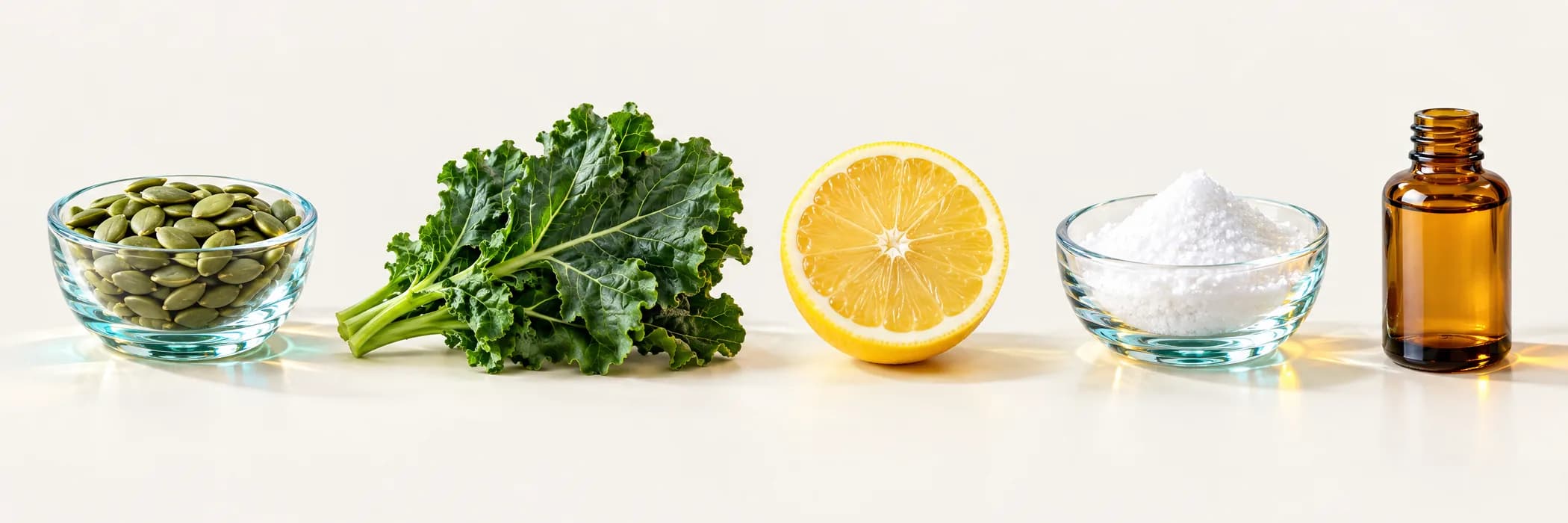
KLOW already delivers copper, so the usual pairing flips.
Calm the same inflammatory switchKPV pushes NF-κB down inside the cell. These push from outside.
- Quercetin:
- 500 mg isoquercetin twice daily, ~20 minutes before meals. It steadies mast cells upstream of the cytokines KPV suppresses.
- Omega-3 + polyphenols:
- ~2–3 g EPA/DHA daily plus curcumin, berries and leafy greens. Both dampen the NF-κB signaling KPV targets.
Manage the copperA 10-unit dose injects ≈ 0.26 mg of copper past the gut's controls.
- No added copper:
- Skip copper supplements; the blend plus a normal diet covers it. The KPV page's 2 mg copper bisglycinate is already covered here.
- Zinc, kept moderate:
- 15–30 mg with food, under the 30–50 mg the KPV page uses, since copper arrives by needle. High doses (≈ 60 mg/day for weeks) deplete copper.
Feed the collagen signalThree of the four signal for new tissue. This is the raw material.
- Hydrolyzed collagen:
- 10–15 g hydrolyzed collagen, 30–60 minutes before activity or with the evening injection.
- Glycine and proline:
- The bulk of collagen. Protein at 1.6–2.0 g/kg/day keeps the pool full. A common addition on a remodeling run is 3–5 g glycine.
Feed the nitric-oxide pathwayBPC-157 ends at eNOS, the enzyme that makes nitric oxide; new vessels need it.
- L-arginine or L-citrulline:
- L-arginine 3–6 g/day or L-citrulline 3 g/day, morning or pre-workout. Arginine feeds eNOS directly; skip it if blood pressure runs low.
Sources:PMID 9587142PMC5793244NIH ODSPMID 27847966PMID 18061177PMID 34992578
Dose calculator
Reconstitution calculator
Calculated for a 1 mL U-100 insulin syringe (100 units/mL).
Units per dose
10 units
Draw this many units on a U-100 syringe
Each unit holds 266.7 mcg
This dose contains
- GHK-Cu1.67 mg
- BPC-157333 mcg
- TB-500333 mcg
- KPV333 mcg
Fixed ratio. Every draw carries all of the vial's peptides in the same proportions; only the total changes.
- Volume per dose
- 0.1 mL
- Doses per vial
- 30
- Concentration
- 26.67 mg/mL
One vial lasts
- Daily
- 30 days
- Every other day
- 60 days
- 5×/week
- 42 days
Research use only. Not for human consumption. Outputs are reference values based on research literature. Verify all measurements independently.
Side effects and what to watch
What people notice. Injection-site irritation is common with copper blends. Rotating sites fixes it. BPC-157's animal toxicology (mice, rats, rabbits, dogs) found no serious toxicity, though 28-day dosing shifted clotting and liver labs and reversibly lowered dogs' creatinine. Thymosin β4 was well tolerated in human intravenous trials up to 1,260 mg. A woman's skin and gums darkened on a BPC-157 and TB-500 product, again on restarting, not after quitting.
How people handle it. One component can't be adjusted alone; if one reacts, lower the whole draw or go to separate vials. Skip copper supplements.
Skip it or take care if. TB-500 promotes new vessels and cell migration, so people with an active or recent cancer avoid it, and so KLOW.
Sources:PMID 32334036PMID 34346165PMID 20536472PMID 34992578NIH ODSFDA briefing document (BPC-157), PCAC July 2026
Common questions
What is KLOW?
KLOW is four peptides in one 80 mg vial, 50 mg GHK-Cu plus 10 mg each of BPC-157, TB-500 and KPV. It is GLOW plus KPV.
How is KLOW dosed?
At the 80 mg + 3 mL mix, most people run 10 units each evening, 1.67 mg GHK-Cu plus 333 mcg each of the rest. The range is 5 to 15 units.
How long do people stay on KLOW?
Most run 4-week blocks at 10 units, then 2–4 weeks off. Skin remodeling runs 8–12 weeks, then 4 weeks off, and many taper to 5 units halfway.
What side effects do people notice on KLOW?
Injection-site irritation is the usual one. Rotating sites fixes it. BPC-157's animal safety studies found no serious toxicity, and TB-500 was well tolerated in human intravenous trials. People with an active or recent cancer skip it.
KLOW, GLOW or Wolverine?
They nest. Wolverine is BPC-157 + TB-500 for injuries. GLOW adds 50 mg GHK-Cu for skin and scars. KLOW adds 10 mg KPV for inflamed skin.
Does the copper damage the other peptides?
One lab study found copper held by GHK inert under mild conditions. Another found it made hydroxyl radical with vitamin C. Radicals oxidize methionine easily. TB-500 has one. BPC-157 and KPV have none. Refrigerate and finish within about four weeks.
Deep dive
Doses used in studies · Molecular identity · References
10From the researchDoses used in studies
The doses used in the studies behind each component, some per kilogram of body weight. GHK-Cu's human data are topical; KPV's strongest evidence is oral.
| Dose | Route | Model | Outcome | Sources: |
|---|---|---|---|---|
| Any | Subcutaneous | No study of the four-peptide blend | No published study has tested GHK-Cu + BPC-157 + TB-500 + KPV together; the 50/10/10/10 vial ratio is a market convention, not a studied formulation | |
| Local intra-wound injection | Injected (local, intra-wound) | Rat, experimental wound chambers (GHK-Cu) | Locally injected GHK-Cu stimulated connective-tissue/collagen accumulation; local delivery, not systemic dosing | PMID 8227353 |
| Low-percentage facial cream (<1%) | Topical | Human, 12-week cosmetic study (GHK-Cu; n≈71; conference / industry-sponsored) | Reported improvements in skin firmness, clarity, and density vs comparators; low-tier evidence | AAD Annual Meeting 2002 (conference presentation) |
| 10 µg/kg | Intraperitoneal | Rat (ligament), BPC-157 | Ligament healing + biomechanics | PMID 20225319 |
| 20–500 µg/kg | IV & IM | Rat (PK), BPC-157 | Pharmacokinetics (n=6/group) | PMID 36588717 |
| Topical / IP | Topical / IP | Rat (dermal wound), TB-500 | +42% re-epithelialization (d4), +61% (d7) | PMID 10469335 |
| 0.05–25 µg/kg | Intravenous | Human (Phase I PK/safety, n=84), TB-500 | Dose-proportional PK; no dose-limiting toxicity | PMID 34346165 |
| Nanomolar | In vitro (cell culture) | Human intestinal epithelial cells & T cells, KPV | Inhibited NF-κB and MAP-kinase activation; reduced pro-inflammatory cytokine secretion | PMID 18061177 |
| Oral (drinking water) | Oral | Mouse, DSS & TNBS colitis (KPV) | Reduced colitis severity and pro-inflammatory cytokine expression | PMID 18061177 |
| Not specified | Oral | Mouse, DSS & T-cell-transfer colitis, incl. MC1R-deficient (KPV) | Earlier recovery, reduced colonic myeloperoxidase; protective even without functional MC1R | PMID 18092346 |
11ChemistryMolecular identity
- Composition
- GHK-Cu 50 mg · BPC-157 10 mg · TB-500 10 mg · KPV 10 mg = 80 mg per vialCross-source vendor agreement
- Ratio
- 5 : 1 : 1 : 1 by mass, 62.5 % GHK-Cu · 12.5 % BPC-157 · 12.5 % TB-500 · 12.5 % KPVCalculated
- Structure / class
- Fixed-ratio, co-lyophilized blend of four research peptides in one vial, not a new molecule; each component keeps its own identity and pharmacology. White to off-white powder with a faint blue tint from the copperCross-source vendor agreement
- GHK-Cu (50 mg)
- Gly-His-Lys · Cu(II) chelate · C14H23CuN6O4+ · 402.92 g/mol · CAS 89030-95-5PubChem CID 71587328
- BPC-157 (10 mg)
- GEPPPGKPADDAGLV (15 AA) · C62H98N16O22 · 1,419.5 g/mol · CAS 137525-51-0PubChem CID 9941957
- TB-500 (10 mg)
- Ac-SDKPDMAEIEKFDKSKLKKTETQEKNPLPSKETIEQEKQAGES (43 AA) · C212H350N56O78S · ~4,963 g/mol · CAS 77591-33-4PubChem CID 16132341 · UniProt P62328
- KPV (10 mg)
- Lys-Pro-Val (3 AA) · C16H30N4O4 · 342.43 g/mol · CAS 67727-97-3PubChem CID 125672
- Copper per vial
- ≈ 7.9 mg elemental copper; GHK-Cu is 15.8 % copper by mass; ≈ 0.26 mg per 10-unit dose (adult oral RDA 0.9 mg/day; oral UL 10 mg/day, not an injected-copper limit)Calculated from PubChem masses
- Half-life (per component)
- No single clock. BPC-157 clears within minutes (rat IV), TB-500 within roughly half an hour to two hours (human IV), GHK-Cu and KPV not established; the blend inherits four separate curves, not onePMID 36588717 · PMID 34346165 · Not established
- Molecular target
- Four separate targets, not one. GHK-Cu carries copper and signals extracellular-matrix synthesis in dermal fibroblasts; BPC-157 acts through the VEGFR2–Akt–eNOS angiogenic pathway; TB-500 sequesters monomeric G-actin; KPV enters cells via PepT1 and inhibits intracellular NF-κB and MAPK signalingPMID 27847966 · UniProt P62328 · PMID 18061177
- Regulatory status
- Not an approved drug in any form; no trial has tested the four-peptide combination; BPC-157 and TB-500 are prohibited in sport (WADA S0 / S2.3)FDA / WADA Prohibited List
12Primary sourcesReferences
- PubChem CID 71587328PubChem CID 71587328 (Prezatide copper / GHK-Cu complex; C14H23CuN6O4+, MW 402.92; Cu(II) chelate)
- PubChem CID 9941957PubChem CID 9941957 (BPC-157; C62H98N16O22; no sulfur, so no methionine or cysteine)
- PubChem CID 16132341PubChem CID 16132341 (Thymosin β4 / TB-500; one methionine, no cysteine)
- PubChem CID 125672PubChem CID 125672 (KPV / Lys-Pro-Val, α-MSH 11-13; C16H30N4O4; no sulfur)
- PMID 21780203Hureau et al., structures and redox properties of the Cu(II) complexes of GHK and DAHK (inert under moderate redox potentials; copper swaps fast between GHK molecules), Chem Eur J 2011
- PMID 17577900Guilloreau et al., ChemBioChem 2007 (with ascorbate, Cu-GHK made more hydroxyl radical than Cu-amyloid-beta or Cu-DAHK)
- PMID 14661084Stadtman & Levine, Amino Acids 2003 (free-radical oxidation of amino acid residues; surface methionine and cysteine are especially sensitive)
- PMID 8227353Maquart et al., J Clin Invest 1993 (in-vivo: locally injected GHK-Cu stimulates connective-tissue/collagen accumulation in rat wound chambers)
- PMID 26236730Pickart, Vasquez-Soltero & Margolina, Biomed Res Int 2015 (regenerative & protective actions of GHK in skin, review)
- AAD Annual Meeting 2002 (conference presentation)Leyden, Stephens, Finkey, Appa & Barkovic. Facial & periorbital GHK-Cu cream cosmetic studies (industry-sponsored; no PMID located)
- PMID 27847966J. Mol. Med. 2017 (BPC-157, VEGFR2/angiogenesis)
- PMID 21030672J. Appl. Physiol. 2011 (BPC-157, fibroblast FAK/paxillin migration)
- PMID 20225319J. Orthop. Res. 2010 (BPC-157, rat ligament healing)
- PMID 36588717Front. Pharmacol. 2022 (BPC-157, rat/dog pharmacokinetics)
- PMID 32334036Regul. Toxicol. Pharmacol. 2020 (BPC-157, formal animal safety/toxicology)
- PMID 10469335J Invest Dermatol 1999 (Tβ4 wound healing, rat)
- PMID 25313062PNAS 2014 (structural basis, Tβ4–actin)
- PMID 34992578Front. Endocrinol. 2021 (Tβ4 function & application review)
- PMID 34346165J Cell Mol Med 2021 (Phase I rhTβ4, IV PK/safety)
- PMID 20536472Phase I synthetic Tβ4, IV PK/safety
- PMID 36613994RGN-259 Phase III neurotrophic keratopathy (Tβ4 eye drops)
- PMID 18061177Dalmasso et al., Gastroenterology 2008 (PepT1 uptake, NF-κB/MAPK inhibition, DSS/TNBS colitis)
- PMID 18092346Kannengiesser et al., Inflamm Bowel Dis 2008 (colitis; protective in MC1R-deficient mice)
- PMID 27458604Viennois et al., Cell Mol Gastroenterol Hepatol 2016 (PepT1 genetic proof; no effect in PepT1-KO)
- PMID 28143741Xiao et al., Mol Ther 2017 (oral hyaluronic-acid-functionalized KPV nanoparticles, DSS colitis)
- PMID 17934097Luger & Brzoska, review 2007 (α-MSH anti-inflammatory activity attributed to C-terminal KPV)
- PMID 9587142Rucker et al. 1998 (copper and lysyl oxidase cross-linking)
- PMC5793244Zinc in wound healing (review)
- NIH ODSNIH Office of Dietary Supplements, Copper fact sheet for health professionals (adult RDA 900 mcg/day; UL 10 mg/day; high-dose zinc depletes copper)
- WADAWADA Prohibited List (BPC-157 S0; Thymosin β4 S2.3; prohibited at all times)
- PMID 17147644Mulder et al., Wound Repair Regen 1994 (randomized, evaluator-blinded, placebo-controlled GHK-Cu gel trial in diabetic foot ulcers)
- PMID 42542926Biçer et al., Jt Dis Relat Surg 2026 (BPC-157, TB-500 and the pair after Achilles tendon repair in rats)
- PMID 34324435Lee & Padgett, Altern Ther Health Med 2021 (knee injections of BPC-157 alone or with thymosin beta-4, chart review)
- FDA briefing document (BPC-157), PCAC July 2026FDA briefing document on BPC-157, Pharmacy Compounding Advisory Committee, July 23–24, 2026
KLOW
80 mg vial, coming soon
Ki Researcher is affiliated with Ki Peptides.
Ships to the US only. Buyers must be 21 or older.
Reviewed by Ki Researcher Team · Research use only · Not medical advice · Updated 2026-10-19