
Liraglutide
FDA-approved GLP-1 receptor agonist · once-daily injection · Victoza and Saxenda
Liraglutide is the FDA-approved GLP-1 behind Victoza and Saxenda, a once-daily copy of the gut's fullness hormone, run for weight loss and steadier blood sugar. In the SCALE trial it took off about 7.9% of body weight. In the LEADER trial it cut cardiovascular events.
At a glance
- Dose
- 0.6 mg up to 1.8 mg, or 3.0 mg for weight loss
- How often
- Once a day, at the same time
- How
- A small injection under the skin, rotating sites
- When
- Any time, with or without food
- Ramp
- Step up weekly to manage nausea, then run it continuously
The 30-second versionEverything on this page, fast
Daily GLP-1 · Weight Loss · Blood Sugar · Appetite Control
The first once-daily GLP-1, sold as Saxenda and Victoza. It promotes approved weight loss (~7.9% in the SCALE trial) and lowers blood sugar through the same receptor as semaglutide, as a daily injection thanks to its ~13-hour half-life.
The basics
- A lab-made copy of GLP-1, the gut hormone that signals fullness and tells the pancreas to release insulin.
- FDA-approved and injected once daily. Victoza for type 2 diabetes, Saxenda for weight loss.
Why people use it
- Real, approved weight loss. ~7.9% (−8.4 kg) in the SCALE trial.
- Turns appetite down. Acts on the brain's hunger centers and slows the stomach, making a calorie deficit easier to hold.
- Steadies blood sugar. Lowers it through glucose-dependent insulin and glucagon suppression, and rarely causes lows on its own.
- A proven heart-risk reduction. The first GLP-1 shown to cut cardiovascular events (the landmark LEADER trial), and cheaper since US generics launched in December 2024.
Stacks well with
- Cagrilintide, an amylin analog on a separate satiety pathway, so it adds a second brake instead of pushing the same one (the CagriSema logic).
- Ipamorelin / CJC-1295, growth-hormone boosters that help keep muscle while you eat less.
Good to know
- Nausea and constipation are the common side effects, worst during the weekly ramp.
- It is a daily injection, seven shots a week where the weekly agents take one.
- Weight returns after stopping, and some of what you lose is muscle. Protein and lifting are the counter.
What it does
- About 7.9% of body weight lostAs Saxenda it took off about 7.9% of body weight in the SCALE human trial.
- Appetite turned downIt acts on the brain's appetite centers and slows the stomach, so a calorie deficit is easier to hold.
- Steadier blood sugarIt raises insulin mainly when blood sugar is high and lowers glucagon, so on its own it rarely causes lows.
- The first GLP-1 to cut heart eventsIn the landmark LEADER trial it was the first GLP-1 shown to cut cardiovascular events.
- The lower-cost GLP-1US generics launched in December 2024, making it the cheaper GLP-1.
- A daily rhythm you can readA once-daily dose lets you read your appetite response day to day and pairs with a daily training schedule.
Sources:PMID 26132939PMID 27295427PMID 19515413DailyMed (Victoza)
How it works
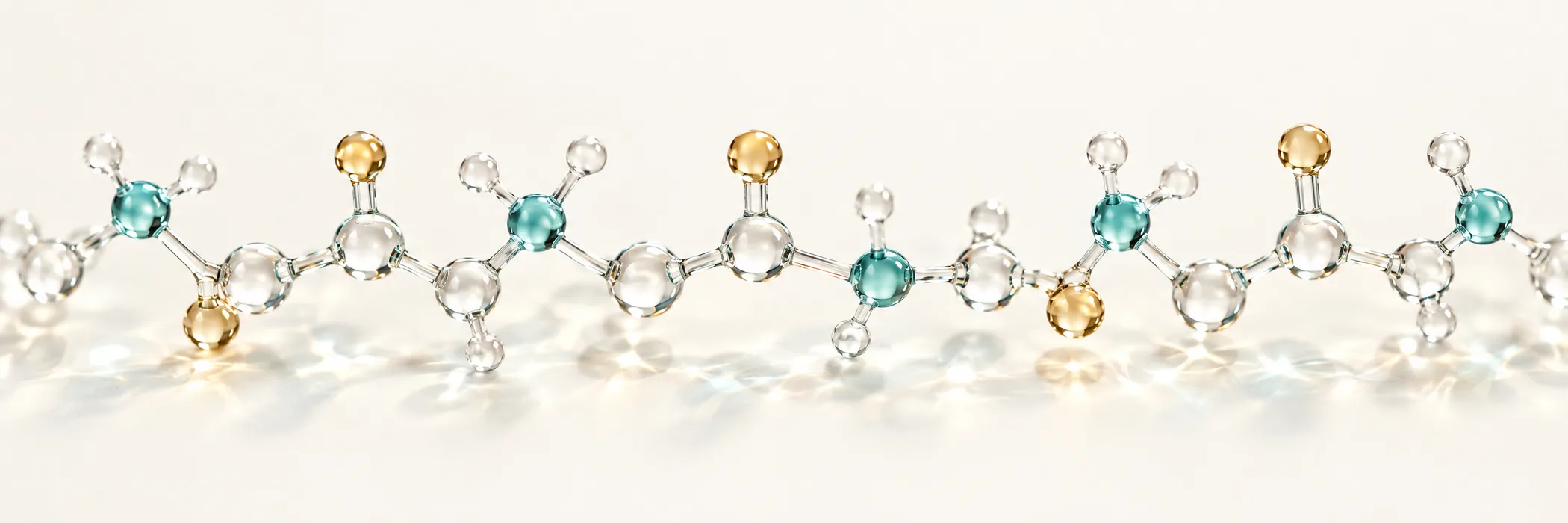

Liraglutide switches on the GLP-1 receptor, the target of glucagon-like peptide-1, a gut hormone released after eating. It works like semaglutide, through the same receptor. A ~13-hour half-life means one injection a day.
Quiets appetite. It acts on the brain's appetite centers (the hypothalamus) to cut hunger and calorie intake, the basis of its Saxenda weight-loss use.
Slows the stomach. Food leaves the stomach more slowly, which blunts the blood-sugar spike after a meal and keeps you full longer.
Steadies blood sugar. It tells the pancreas to release more insulin, mainly when blood sugar is high, and lowers glucagon, the hormone that tells the liver to release sugar. On its own it rarely causes hypoglycemia (dangerously low blood sugar).
Sources:DailyMed (Victoza)PMID 27295427
How to dose it
A small injection under the skin, once a day, stepped up weekly to keep nausea down.
Dose tiersPeople start at 0.6 mg daily, stepping up each week to 1.8 mg or 3.0 mg.
- Victoza (type 2 diabetes):
- 0.6 mg once daily for at least 1 week, then 1.2 mg once daily, then 1.8 mg/day at most if blood sugar needs it.
- Saxenda (weight management):
- 0.6 mg once daily for 1 week, then 1.2 mg, 1.8 mg and 2.4 mg for 1 week each, then 3.0 mg/day.
- If a step is rough:
- People hold the previous dose an extra week. If 3.0 mg is still not tolerated, the label says stop.
- Why it is daily:
- The ~13 h half-life covers a day, not a week.
- What to expect:
- ~7.9% (−8.4 kg) at 3.0 mg/day in SCALE.
How to injectOnce a day under the skin, same hour, rotating sites.
- Injection site:
- Abdomen (a few inches from the navel), upper thigh or upper arm. Rotate sites, or fatty nodules slow absorption.
- Time of day:
- Any time, with or without food. People hold one fixed hour so the ~13 h half-life keeps levels even.
- Food window:
- None. Food does not affect absorption.
- Pre-filled pen:
- Victoza dials 0.6, 1.2 and 1.8 mg; Saxenda dials 0.6 mg steps. For a research vial, the calculator on this page gives syringe units.
Cycle and breaksPeople run it continuously.
- Duration:
- Open-ended. Weight comes back and the blood-sugar benefit fades over weeks to months after stopping.
- The 16-week check:
- The Saxenda label says reassess at 16 weeks and consider stopping if less than 4% has come off.
- Keeping muscle:
- Some of the loss is muscle. Protein 1.6–2.0 g/kg/day plus resistance training counters it (see Cofactors).
Mixing the vialPens come ready. The calculator on this page does research-vial math.
- Standard mix:
- 5 mg vial + 2 mL bacteriostatic water = 2.5 mg/mL (2,500 mcg/mL).
- Syringe units:
- At 5 mg in 2 mL, 0.6 mg takes 24 units, 1.2 mg 48 units and 1.8 mg 72 units. 3.0 mg takes 120 units, two draws.
Best time to take it


Implied best time
Same time daily
Most people take liraglutide once a day at the same time. The hour is yours to pick.
- Its half-life is about 13 hours, so a fixed daily time keeps blood levels even from one day to the next.
- It works with or without food. The label places no meal restriction.
- A morning dose lets you read appetite through the day. An evening dose lets you sleep through any early nausea.
Sources:DailyMed (Victoza)
What to stack it with


Partners that work through a different pathway. A second GLP-1 adds nothing.
Liraglutide + CagrilintideAn amylin analog on a second satiety pathway, the CagriSema logic.
- Why it works:
- Cagrilintide copies amylin, a hormone that slows the stomach and signals fullness through its own receptor. Two separate brakes.
- The protocol:
- Liraglutide at its daily dose (0.6 mg up to 1.8–3.0 mg) plus cagrilintide under the skin, typically 0.3 mg once weekly rising to 1.2–2.4 mg/week (CagriSema trial doses).
- Outcome:
- The basis of the step-up in the CagriSema trials, which paired cagrilintide with semaglutide.
Liraglutide + Ipamorelin / CJC-1295Growth-hormone pulses to hold on to muscle through the calorie deficit.
- Why it works:
- Ipamorelin and CJC-1295 trigger growth hormone pulses that favor fat burning and muscle retention, separate from GLP-1.
- The protocol:
- Liraglutide at its daily dose plus ipamorelin 100–300 mcg at bedtime, or CJC-1295 DAC 2 mg weekly, or the non-DAC form 100 mcg 2–3× daily, all under the skin.
- Outcome:
- For a longer run where fat versus muscle matters as much as the scale.
Why not a second GLP-1Semaglutide and tirzepatide use the same receptor, so people switch rather than stack.
- Same receptor:
- Two GLP-1 agonists compete for one receptor and add side effects, not effect.
- Tirzepatide is GLP-1 + GIP:
- Tirzepatide adds GIP, a second gut hormone, but already covers the GLP-1 receptor, so liraglutide on top is redundant.
- If it is not enough:
- People who want more switch to semaglutide or tirzepatide instead.
Support nutrients
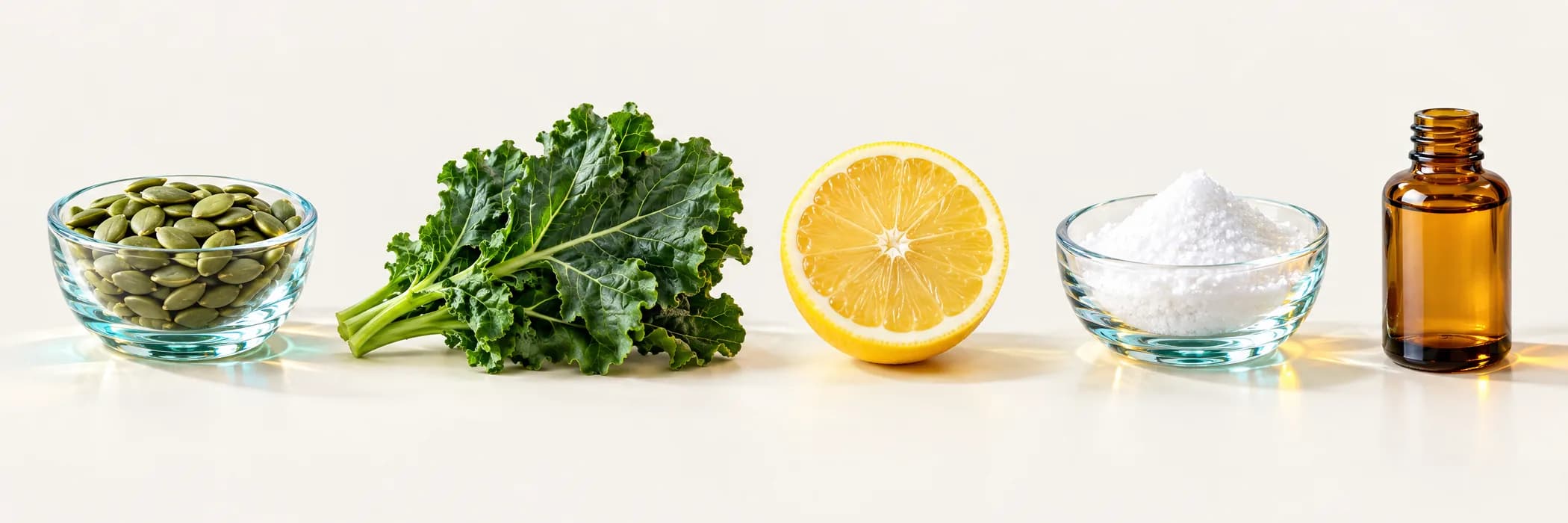
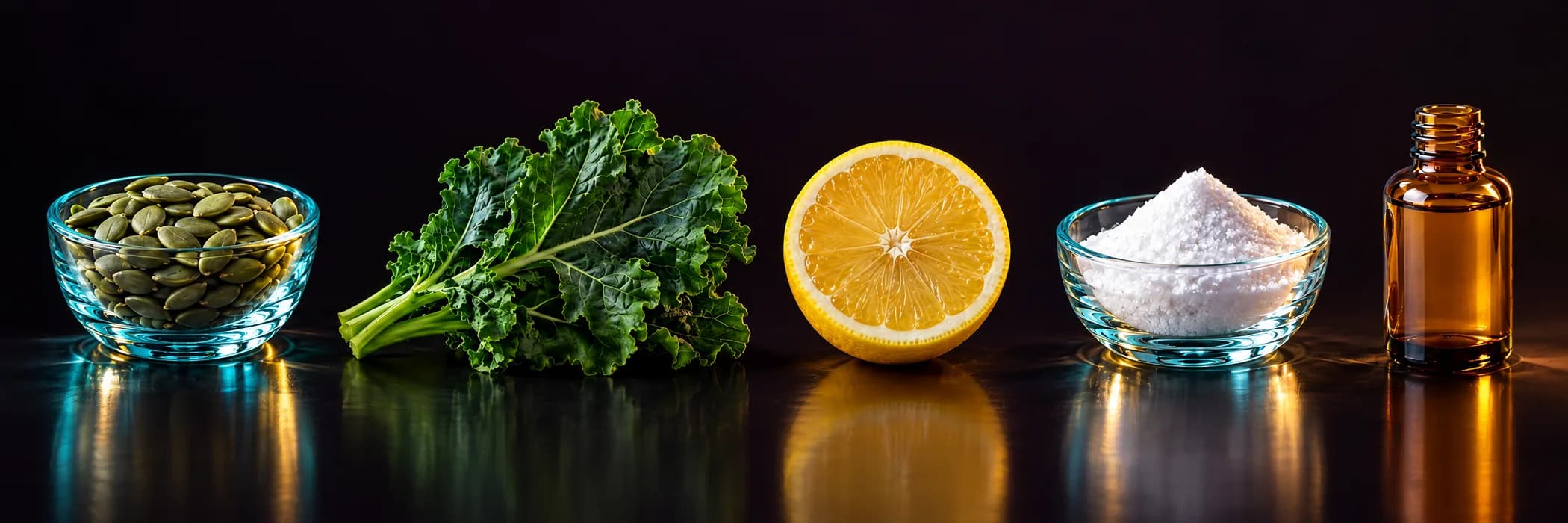
Settle the stomach, keep electrolytes up, protect muscle.
Nausea and constipationThe two that knock people off it.
- Ginger:
- 1–2 g (capsules or crystallized) 20–30 minutes before injection or a meal during the ramp weeks.
- Vitamin B6:
- 25–50 mg pyridoxine daily, with the ginger or at the same meal.
- Magnesium:
- 300–400 mg magnesium glycinate or citrate at night. It draws water into the colon.
- Fiber and water:
- 25–35 g/day fiber (psyllium, vegetables, legumes) plus at least 2 L water, or constipation worsens.
ElectrolytesLess food means less sodium, potassium and magnesium.
- Sodium:
- Do not over-restrict salt. Brain fog, fatigue and headache often mean low sodium. Salt food or add electrolyte drinks.
- Potassium:
- Potassium-rich foods (avocado, leafy greens, banana, salmon) or a 100–200 mg/day supplement.
- Magnesium (double duty):
- The 300–400 mg above covers this too.
Protein, lifting and creatineThe top priority. Appetite drops, protein drops, and muscle follows.
- Protein target:
- 1.6–2.0 g protein per kilogram of body weight per day (roughly 0.7–0.9 g/lb), protein first at each meal.
- Resistance training:
- 2–4 sessions per week, the partner to high protein.
- Creatine monohydrate:
- 3–5 g/day, any time, for muscle performance in a deficit.
- Multivitamin:
- One a day. Watch vitamin D, B12, iron (especially in women) and zinc.
Gut microbiomeSlower transit gives gut bacteria more time with food.
- Fermented foods and probiotics:
- Daily yogurt, kefir, sauerkraut or kimchi, or a probiotic (10–50 billion CFU, colony-forming units).
- Prebiotic fiber:
- 5–10 g/day of inulin or fructo-oligosaccharide (FOS) foods (chicory root, garlic, onion, asparagus).
Dose calculator
Reconstitution calculator
Calculated for a 1 mL U-100 insulin syringe (100 units/mL).
Units per dose
72 units
Draw this many units on a U-100 syringe
Each unit holds 25 mcg
- Volume per dose
- 0.72 mL
- Doses per vial
- 2
- Concentration
- 2.5 mg/mL
One vial lasts
- Daily
- 2 days
- Every other day
- 5 days
- 5×/week
- 3 days
- Large draw (72 units). That's normal for mg doses. To check it, multiply the units by what each unit holds. You should get your dose.
Research use only. Not for human consumption. Outputs are reference values based on research literature. Verify all measurements independently.
Side effects and what to watch
What people notice. Nausea, diarrhea, vomiting, constipation, indigestion and less appetite, scaling with dose and worst during the ramp.
How people handle it. An extra week on a step, ginger and B6 for nausea, magnesium for constipation, protein and lifting to keep muscle. Weight returns after stopping.
Skip it or take care if. The label says to skip it with a personal or family history of medullary thyroid carcinoma (a thyroid cancer) or multiple endocrine neoplasia type 2 (MEN 2). It says stop if pancreatitis is suspected, and lists gallbladder disease, kidney injury from dehydration, faster heart rate, low blood sugar with insulin or sulfonylureas, and, on Saxenda, suicidal thoughts.
Competing? On the WADA Monitoring Program, tracked and not prohibited.
Common questions
How is liraglutide dosed?
Once a day under the skin. People start at 0.6 mg and step up each week, to 1.8 mg on Victoza or 3.0 mg on Saxenda.
How is it different from semaglutide?
Same receptor, same effects. Liraglutide's ~13-hour half-life means one injection a day; semaglutide lasts about a week and took off more weight in its trials. Liraglutide is cheaper since US generics launched in December 2024, and was the first shown to cut heart events.
How much weight do people lose?
In SCALE the 3.0 mg daily dose took off about 7.9% (−8.4 kg) over 56 weeks, against about 2.6% on placebo. 63.2% of people lost at least 5%.
Why is it injected daily?
Its half-life is about 13 hours. A C16 fatty-acid chain binds it to blood albumin and stretches its action to roughly half a day, not a full week.
Do I need to cycle it?
No. People run it continuously, and weight returns over weeks to months after stopping. The Saxenda label says to reassess at 16 weeks and consider stopping if less than 4% has come off.
What does it stack with?
Cagrilintide for a second satiety pathway. Ipamorelin or CJC-1295 to keep muscle while eating less. A second GLP-1 such as semaglutide or tirzepatide adds nothing; people switch instead.
Deep dive
Doses used in studies · Molecular identity · References
10From the researchDoses used in studies
These are the doses used in the big human trials, LEADER, SCALE and LEAD-6. All were once-daily injections under the skin.
| Dose | Route | Model | Outcome | Sources: |
|---|---|---|---|---|
| 1.8 mg (or max tolerated) | SC daily (~3.8 yr) | Human (LEADER, T2D high CV risk, n=9,340) | Reduced major cardiac events, plus CV and all-cause mortality, vs placebo | PMID 27295427 |
| 3.0 mg | SC daily (56 wk) | Human (SCALE, obesity, no diabetes, n=3,731) | Weight −8.4 kg (~7.9%) vs −2.8 kg placebo; ≥5% loss in 63.2% vs 27.1% | PMID 26132939 |
| 1.8 mg | SC daily (26 wk) | Human (LEAD-6, T2D, vs exenatide twice daily) | HbA1c −1.12% vs exenatide −0.79% (Δ −0.33%, p<0.0001); HbA1c <7% in 54% vs 43% | PMID 19515413 |
11ChemistryMolecular identity
- Molecular weight
- ~3751.2 Da
- Molecular formula
- C172H265N43O51
- Monoisotopic mass
- 3748.95 Da
- Molecular target
- GLP-1 receptor (agonist)
- Amino acids
- 31-residue backbone (97% homology to GLP-1(7-37))FDA label; PubChem CID 16134956
- Structure / class
- Acylated GLP-1 receptor agonist; Arg34, Lys26 C16-palmitoyl via γ-Glu spacer; >98% albumin-boundFDA label; review literature
- CAS / UNII
- 204656-20-2 · 839I73S42APubChem CID 16134956; FDA UNII
- Brand / approval
- FDA-approved as Victoza (T2D, 2010), Saxenda (obesity, 2014); US generics 2024FDA label
- Regulatory status
- FDA-approved drug; not prohibited by WADA (liraglutide not individually named on the 2026 Monitoring Program)FDA / WADA 2026
12Primary sourcesReferences
- PubChem CID 16134956PubChem CID 16134956 (Liraglutide)
- DailyMed (Victoza)DailyMed, Victoza (liraglutide) label
- DailyMed (Saxenda)DailyMed, Saxenda (liraglutide) label
- PMID 27295427Marso et al., NEJM 2016 (LEADER, CV outcomes)
- PMID 26132939Pi-Sunyer et al., NEJM 2015 (SCALE, obesity)
- PMID 19515413Buse et al., Lancet 2009 (LEAD-6, vs exenatide)
- WADA 2026WADA 2026 Monitoring Program (GLP-1 class monitored, not prohibited)
Reviewed by Ki Researcher Team · Research use only · Not medical advice · Updated 2026-09-24