
Why growth-hormone peptides are harder to reconstitute
GH-axis peptides have a reputation for clouding, clumping, and gelling in the vial. The cause is not one problem but four. The right fix depends on which one you are looking at.
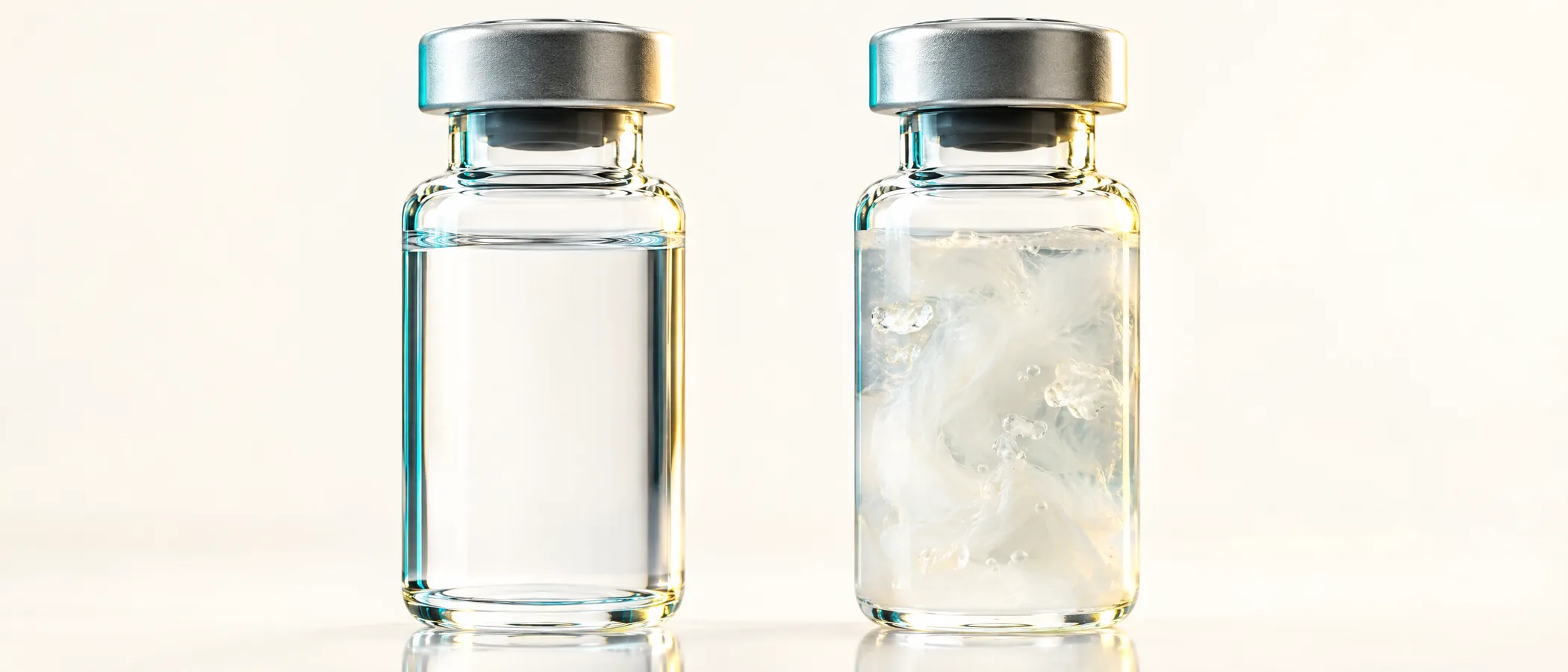
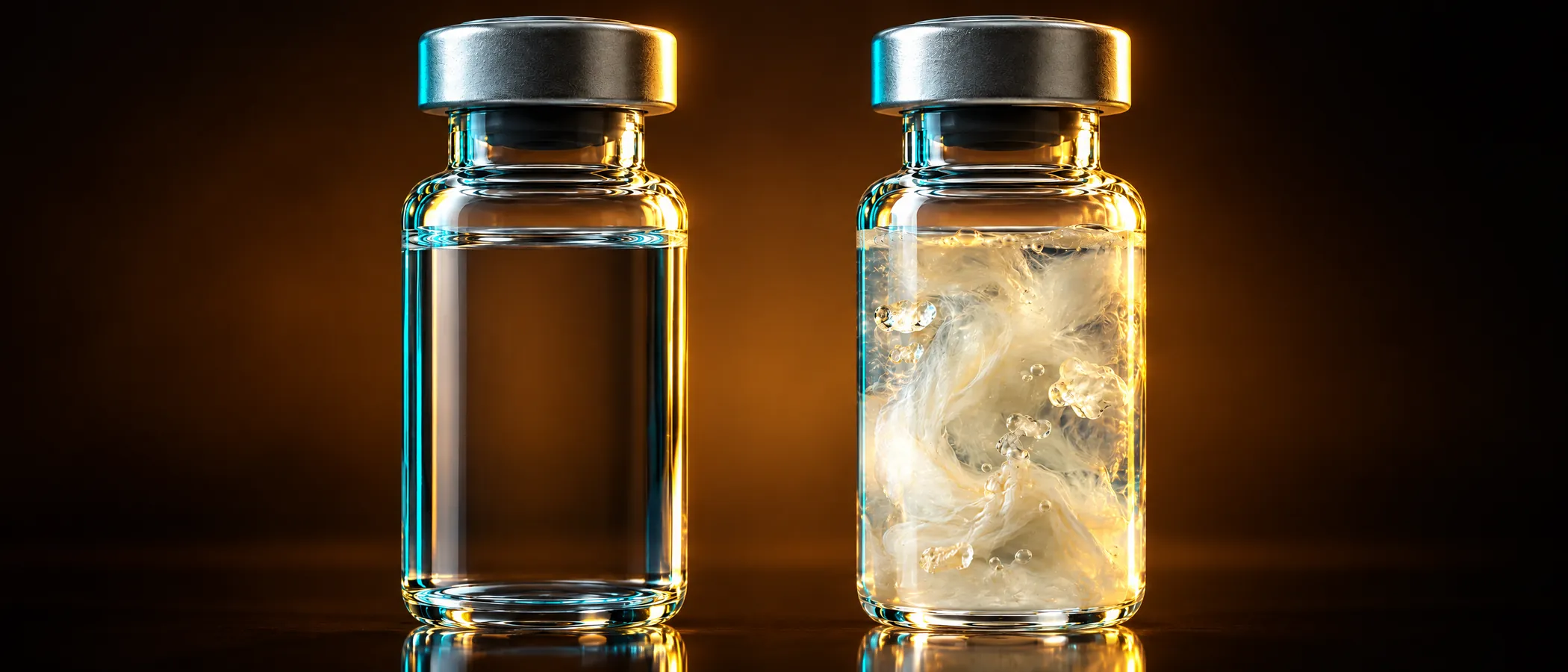
Almost everyone who works with growth-hormone (GH) peptides eventually hits the same wall: a vial that goes cloudy, leaves clumps on the glass, turns to gel, or simply will not clear. The reputation is deserved. This family is genuinely fussier than most research peptides. But "GH peptides are hard to reconstitute" hides the useful part. They are hard for four different chemical reasons, and the reasons barely overlap. Knowing which one you are dealing with is the difference between a fixable vial and a wasted one.
This page explains why these molecules resist going into solution, and what that looks like. It is not an injection guide. For the vial-to-syringe math and what a good solution should look like, see the reconstitution and bacteriostatic-water guides. For shelf life, see the storage guide.
Start with what "easy" looks like
The contrast tells you most of the story. BPC-157 and TB-500 drop into bacteriostatic water and go clear in under a minute. Semaglutide does too. Why are those forgiving? Two reasons: they are either short and carry a strong electrical charge (which keeps their molecules pushing apart instead of clumping), or, in semaglutide's case, a pharmaceutical deliberately engineered and buffered to stay in solution. The GH-axis peptides mostly have neither advantage.
The principle underneath all of it: charge keeps peptides dissolved
A dissolved peptide stays dissolved largely because its molecules repel each other. Give a peptide a net electrical charge, lots of positive or lots of negative, and like charges push neighboring molecules apart, keeping them surrounded by water instead of sticking together. Strip that charge away, and the molecules find each other, clump, and fall out of solution because nothing pushes them apart. The pH at which a peptide carries no net charge is called its isoelectric point (pI), and that is precisely the pH where it is least soluble. Bacteriostatic and sterile water sit around pH 5.5–7. A peptide whose pI lands in that window, or that has little charge to begin with, is set up to struggle.
Reason 1: several of them are proteins, not peptides
Most research peptides are short, floppy chains with no fixed shape. Human growth hormone (somatropin) is not. It is a 191-amino-acid folded protein held together by two disulfide bridges. IGF-1 is a 70-amino-acid protein with three disulfide bonds and a defined three-dimensional fold. IGF-1 LR3 and IGF-1 DES are engineered versions of that same folded protein. The point is that a folded protein has a delicate native shape it can *lose*. It can misfold, denature, and aggregate, while a short peptide has no such structure to wreck.
The fastest way to wreck it is shaking. The surface where air meets water is hostile to a folded protein. Molecules rush to that interface and partly unfold there within milliseconds, exposing their sticky inner cores, which then latch onto each other. Shaking and vigorous mixing create enormous amounts of that air-water surface and foam, so they actively drive the protein to denature and aggregate. That is the cloudiness and froth people report with HGH and IGF-1. It is not a bad batch. It is physics.
This is not folklore. It is written into the drug labels. Genotropin (somatropin) instructs: "Do not shake; shaking may cause denaturation of the active ingredient." Manufacturers also add surfactants (polysorbate 20 in Egrifta SV, poloxamer 188 in Norditropin) for the express purpose of shielding the protein from interfacial damage during mixing. When a formulation has to include an ingredient just to survive reconstitution, that tells you how fragile the molecule is.
Reason 2: charge and pH set the solubility window
Growth hormone is the textbook case of the pI problem. Its isoelectric point is about 5.1, which sits right inside the pH range of plain bacteriostatic water. In other words, neutral water drops HGH into its zone of minimum solubility. That is exactly why pharmaceutical somatropin is never sold as bare powder to mix with tap-pH water. It comes pre-buffered (Genotropin reconstitutes at about pH 6.7) or ready-to-use, to keep it off its solubility floor.
IGF-1 and its analogs are a different and even sharper case. IGF-1 is very soluble below pH 5.0 (concentrations of 50–200 mg/mL are achievable), but its solubility falls off a cliff between pH 5.0 and 5.5, and above pH 5.5 it drops below 10 mg/mL. Plain bacteriostatic water lands squarely on the bad side of that cliff. So IGF-1 reconstituted in neutral water tends to clump and refuse to clear, which is why people so often assume they were sold fake product when the real problem is the diluent.
The fix is an acidic diluent, and it is well established. The pharmaceutical form of IGF-1 (mecasermin / Increlex) is buffered to about pH 5.4 with acetic acid and sodium acetate. Research-grade IGF-1 LR3 and IGF-1 DES are routinely reconstituted in dilute acetic acid (around 0.1 M / 1%) or 10 mM hydrochloric acid rather than plain bacteriostatic water. The low pH protonates the protein, restores its charge, and puts it into solution. Some people then dilute further with bacteriostatic water for handling, up to 3 mL in total, the most a standard vial holds.
IGF-1 is the one place in this family where the popular advice "use acid, not bac water" is genuinely correct, but only for getting it *dissolved*. IGF-1's pI is actually basic (~8.7), so its precipitation near pH 6 is a solubility-cliff behavior, not the simple pI rule from Reason 1. Acid dissolves it. Neutral water does not.
Reason 3: size and stickiness in the GHRH analogs
The growth-hormone-releasing-hormone (GHRH) analogs are a third, separate problem: Tesamorelin, CJC-1295, and Sermorelin. By charge they are strongly basic (their pIs are around 10–11), so the water-pH issue from Reason 2 is not what trips them up. What trips them up is that they are long and relatively water-repellent. Long peptides with stretches of greasy, water-avoiding residues tend to bury those stretches against each other rather than face the water. When many molecules do this in register, they lock together into sheet-like aggregates. That is dissolution's enemy. The molecules would rather stick to each other than dissolve.
Tesamorelin is the extreme example. The most common complaint in the whole family is that it turns to gel. It is the longest of the group (44 amino acids) and carries a fatty (lipid) cap on one end that adds an extra water-repellent anchor, so it is especially prone to thickening and gelling rather than dissolving cleanly. The community workaround is patience and gentleness: add the water slowly down the glass, swirl rather than shake, give it time, and warm it in the hand if needed. That is exactly what the Egrifta SV label formalizes: "Mix by rolling the vial gently in your hands for 30 seconds. Do not shake." CJC-1295 and Sermorelin sit on the milder end of the same spectrum: occasional haze or floaters, usually clearing with time and gentle handling.
Reason 4: the powder itself
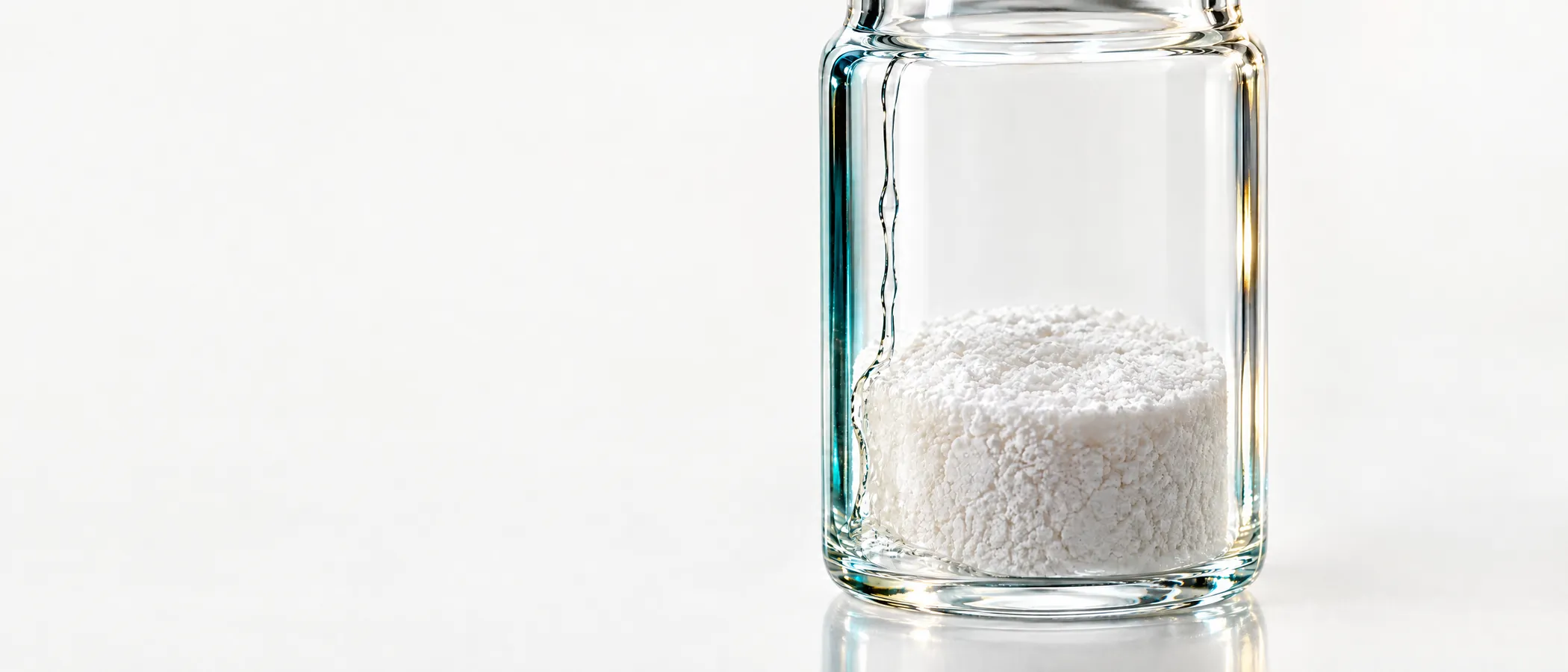
The last reason has nothing to do with the peptide's sequence and everything to do with how it was freeze-dried. A pharmaceutical lyophilized vial is not pure peptide: it contains a bulking agent (mannitol or glycine) that builds an open, easily-wetted cake, a sugar protectant (sucrose or trehalose) that cushions the molecule through drying, and often a surfactant. Egrifta SV, for example, contains mannitol, sucrose, histidine, and polysorbate 20 alongside the actual peptide. A typical research-grade vial is bare peptide with none of that. Bare lyophilized peptide can dry into a dense, glassy plug that water struggles to penetrate, so it sits there, floats, or wets slowly, and it has no surfactant to protect it from the interfacial damage in Reason 1. Same molecule, worse dissolving experience, purely because of the fill.
Where each one actually lands
| Peptide | Why it can be tricky | What you tend to see |
|---|---|---|
| HGH / somatropin | Folded 191-aa protein; pI ~5.1 sits in plain water's pH range | Cloudy or foamy if shaken; pharma versions come pre-buffered |
| IGF-1 / LR3 / DES | Folded protein; solubility drops sharply above pH 5 | Clumps or won't clear in plain water; needs an acidic diluent |
| Tesamorelin | 44-aa GHRH analog with a lipid cap; aggregation-prone | Gels or thickens; slow to dissolve |
| CJC-1295 / Sermorelin | Long, moderately water-repellent GHRH analogs | Occasional haze or floaters; usually clears with patience |
| Ipamorelin · GHRP-2 · GHRP-6 · Hexarelin | Small and strongly charged (basic) | Dissolve in plain water, no acid required; not the hard ones |
| BPC-157 · TB-500 (for contrast) | Short / charged, no folded structure | Clear in about a minute |
| Semaglutide (for contrast) | Engineered and buffered to pH ~7.4 | Dissolves readily |
What actually helps
Most growth-hormone-peptide reconstitution problems are preventable with technique and the right diluent. This playbook applies to the whole family, whichever one you are mixing:
- Add the water slowly, down the side of the vial. Aim the stream at the inner glass wall, not straight onto the powder. Hitting the cake directly whips up foam and wets it unevenly. Both make dissolving harder.
- Swirl or roll, never shake. Gentle rotation dissolves; shaking forces air into the liquid and denatures the fragile ones (HGH and IGF-1 especially). Roll the vial between your palms instead.
- Give it time. These are not the one-minute peptides. Let the vial stand. Tesamorelin in particular can take 10–15 minutes. Walk away and come back before deciding it failed.
- Warm it gently. Room temperature dissolves better than fridge-cold. Rolling a slow or thickening vial in your hands for a minute often finishes the job; a tesamorelin vial that has started to gel will sometimes re-liquefy if left at room temperature.
- Don't over-concentrate it. Forcing a large fill into too little water pushes past the solubility limit, the exact failure mode for IGF-1 and tesamorelin. Using more diluent (within your dosing math) means an easier dissolve and a clearer solution.
- Match the diluent to the peptide. Plain bacteriostatic water works for almost all of them, but IGF-1 and its analogs need an acidic diluent (next section). Using the wrong one is the single most common avoidable failure in this family.
- Then store it right. Refrigerate the reconstituted vial, keep it out of light, and never freeze it. (See the storage guide for the full shelf-life picture.)
If your vial won't clear
What you see in the vial usually points straight at the cause and tells you whether to rescue it or bin it.
| What you see | Most likely cause | What to do |
|---|---|---|
| Cloudy or foamy right after mixing | Shaken or squirted too hard, causing interfacial denaturation (HGH, IGF-1) | Let it settle; next time add water slowly and swirl. If it clears, it's fine; if it stays cloudy, discard it |
| Clumps or powder that won't dissolve (IGF-1) | Neutral diluent, but IGF-1 needs acid | Reconstitute in an acidic diluent (dilute acetic acid or 10 mM HCl), not plain bac water |
| Thick or gel-like (tesamorelin) | Too concentrated plus aggregation | Use more water (up to 3 mL, the most a standard vial holds), gentle warmth, and time. If it has set into a firm gel, it is likely lost |
| A few specks floating in otherwise clear liquid | Undissolved fill, sometimes a stray fiber | Swirl and give it more time; if particles persist, discard |
| Cloudy, gritty, or colored after it was already clear | Degradation or contamination | Discard. Do not use. |
| Dry plug that floats and won't wet | Dense, excipient-free cake | Tap it down under the water, swirl, and be patient; a true non-wetting plug just needs time |
Four things people get wrong
"It's the TFA salt." Mostly folklore, at least for dissolution. Peptides made by standard synthesis do carry residual trifluoroacetate (TFA) left over from purification, and there are real reasons to remove it: it can be toxic to cells and interfere with lab assays. But no solid source identifies residual TFA as a primary reason a peptide refuses to dissolve. When a vial won't clear, the cause is far more likely the pH, the water-repellent chemistry, or interfacial denaturation covered above.
"All growth-hormone peptides need acetic acid." They do not, and this is the most common mistake. The small secretagogues are strongly positively charged, with basic pIs around 9–10: Ipamorelin, GHRP-2, GHRP-6, and Hexarelin. Unlike IGF-1, they dissolve in ordinary bacteriostatic water and do not *require* an acidic diluent. (Some people still mix the aromatic, water-repellent ones like GHRP-6 or hexarelin with a little acetic acid, but for these it is optional, not necessary.) The hard acid requirement belongs to IGF-1 and its analogs specifically, not to the family as a whole. Treating every GH peptide like IGF-1 is how people end up needlessly acidifying peptides that never needed it.
"Bacteriostatic water ruins IGF-1 in three days." This blends two separate questions. IGF-1 genuinely dissolves poorly in neutral water. That is a real *dissolution* problem, solved with an acidic diluent. But the louder claim that the benzyl alcohol in bacteriostatic water chemically destroys the molecule within days is disputed. Independent testing has found reconstituted IGF holding up far longer than that when kept refrigerated. Keep "won't dissolve" and "won't last" as two different conversations.
"A collapsed or ugly cake means a dead vial." Not necessarily. A freeze-dried cake that has slumped or shrunk looks alarming, but controlled studies have found collapsed cakes reconstitute and perform comparably to picture-perfect ones. Judge the solution after mixing, not the look of the powder. A clear, colorless, particle-free liquid is the real test, regardless of how the cake looked going in.
This guide covers dissolution chemistry, not injection technique. Treat the values here as reference points and verify them independently. Inspect every reconstituted vial before use, and discard anything that stays cloudy, gritty, or fails to clear.
Sources
- US Patent Application US20050266046A1 (Chiron / Novartis)IGF-1 is very soluble below pH 5.0 (50–200 mg/mL) but solubility falls below 10 mg/mL above pH 5.5, the basis for acidic reconstitution
- FDA label, Increlex (DailyMed)Mecasermin (recombinant human IGF-1) is formulated at pH ~5.4 with acetic acid and sodium acetate buffer; 70-aa chain with 3 intramolecular disulfide bridges
- UniProt P05019IGF-1: 70-amino-acid mature chain with three disulfide bonds; isoelectric point ~8.7
- UniProt P01241 · PMID 1368806Somatropin: 191-amino-acid protein with two disulfide bonds; isoelectric point ~5.0–5.2 (isoelectric focusing)
- FDA label, Genotropin (DailyMed)Somatropin must not be shaken; "shaking may cause denaturation of the active ingredient"; reconstitutes at ~pH 6.7
- FDA label, Egrifta SVTesamorelin (Egrifta SV) contains mannitol, sucrose, histidine and polysorbate 20; "Mix by rolling the vial gently in your hands for 30 seconds. Do not shake."
- AAPS Journal review, interfacial stress in biologics (PMC6435788)Proteins adsorb to and partly unfold at the air-water interface; agitation that renews this interface drives aggregation (the mechanism behind "do not shake")
- Shaw, Grimsley, Pace et al., Protein Science 2001 (PMC2374010)Protein solubility is minimized near the isoelectric point, where zero net charge removes electrostatic repulsion (demonstrated by engineered pI shifts in RNase Sa)
- PubChem CID 16137828Tesamorelin = [trans-3-hexenoyl]-human GHRH(1-44), a 44-residue GHRH analog with an N-terminal fatty-acyl group
- Bachem, peptide solubility technical noteHydrophobic / neutral peptides resist aqueous dissolution and require organic co-solvents or pH shifts; acidic peptides dissolve in base, basic peptides in acid
- Sikora et al., Pharmaceuticals (Basel) 2020. Counter-ions in peptides (PMC7761850)Residual trifluoroacetate's documented effects are primarily cytotoxicity and bioassay interference; it is not established as a primary cause of dissolution failure
- Schersch et al., J Pharm Sci 2010 (PMID 20039389)Collapsed lyophilizate cakes showed reconstitution times and protein stability not relevantly different from non-collapsed cakes
Related peptides
- TesamorelinStabilized GHRH analog · FDA-approved for HIV-associated visceral fat
- CJC-1295Short-acting GHRH analog · Mod GRF, the no-DAC form
- SermorelinGrowth-hormone-releasing hormone analog · GRF(1-29)NH₂
- IpamorelinSelective growth-hormone secretagogue · Pentapeptide ghrelin-receptor agonist
- IGF-1 LR3Long-[Arg³] Insulin-like Growth Factor 1 · 83-AA IGF-1 analog
- IGF-1 DESdes(1-3) Insulin-like Growth Factor 1 · 67-AA truncated IGF-1
- BPC-157Body Protection Compound · Pentadecapeptide BPC 157
- TB-500Ac-LKKTETQ · the actin-binding fragment of Thymosin β4
Research use only · Not medical advice · Updated 2026-09-24